Sensitivity is the number that decides how loud a box gets, impedance decides what amplifier will drive it, and the power figures only matter after both. Read them in that order and a 400 W box can beat a 2,000 W one.
Most spec sheets list four power figures and leave you to guess which ones matter. They matter in a fixed order: sensitivity tells you how loud the box goes, impedance tells you what amplifier it will accept, and only then does power mean anything. Get that order wrong and you buy a 2,000 W amplifier that is quieter than the 400 W one it replaced.
What does speaker impedance actually mean?
Impedance is the load the speaker presents to the amplifier, measured in ohms. It is not fixed — it varies with frequency, and the sheet figure (8 Ω, 4 Ω) is a nominal value near the low end of the curve.
A 4 Ω speaker draws about twice the current of an 8 Ω speaker at the same voltage, so it pulls more power from a given amp. That is good until the amp cannot supply the current, at which point it clips, throttles or protects.
- 8 Ω — the safe default. Any amp drives it. Two in parallel gives 4 Ω.
- 4 Ω — louder per amp channel, but check the amp is rated for continuous 4 Ω, not just “4 Ω minimum”.
- 2 Ω — subwoofer territory. Few amps are honestly rated here for long shows.
- 70 V / 100 V — constant-voltage distribution for installed systems, not for touring.
Two 8 Ω boxes in parallel gives 4 Ω and doubles the current draw; in series it gives 16 Ω and halves the power. Most people run parallel because it is easier to cable, then wonder why the amp gets hot. The Peavey NC 110 pair on this site is a typical case: two 8 Ω boxes, 4 Ω on one amp channel.
Why is sensitivity the number you should read first?
Sensitivity is measured in dB per watt at one metre, usually written dB/W/m. It tells you how efficiently the speaker converts electrical power into sound. A 3 dB difference is a doubling of amplifier power — so a 99 dB speaker needs a quarter of the power of a 93 dB speaker to hit the same level.
That is not a small difference. A 10-inch box at 99 dB will outrun a 12-inch box at 93 dB on the same amplifier, and run cooler doing it. It is the most overlooked number on a used speaker listing, and the one that decides whether your amp rack is adequate.
- Under 90 dB — inefficient. Hi-fi and some budget PA. Needs real power.
- 95–98 dB — normal professional PA territory.
- 99 dB and above — efficient. Horn-loaded designs, good touring boxes.
An honest sensitivity figure is quoted at 1 W / 1 m. If the listing does not say the distance, treat the number as optimistic.
What is the difference between RMS, program and peak power?
Three numbers, same driver, different levels of abuse — and vendors pick whichever looks best.
- RMS (continuous) — the power the driver can take for hours with a defined test signal. This is the real working limit.
- Program / music power — usually 2× RMS. A short-term allowance for real music with peaks and rests.
- Peak — a brief transient figure, often 4× RMS. Great for a brochure, useless for planning.
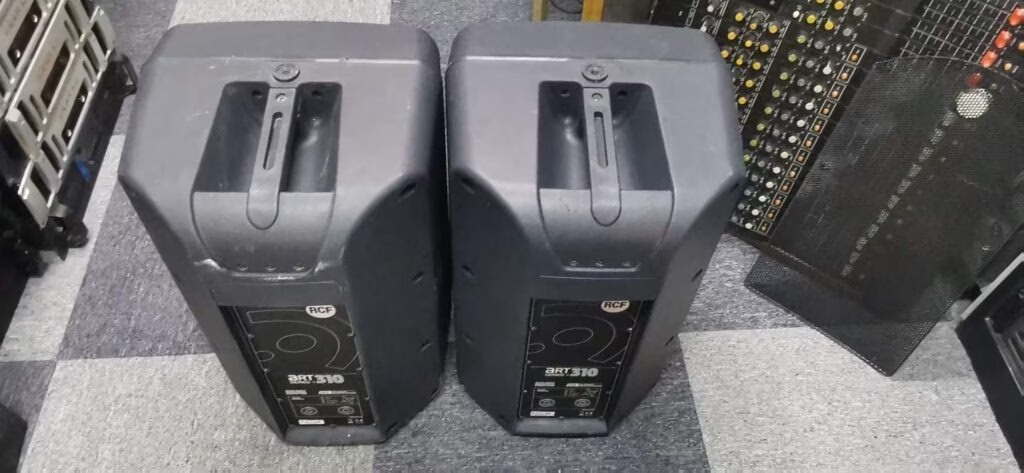
The RCF ART 310 listed here quotes 800 W peak and 400 W RMS — a clean 2:1, which is one of the more honest ratios you will see. When you see a box advertised as “1,200 W” with no qualifier, assume it is the peak number and divide by four to get the working figure.
How much amplifier power does a speaker actually need?
Common advice says match the amp to the RMS rating. That gets people into trouble: under-powering a speaker damages it more often than over-powering, because a clipping amp sends high-frequency harmonics that cook tweeters.
A practical rule for used PA gear: pick an amplifier rated at roughly 1.5× to 2× the speaker’s continuous rating, and make sure the amp is honest about the impedance it drives. A 400 W RMS box wants 600–800 W of clean amplifier. Set the limiter, and you will never use the headroom until you need it.
Subwoofers move toward 2×, because low frequencies demand sustained current. That is where an amp like the Adamson PLM 20K44 earns its price — genuine current delivery, not brochure watts.
Do these numbers change when the gear is used?
They do, which is why second-hand needs a check rather than a spec sheet. Cooked voice coils show higher DC resistance. Ferrofluid in compression drivers dries out and the top end drops. Capacitors in an old passive crossover drift and shift the crossover point.
A multimeter across the terminals should read slightly below nominal — about 6 to 7 Ω for a healthy 8 Ω driver. If it reads 4 Ω or open circuit, the driver has a problem. If the two boxes of a pair read differently, one has been abused. That check takes a minute, costs nothing, and is worth doing before you pay for shipping from China.
For a step-by-step version of that inspection, see how to test a used PA speaker before you buy it.
Key takeaways
- Sensitivity (dB/W/m) decides how loud a box gets. Read it before you read the power rating.
- 3 dB more sensitivity equals half the amplifier power for the same output.
- Impedance is frequency-dependent; the nominal figure is the one the amp has to survive.
- Divide any unqualified “peak” wattage by four to get a working figure.
- Aim for an amplifier around 1.5–2× the speaker’s continuous rating, and never let it clip.
Where to go next
Sizing a system around a specific box? Browse used speakers or the amplifier listings and send us the model numbers — we will tell you what pairs with what, including the impedance each channel really sees. Full catalogue on the shop page, or contact us with your setup and destination port.