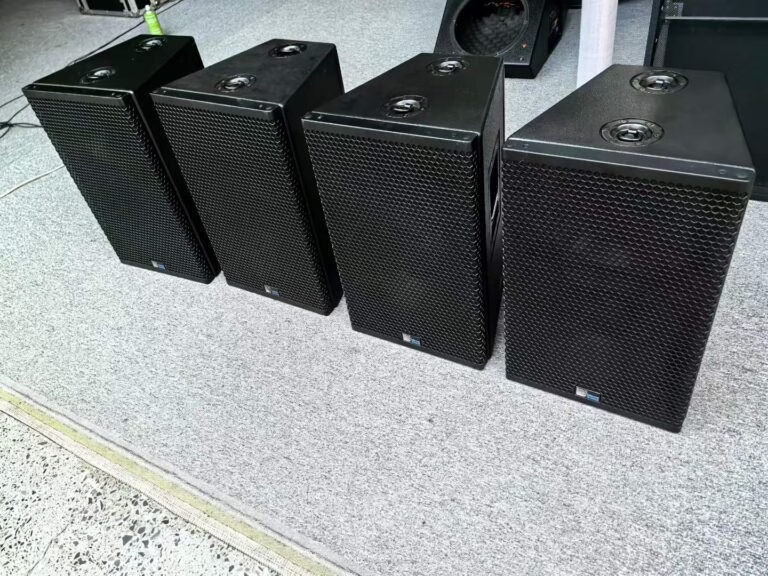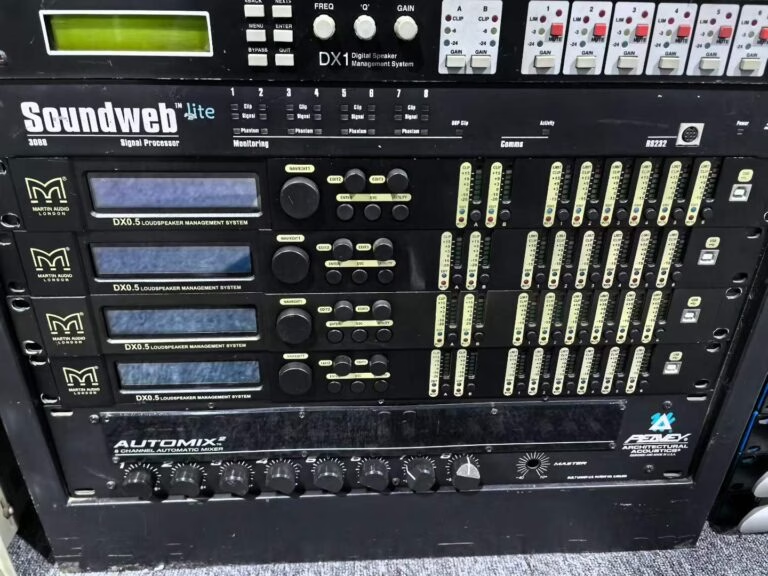
For 300 people indoors, plan on roughly 1,500 to 3,000 W of program power per side, or about 5 to 10 W of amplifier power per seated person. Two subs are the practical minimum for anything with kick drum or bass guitar in it, and coverage angle decides whether the people at the back hear the same thing as the people at the front.
The wattage question is the one everybody asks and the one that answers least. Power ratings on a cabinet are a marketing number, measured differently by every manufacturer, and a speaker rated 1,000 W that runs out of excursion at 600 W is not a 1,000 W speaker in any useful sense. What a 300-capacity room actually needs is a specified sound pressure level at the back row, and enough headroom to reach it without the system living on its limiter.
That said, you do need a starting number, and there is a defensible one. Work from the audience, not from the box.
What is the power-per-person rule of thumb?
Five to ten watts of amplifier power per person, programme material dependent. A 300-person room therefore lands between 1,500 W and 3,000 W of total system power, and that is the number you compare against the amplifier channels you actually own.
The low end of that range covers speech, acoustic acts and background music in a room with soft furnishings. The high end covers a rock or DJ show that has to stay clean at the back of a hard-surfaced room with 300 people standing in it. The range is wide because it is doing real work: a wedding band and a metal band are not asking the same thing of the same room.
Treat the result as a floor for the main system only. Subwoofers are counted separately, and monitors, fills and delay speakers are on top. A common mistake in a first 300-capacity rig is to spend the entire budget on main speakers and then discover there is nothing left for a monitor mix, so the band cannot hear itself and blames the PA.
Why is the power rating on the box misleading?
Because there is no single standard behind it. Some manufacturers quote peak power, some quote continuous AES power, some quote a number measured with a band-limited noise signal that no musical programme will ever resemble. A cabinet quoting 2,000 W peak may be a 500 W continuous design. Multiplying the peak number by two and buying the cheapest amplifier that matches it produces a system that is either underpowered or protected by a limiter that engages constantly.
The useful figure is sensitivity, expressed in dB at 1 W at 1 metre, because that tells you how much sound pressure you get for the watts. A cabinet at 99 dB sensitivity needs a quarter of the power of one at 93 dB to reach the same level. Six dB of sensitivity is worth four times the amplifier, and it costs nothing at the box office except the price of the better cabinet. This is the single most useful number on a used speaker’s datasheet, and the reason a 300 W high-sensitivity box can outperform a 900 W low-sensitivity one in the same room.
If a used listing does not quote sensitivity, ask. A seller who has the cabinet in front of them can usually read it off the label or the manual, and a seller who cannot or will not is telling you something about the rest of the listing too.
How loud does a 300-capacity room actually need to be?
Around 100 dB SPL A-weighted at the mix position for a lively show, with 105 to 110 dB peaks on the loudest chorus. That is not a target to hit continuously; it is the peak the system needs to reach without distortion, which means the system should be capable of 6 dB more than you plan to use.
Headroom is what separates a system that sounds relaxed from one that sounds strained. A rig running at 95% of its maximum output all night has no transient left: kick drums flatten, vocals lose their edge, and the audience reads the result as “loud but not exciting”. The same rig with 6 dB in reserve sounds bigger at the same measured level. This is why the 5 to 10 W per person figure is not generous — it already assumes you are not running the system flat out.
Outdoors the numbers move up. A 300-person outdoor show has no walls to reinforce the low end and no ceiling to contain the mids, so budget 1.5 to 2 times the indoor power, and expect the subwoofer stack to be the part that grows fastest.
Do two speakers cover 300 people, or do I need four?
Two cabinets cover 300 people if they have enough pattern control to reach the back row without blasting the front. That usually means a 60 by 40 degree horn or narrower, flown or on stands high enough that the bottom of the pattern lands on the last row rather than the first. Four cabinets in a 300-room is often about coverage and headroom rather than raw level: two per side gives a wider, smoother field and lets each amplifier run comfortably.
Room shape changes the answer more than capacity does. A long narrow room wants a narrower pattern to avoid side-wall reflections. A wide shallow room wants two pairs covering left and right halves rather than one pair trying to spray the full width. Standing audiences absorb differently from seated ones, and a room with a low ceiling will build low-mid energy that no amount of extra power fixes.
Where domestic stock makes this easier is that pattern control is a spec you can shop on. A used wide-coverage cabinet such as the Meyer Sound UPM-1P covers a wide, even field for front fills and smaller rooms, while a line array element like the Meyer Sound MICA is the tool for throwing a controlled pattern to the back of a 300-seat room without killing the front rows.
How many subwoofers does a 300-capacity room need?
Two, minimum, and four is the point where the low end stops being a compromise. Below two, a single sub in a 300-room gives you a lobe of bass in the middle and a thin sound at the edges, and the level changes dramatically as you walk across the floor.
Doubling the subwoofer count adds roughly 3 dB of maximum level, which is a modest gain, but the real benefit is smoother distribution and less strain per cabinet. Four subs running gently will always sound better than two subs running at their limit, and in a 300-room the four-sub rig typically costs less than the amplifier and driver replacement bills from abusing a pair.
Placement matters as much as count. Centred under the stage in a block gives the most even coverage and the most coupling. Separated left and right creates a power-alley interference pattern that is audible as you walk across the room, and no EQ setting fully fixes it.
What should I check on a used system before buying it for a 300-room?
Start with the amplifier’s continuous rating into the actual load, not the bridged peak figure printed on the front panel. Then check the drivers: a used cabinet’s cone and surround should be intact and the horn diaphragm should not rattle at low level. Push it with a music source at moderate volume and listen for the cabinet running out of travel before the amplifier runs out of power — that tells you which component will set your ceiling in the room.
For a system that will live in a 300-capacity venue, buy for reliability rather than the last dB. A pair of professional-grade powered cabinets with proven service history will outlast three cheap boxes, and when something does fail you can get it repaired. Our used PA system listings show what is in stock and shipping as complete lots, which is the practical way to buy a first rig for a room this size.
Key takeaways
- 300 people indoors: 1,500-3,000 W of program power, about 5-10 W per person.
- Sensitivity matters more than the wattage rating: 6 dB of sensitivity is worth four times the amplifier.
- Aim for 100 dB at the mix position with 105-110 dB peaks, and keep 6 dB in reserve.
- Two subs is the minimum, four is where the low end stops being a compromise.
- Outdoors, double it. Coverage angle and placement decide more than raw power.