Description
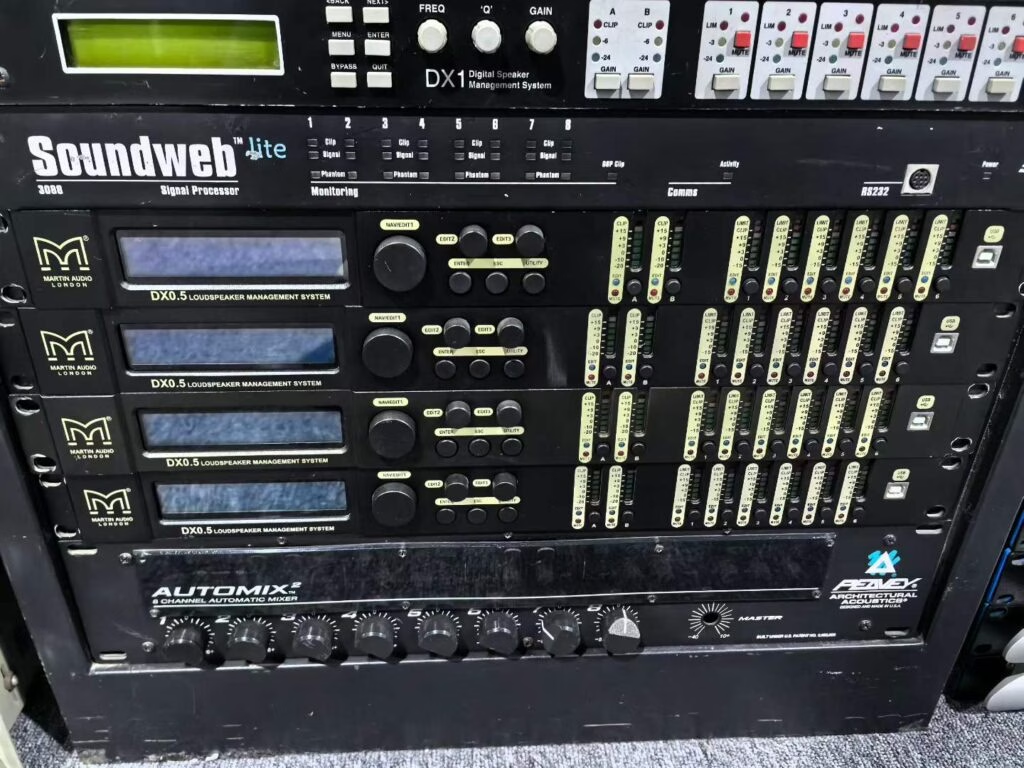
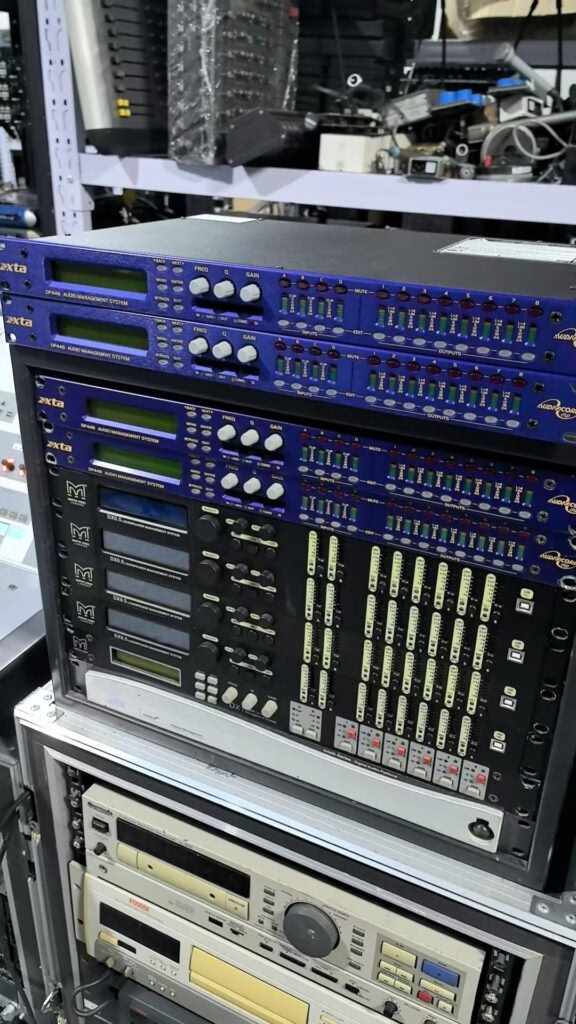
The short answer: this is a complete installed-sound processing rack, in stock, price on request. Six units in one flight-cased 19-inch rack — a BSS Soundweb Lite 3088 system processor, an XTA DX1 digital speaker management system, four Martin Audio DX0.5 loudspeaker controllers, and a Peavey Automix² eight-channel automatic mixer at the bottom. Someone built this to run a multi-zone venue: distributed delay speakers, a main LCR, monitors, and an unstaffed conference or worship room, all from one rack. It is being sold as a set.
What is actually in the rack?
Five different processing families sharing one frame, which tells you a lot about how it was used. Reading top to bottom:
- XTA DX1 — 2-in 6-out digital speaker management, the 1U unit at the top. XTA is the British company that grew out of the designers behind Klark Teknik crossovers; the DX series is the touring-standard drive unit for line arrays and bi/tri-amped systems.
- BSS Soundweb Lite 3088 — the DSP heart of the rack. Eight inputs, eight outputs, freely routable, configured in Harman’s London Architect software over a serial or network link. This is the unit that handles zone logic, paging priority, ducking and preset recall.
- 4× Martin Audio DX0.5 — the loudspeaker management units, each 2-in 4-out with front-panel LCD and encoder. Four of them means up to 16 output channels of Martin-specific crossover and EQ presets, which is exactly what you need for a venue running Blackline or AQ series boxes.
- Peavey Automix² — eight-channel automatic mixer. Not a DSP processor in the same sense: it opens and closes mic channels by gain-sharing so a conference table or a panel of lavalier mics does not feed back. It sits in the rack because it feeds the Soundweb input.
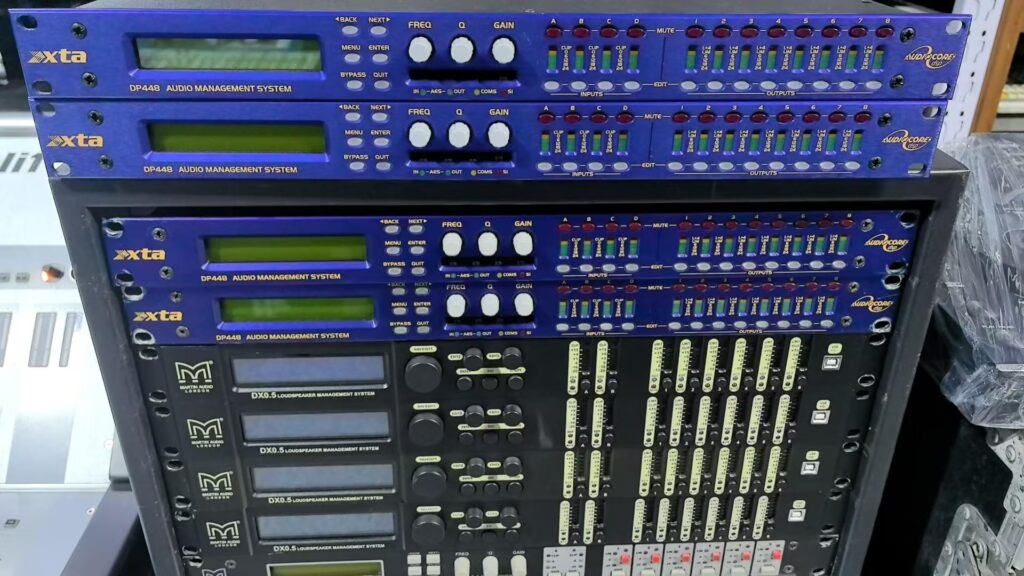
Total: 4U of processing spread over six boxes, plus the rack itself. Everything in the photos is present — no gaps, no missing blanking plates hiding a hole where a unit used to be.
Why put these five together?
Because it works. A Soundweb handles system-wide routing and presets, the DX1 drives the main hangs, the DX0.5s drive the fills and delays, and the Automix cleans up the speech channels before they reach the DSP. That is a standard 2010s installed-sound architecture and it is still a sensible one in 2026, because none of these units need an app, an account or a firmware subscription to run.
The trade-off is that you are buying five pieces of legacy architecture rather than one modern processor. A single Q-SYS or a modern Symetrix can do all of this in 2U with a web interface. The reason people still buy racks like this is price: a complete working rack at a fraction of the cost of one current-generation DSP, and hardware that a local technician who trained in 2012 can still service.
Is this gear still supported in 2026?
Partly, and honestly that matters more than the spec sheet.
- Martin Audio DX0.5 — discontinued, replaced in the line by newer controllers. Units still trade in the used market; presets are still available from Martin Audio service, and the front-panel workflow is self-contained.
- BSS Soundweb Lite — long out of production, superseded by Soundweb London. The 3088 is still found in working installs because it is fanless and boringly reliable, but Harman no longer develops London Architect for it. You need the software archived, and you need the right serial adapter.
- XTA DX1 — XTA still supports the DX range for service; the DX1 is older than the DP series but not orphaned.
- Peavey Automix² — Peavey’s service network is strong in the US and thin elsewhere; the Automix is simple enough that most faults are a dead channel rather than a dead unit.
What this means for a buyer: budget for one spare unit in the family you rely on most, and get the configuration files (Soundweb .swl / London Architect project, DX series presets) handed over with the rack. Without the config files, a Soundweb is a very expensive box of connectors.
What condition is the rack in?
All six units power up and show their front-panel displays; the photos show the LCDs lit and the meters idle. The rack frame is a standard 19-inch case, deep enough for the units, with the front rails intact. Cosmetic wear is consistent with installed use — dusty rack ears, some paint loss on the DX0.5 front panels — nothing that suggests touring abuse.
What we have not done is a full audio path test with a signal generator, or a factory reset of the Soundweb to confirm the config survives. If you need one, ask and we will run a signal through every output and send you the results before you commit.
What should you pay for a rack like this?
Pricing on discontinued processors has collapsed, which is good news here. Rough used-market figures for the individual pieces:
- Martin Audio DX0.5: USD 250–500 each depending on condition and preset availability.
- XTA DX1: USD 400–800, higher if the presets are intact.
- BSS Soundweb Lite 3088: USD 300–700, and much more with the original config and cables.
- Peavey Automix²: USD 150–350.
Added up individually that is somewhere north of USD 2,500 of used hardware. Racks sold as a set usually go for less than the sum of the parts because the buyer takes on the integration risk. Price on this listing is on request — send us the destination port and we will quote the rack and the freight together.
Who is this for, and who should skip it?
Good fit: a venue or church replacing a dead processor and keeping the same speaker system, an integrator who wants a cheap test/spare rack, a rental company that still has Martin boxes in inventory, or anyone building a multi-zone system on a tight budget.
Poor fit: anyone who needs a networked, software-managed DSP with remote monitoring, anyone without a technician who knows Soundweb, and anyone in a market where getting 230 V rack power and a serial adapter is a hassle. Be honest with yourself about the last one — the hardware is cheap, the expertise is not.
Can it ship, and what about power?
Yes. The rack ships as one unit in its case, which is the safest way to move it: about 30–40 kg crated, well under the weight that forces LCL freight. To most Asian and African ports a rack this size goes by air freight cheaply or in an LCL groupage container; to Europe and the Americas, air is usually the better deal for a single rack.
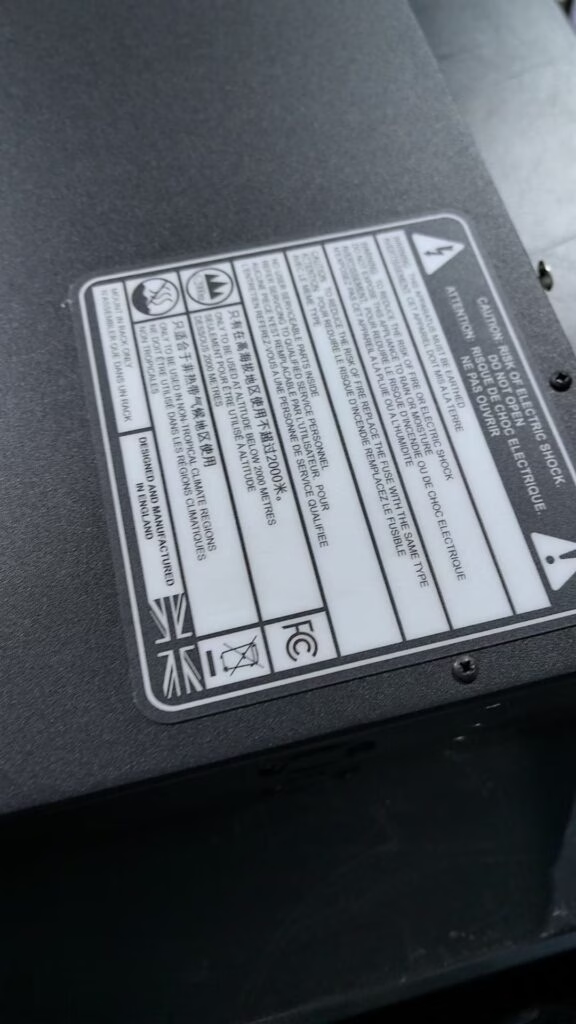
All units are 220–240 V, which is fine for Europe, the Middle East, Africa and most of Asia. For 110–120 V markets you need a step-up transformer — a 2 kVA unit covers this rack comfortably — or you accept the cost of swapping power supplies, which is not worth it on discontinued gear.
Key Takeaways
- What it is: a six-unit installed-sound processing rack — Soundweb Lite 3088, XTA DX1, 4× Martin Audio DX0.5, Peavey Automix², in a 19-inch case.
- Price: on request, in stock in China. Individual used values total roughly USD 2,500+.
- Strength: no software subscription, no cloud dependency, serviceable by a trained technician.
- Limitation: all discontinued families; you need the config files and one spare unit.
- Power: 220–240 V native; 110 V markets need a 2 kVA step-up transformer.
Want the config files, a per-unit test report, or a freight quote to your port? Tell us where it is going and we will come back with a landed figure. If you are only after one piece, browse the rest of our processing and mixer stock.