Description
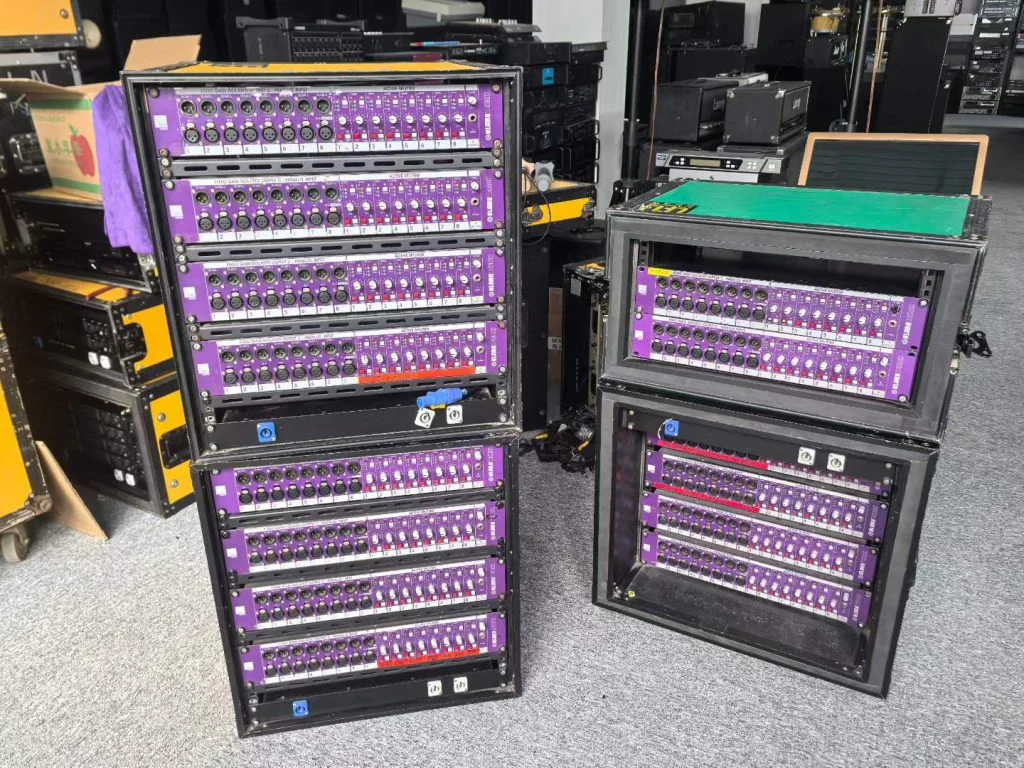
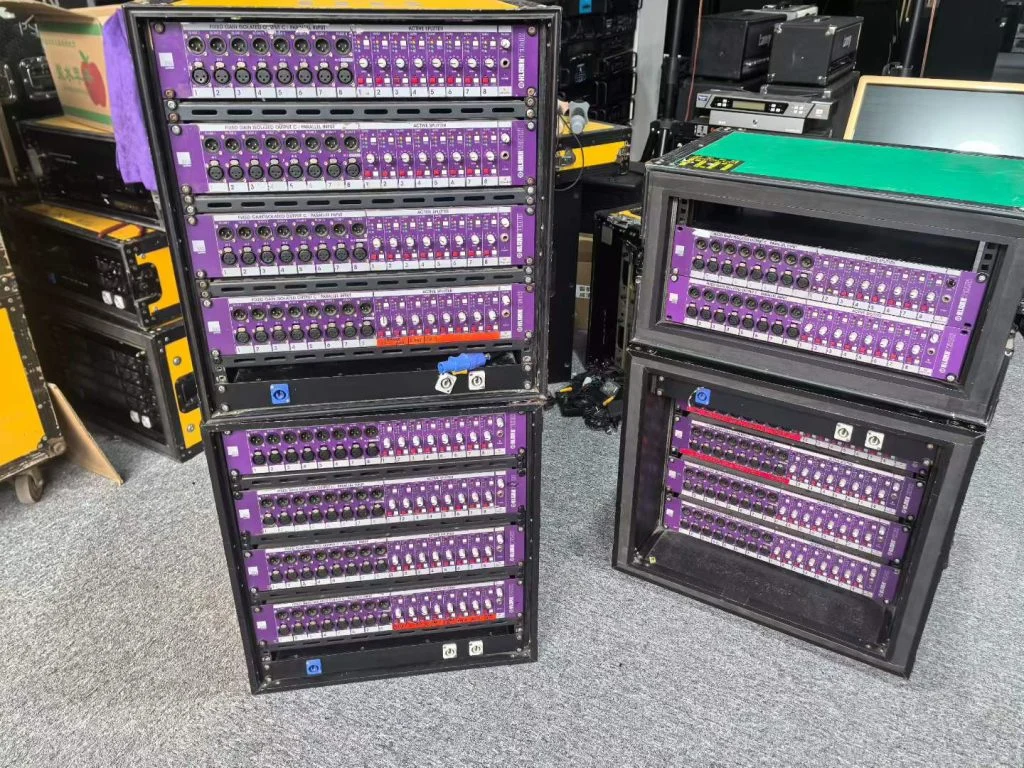
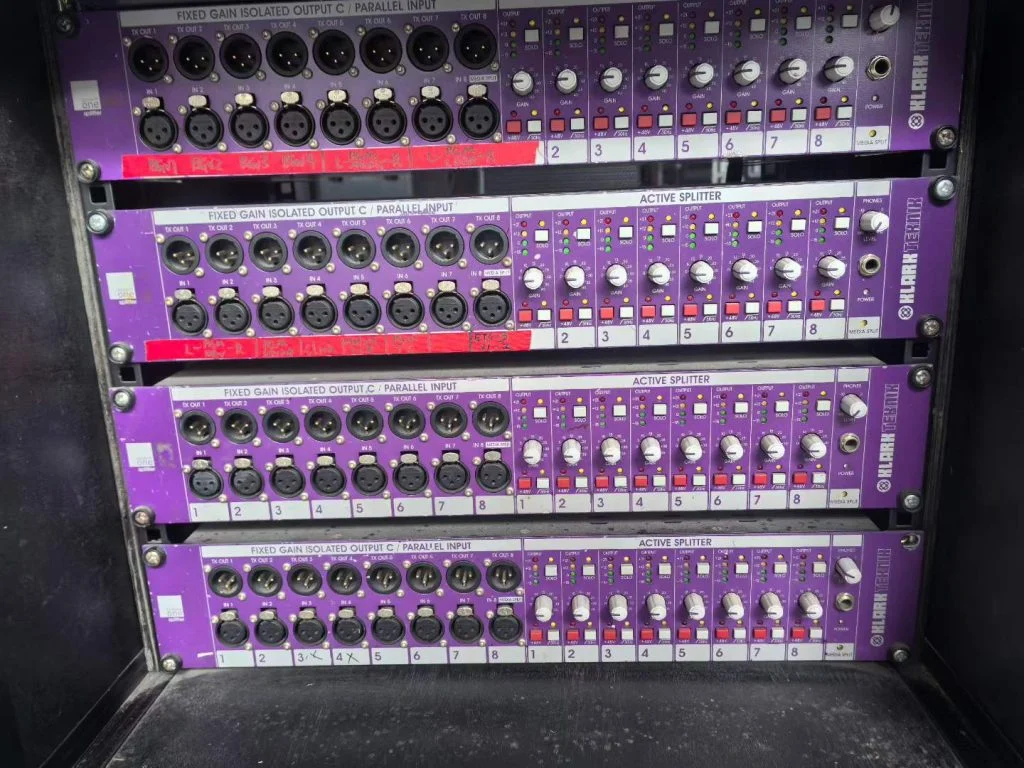
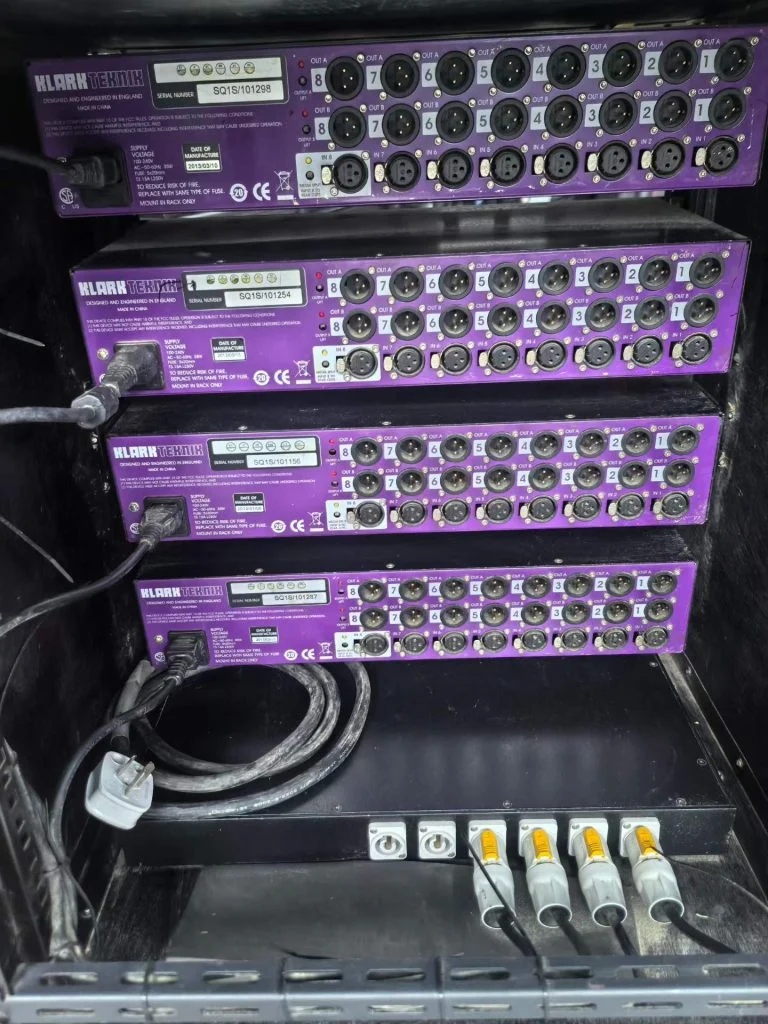
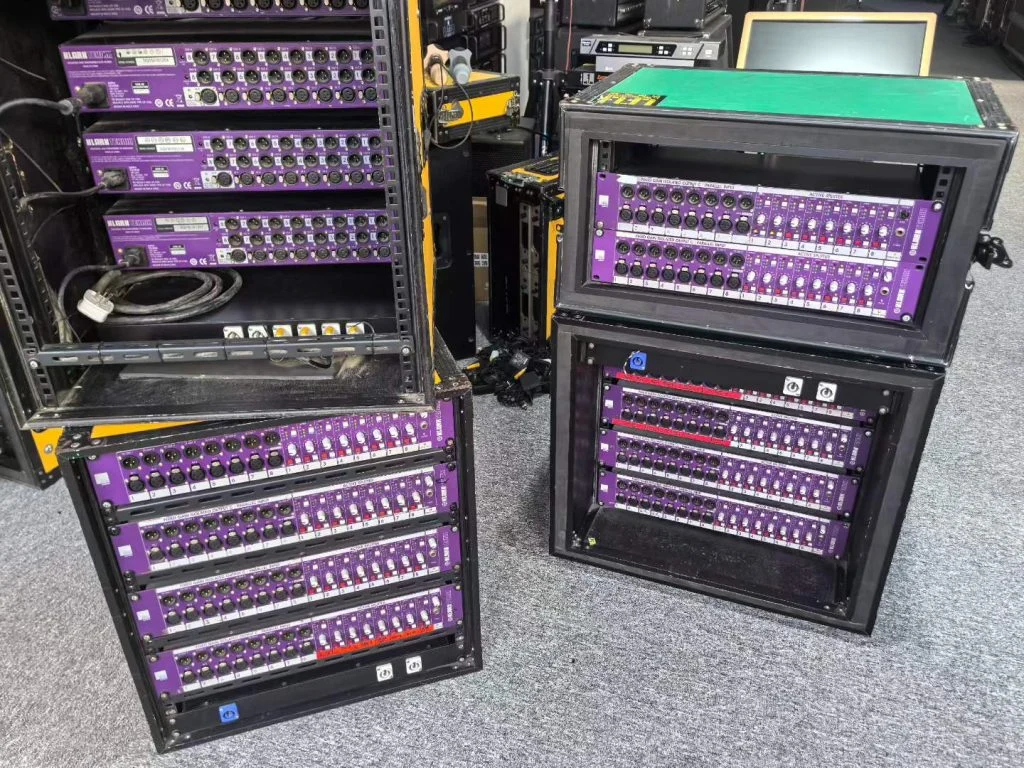
A five-piece Klark Teknik active splitter set, in stock now: 40 microphone channels in total, each with a parallel link and an independently isolated output. The modules are standard 19-inch rack units housed in two flight cases. Price on request.
This is the kind of kit that gets bought once and then stays in a touring rack for fifteen years. If you run a festival stage, a broadcast feed, a monitor world separate from FOH, or a church that records while it reinforces, a splitter is not an accessory — it is the thing that stops an earth loop from ruining a Sunday. Five modules of eight channels is a sensible size: 32 channels covers a four-piece band with a drum kit, and the last eight are there for playback, talkback and the guest that turns up with a laptop.
What exactly is in this listing?
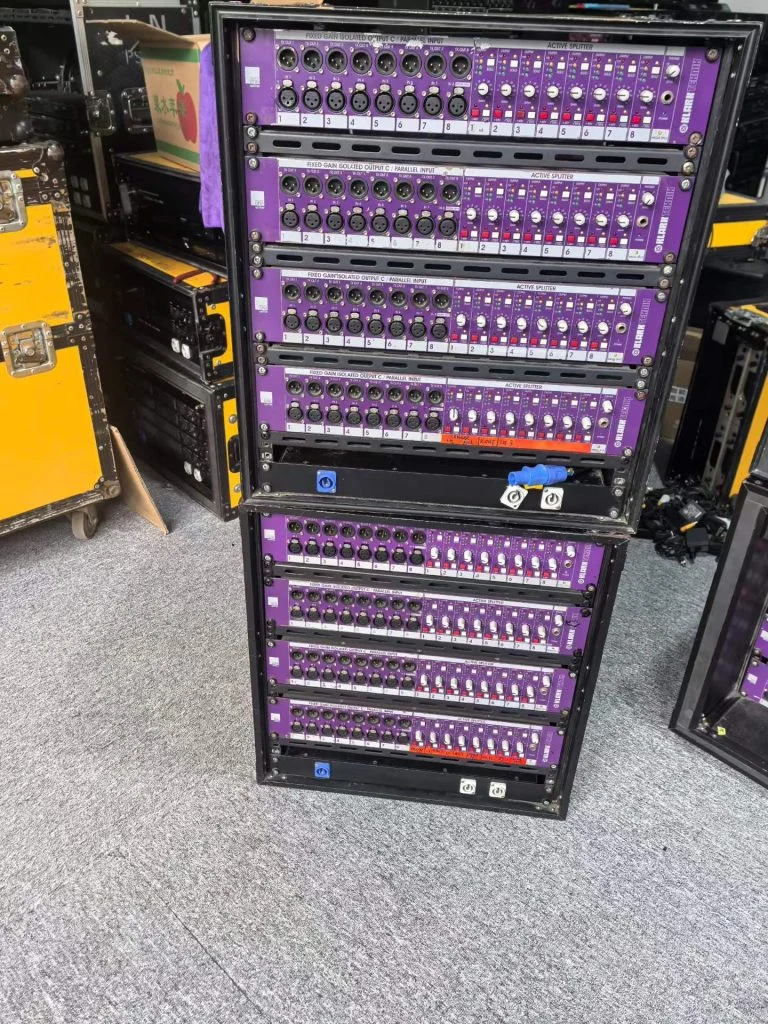
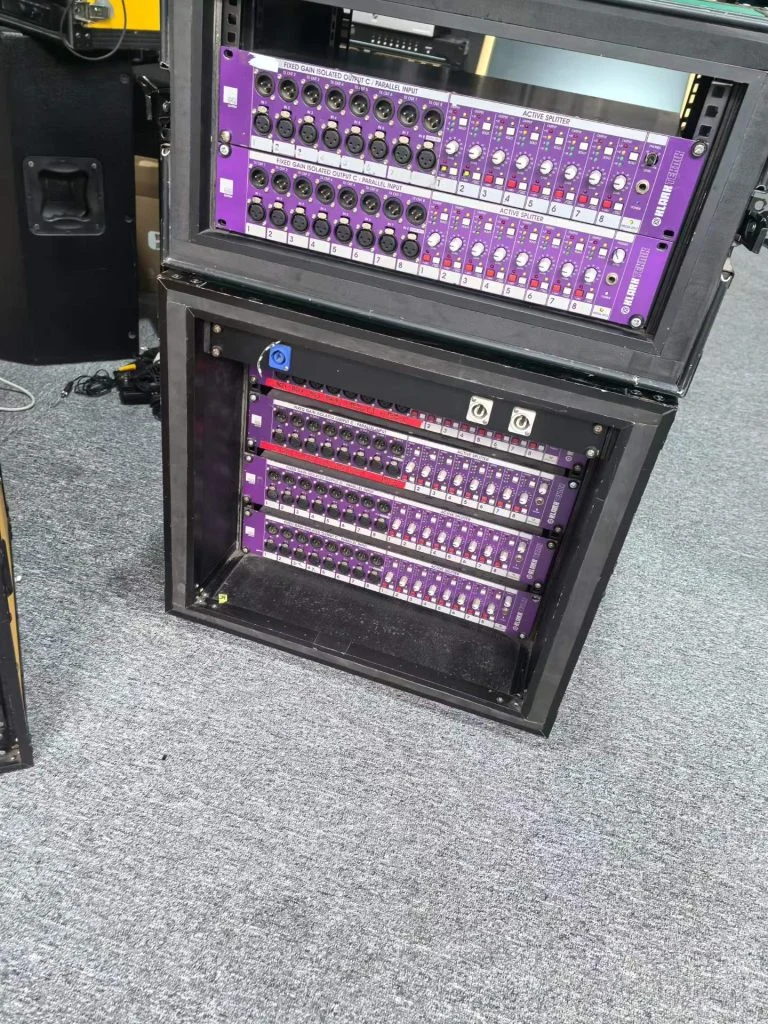
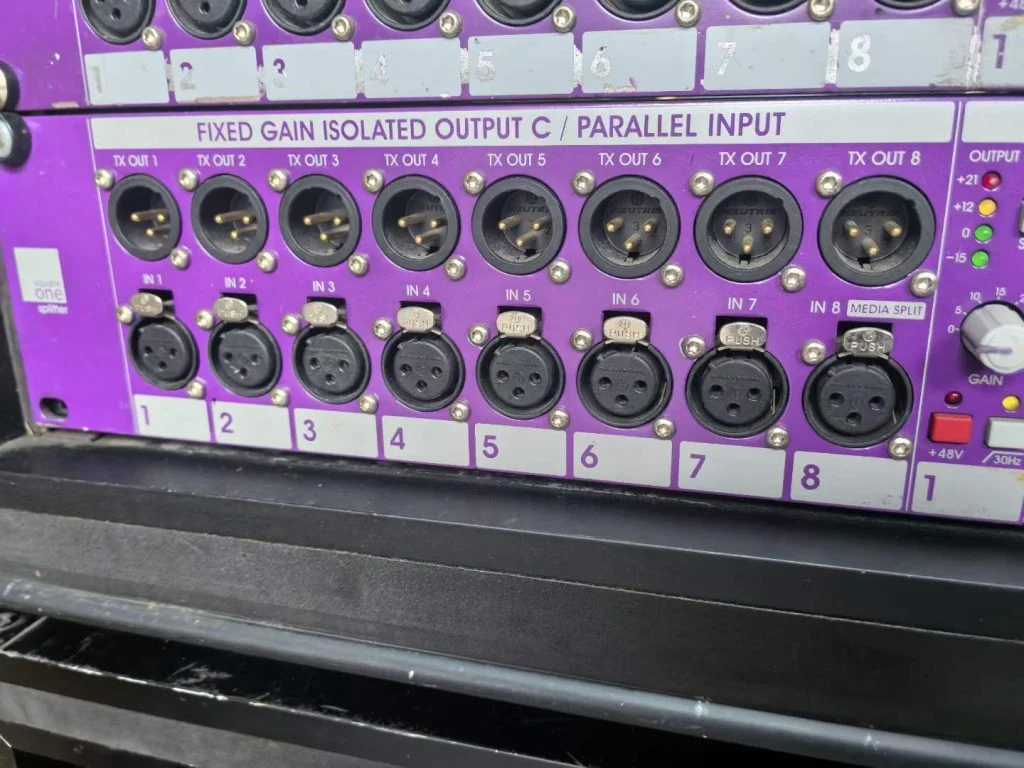
Five identical panels, each 1U, each carrying eight XLR inputs and eight XLR outputs. The panels are the purple Klark Teknik design and the silkscreen is unambiguous about what they do: Fixed Gain Isolated Output C / Parallel Input across the top, Active Splitter on the body, and © Allen & Heath on the right-hand edge — Klark Teknik and Allen & Heath have been under the same roof for years, so panels carrying both names are entirely normal. Per channel you get:
- One XLR input plus a parallel input that lets you daisy-chain the same source to the next module.
- One transformer-isolated output, fixed gain, on XLR.
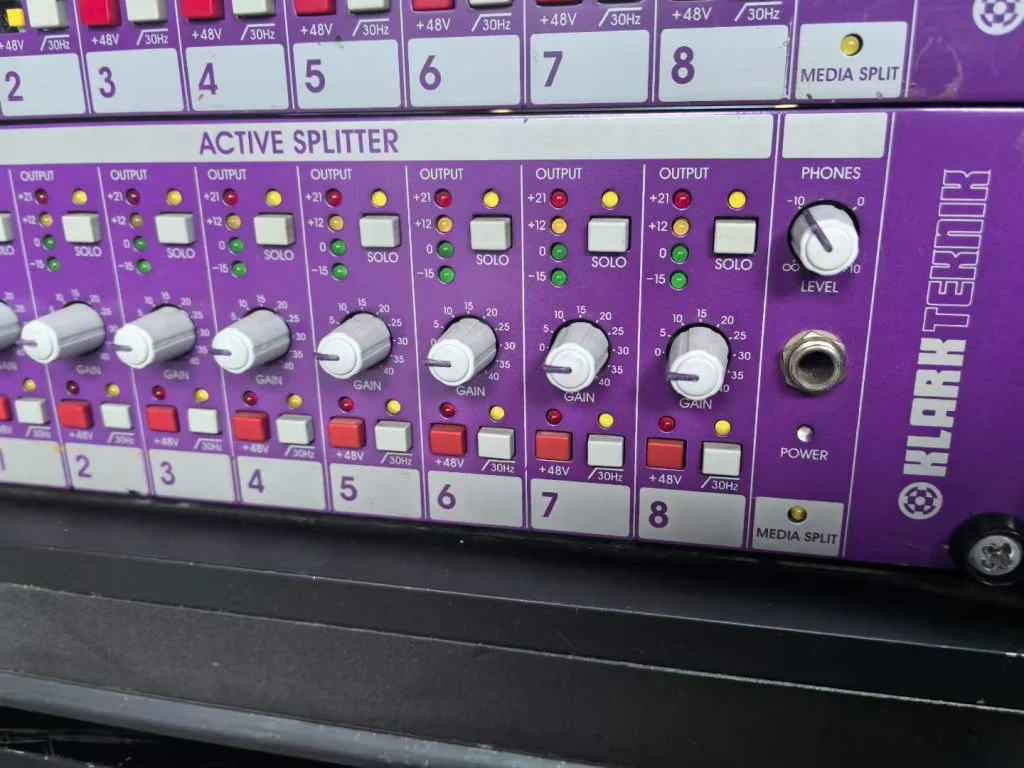
- A gain trim, a SOLO button, a switchable +48V phantom and a switchable 30 Hz high-pass.
- A four-LED level ladder marked +21 / +12 / 0 / −15 dB.
There is also a MEDIA SPLIT position on channel 8 of each panel and a front-panel PHONES output with its own LEVEL control — useful when you need to listen to a source without stealing a monitor wedge.
Why transformer isolation still matters
An active splitter gives you two things a passive Y-cable cannot. First, it buffers: a passive split loads the microphone and drops level on both legs, which is exactly the wrong outcome when you are feeding a broadcast truck that insists on a hotter signal than your monitors. Second, and more importantly, the isolated leg is galvanically separated from the direct leg. When FOH is on a generator and video is on a building supply, that separation is the difference between a clean show and a mains hum you cannot notch out.
Reach for this set when you are feeding a second console, a recording rig or a stream from the same stage box. If you are simply splitting a single keyboard or a playback source, a passive split is cheaper and lighter — do not buy forty isolated channels for a two-source problem.
How should you check them before you buy?
Five modules means five chances for a tired one to hide. The honest procedure is short: send a 1 kHz tone down each input and confirm the level on the isolated leg matches across all forty channels to within a fraction of a dB. Then push +48V and listen for the pop, and click the 30 Hz filter in and out — a dirty switch is the most common fault on kit this age and it is a five-minute fix, but you want to know. Finally, run a mic on each channel at high gain and listen for hum; a transformer that has taken a knock will let mains through where its neighbours are silent.
Cosmetically, expect the usual: rack rash on the mounting ears, tape residue from channel labels, and LED ladders where one or two segments have gone. None of that stops a show. A dead channel or a noisy transformer does, so that is where the inspection effort belongs.
Who is this actually for?
Buy it if you supply PA for events and regularly need to hand a clean, isolated feed to a broadcaster, a second engineer or a house system. Buy it if you are building a fixed install where FOH and monitors live in different rooms. Skip it if you work solo in small rooms — forty channels of isolated splitting is a lot of copper and rack space for a two-mic gig, and a small passive split will serve you better.
The flight cases make this practical to ship and to store, which matters for export; the modules are standard 1U so they will drop into any rack you already own.
What you get and how to see it
Nine photos are published on this page, covering the rack front, the modules in their open cases, close-ups of the input and output fields, the gain and level detail, and the rear connectors. The set is sold as one lot. Condition is used but complete and working; the units are in stock and ready to ship.
Price is on request — send us the channel count and destination and we will quote. If you need a matching digital console to feed, or a set of self-powered speakers to hang off the other end, we hold those too, and the PA systems section has the rest of the racks.
Key Takeaways
- Five Klark Teknik 8-channel active splitters — 40 mic channels, 40 isolated outputs.
- Each channel: XLR in, parallel link, transformer-isolated out, gain trim, SOLO, +48V, 30 Hz HPF.
- 1U 19-inch modules, supplied in two flight cases.
- Fixed gain isolated outputs — buffered and galvanically separated, so no earth loops into a broadcast feed.
- Test procedure: 1 kHz across all forty channels, check +48V pops, listen for hum on each isolated leg.