
Test a used speaker by hand and by ear: push the cone and listen for scraping, sweep a sine tone, measure the impedance, and check the surrounds and connectors. Ten minutes and a $20 multimeter catch most failures. They catch them before you load the box into a van.
I have bought used PA speakers for fifteen years, and the failures I have eaten were never mysterious. They were a rubbing voice coil, a corroded NL4, a surround that had gone hard in a hot container, or a driver somebody had swapped for a cheaper part. All four are visible or audible in a shop.
Why do I need to test at all if the seller says it works?
“Works” usually means “made a noise when I plugged it in”. It does not mean the compression driver is producing anything above 8 kHz. And it certainly does not mean the box will survive a four-hour show at 90 % of its rated power. Testing is not distrust; it is checking the parts that fail silently.
A speaker is mostly mechanical. The electrical side either works or does not, and it is the easy half to check. The cone, the surround, the spider and the voice coil gap are where the money goes when they go wrong, and none of them show up on a spec sheet.
Step 1: push the cone and listen for the scrape
With the speaker disconnected and face up, put two fingers evenly on the cone near the dust cap and push straight down, slowly. You are feeling for two things: smooth resistance, and silence. A healthy driver moves like a piston with no noise at all.
A soft scraping sound — sandpaper on wood — means the voice coil is rubbing the magnet gap. That driver is finished. It might play at low volume for another month, but it will buzz the moment it gets warm and it is not repairable at a sensible price. Do this on every driver in the box, and do not let a seller tell you the dust cap is just dirty.
Step 2: check the surround and the spider
Run a fingertip around the outer edge of the cone, front and back. Foam surrounds from the 1990s and 2000s are the classic failure — they go sticky, then crumbly, then the cone starts to sag and the coil rubs. Rubber surrounds last much longer but can harden from UV or heat, and a hard surround costs you low end.
Look through the basket at the spider — the corrugated disc behind the cone. It should be flat and intact, not sagging or separated at the glue line. If the cone sags visibly when the box lies on its back, walk away; that cabinet has been stored hot and upright for years.
Step 3: sweep it with a sine tone
A phone and a free signal generator app is enough. Start at 40 Hz, sweep slowly up to 15 kHz, and listen for three specific faults:
- Buzzing at one narrow frequency — usually a loose grille, a rattle in the cabinet, or a screw rolling around inside.
- Silence above roughly 8 kHz — the compression driver or its protection lamp is dead. Many people do not notice this at low volume and buy a box that sounds dull at every show afterwards.
- Distortion that arrives early and gets worse — a tired driver or a crossover capacitor that has drifted. Caps age; a 20-year-old electrolytic is not doing what the label says.
Be realistic about level. You cannot assess power handling in a shop, and anyone who offers to demonstrate at full tilt is demonstrating something else. What you can judge is whether the box is clean at moderate level, which is where small faults announce themselves.
Step 4: measure the impedance with a multimeter
Set the meter to resistance, put the probes across pin 1+ and 1− on the NL4 (or the screw terminals), and expect a reading of roughly 6 to 7 ohms on a nominal 8-ohm cabinet. A 4-ohm box reads around 3. A dead short means a shorted coil or a bridged connector; an open circuit means a broken lead or a blown driver.
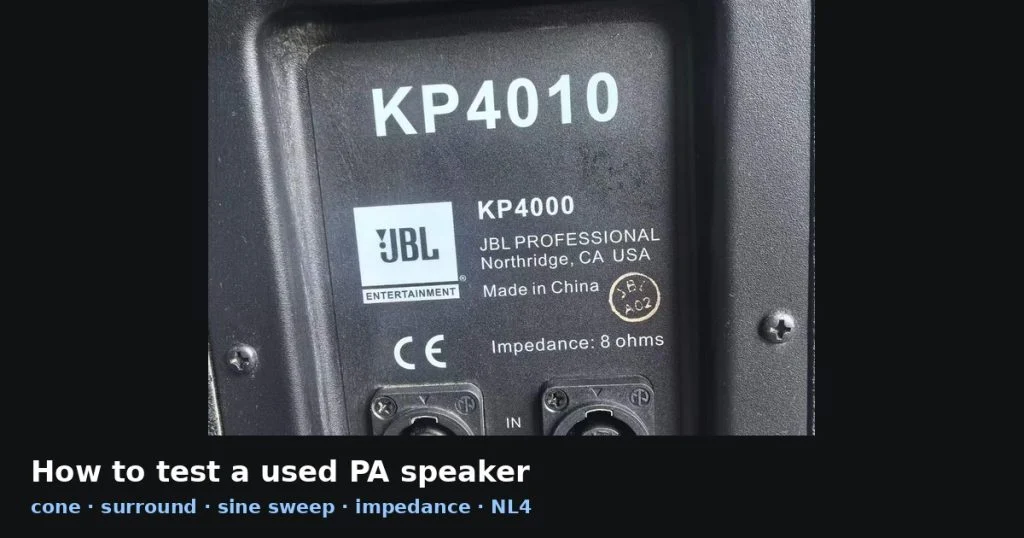
What you will not learn from that number is the real impedance curve, which dips well below nominal at resonance and can halve the load your amplifier sees. That is why a “8 ohm” cabinet can pull more current than its label suggests. Our JBL KP4010 listing shows the rear panel with the 8-ohm rating and both IN and THRU sockets for exactly this reason — the second connector tells you the box can be looped, and looping changes the total load.
Step 5: check the connectors and the crossover
Look into each NL4 socket with a torch. The pins should be bright metal, not green or black — corrosion there costs you level and creates intermittent dropouts that are miserable to trace at a gig. Wiggle the connector while the speaker is playing; if the sound cuts, the socket needs replacing.
If the rear panel comes off, look at the crossover board. Heat discolouration, swollen capacitors or re-soldered joints are all signs someone has already been in there. That is not automatically bad, but you should ask why.
Step 6: check the cabinet, screws and grille
Press the corners of the cabinet for soft spots — water damage in plywood shows up as delamination before it shows up as a hole. Tighten nothing, but look for missing screws and elongated holes where screws have been over-torqued. A grille that rattles will find its resonant frequency around 200 Hz and drive you mad.
Also smell the inside. A musty cabinet has been stored wet, and speaker drivers do not enjoy that any more than you do.
What you can skip
You do not need an impedance analyser, a measurement mic or a calibrated room. Those tools answer questions about design, not about whether this particular unit is broken. And you do not need to hear the speaker in a perfect room — a warehouse is fine, because every fault above is audible in a bad room too.
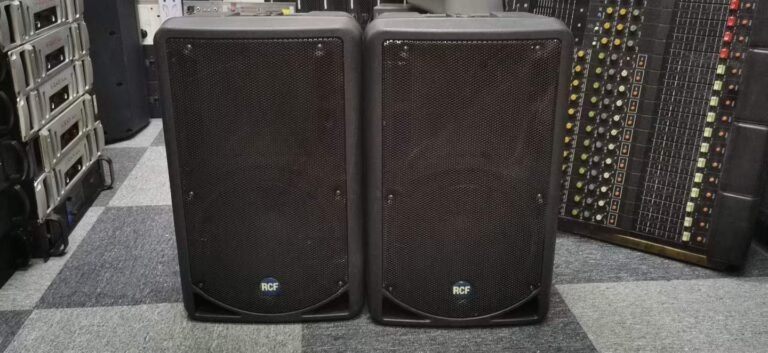
What you should not skip is testing a second identical box next to the first. Two cabinets side by side make small differences obvious: one sounds brighter, one is quieter, one buzzes. If a seller has a pair and refuses to play them together, that is your answer.
A ten-minute version for people who are in a hurry
- Push every cone. Listen for scraping. One second per driver.
- Sweep 40 Hz to 15 kHz at moderate level from a phone.
- Resistance across 1+/1−. Expect 6–7 ohms for a nominal 8-ohm box.
- Torch into every NL4. No green pins.
Key takeaways
- A scraping cone when pushed by hand means a rubbing voice coil, and the driver is effectively dead.
- A cabinet that goes silent above 8 kHz has a failed compression driver or protection lamp — the most commonly missed fault.
- A nominal 8-ohm speaker reads about 6–7 ohms on a multimeter; that is normal, not a fault.
- Green or black NL4 pins cause intermittent dropouts and cost almost nothing to spot with a torch.
- If you can test two matching cabinets together, do it — differences are far easier to hear than to describe.
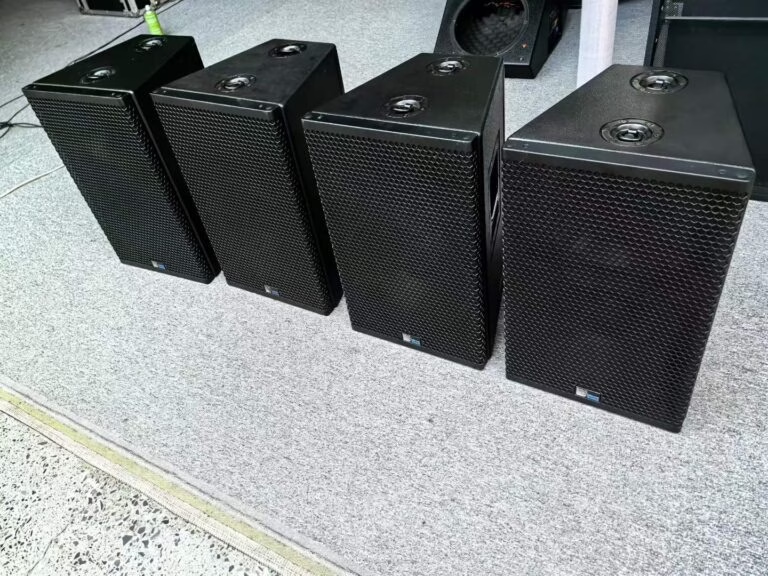
Every cabinet we list is photographed including the rear panel and, where it matters, the drivers themselves — you can see the parts you would check in person on the K-array KF12 page and our other used speakers. If you want a specific driver tested before you commit, tell us the model and we will do it and send you the numbers.
1 Comment