A refurbished mixer or power amplifier is worth buying only when you can prove what was replaced. Ask for the service invoice, test the pots and faders for scratch, run a sine sweep through every channel, and check the power supply capacitors for swelling or date-code mismatch. If none of that documentation exists, assume the unit is untouched stock that has simply been cleaned and photographed well.
I have bought and sold used audio gear for fifteen years. The units that failed on me were never the ones with worn paint. They were the ones with fresh paint, new knobs from a generic parts bin, and a story about a studio that closed. Refurbishment is a real craft. But “refurbished” has no legal meaning in used pro audio, so the word tells you nothing on its own.
What does “refurbished” actually mean in used pro audio?
Nothing standardised. A large reseller might mean a bench test plus a 90-day warranty. A marketplace seller might mean wiped down with a cloth. Both write the same word.
Ask three questions and the ambiguity collapses. What was replaced, by name? Who did the work, and is there an invoice? What happens if the unit fails in month two? A real refurbisher answers all three. A flipper answers the first and dodges the rest.
How do I tell a recap from a clean-up?
Open the lid. It is the most informative thing you can do, and most sellers allow it if you ask before paying.
Look at the electrolytic capacitors on the power supply board. Original caps from a 2008 console carry date codes from 2007 or 2008. If the amp was genuinely recapped, the new parts carry codes from the last two or three years, and the solder joints around them look fresher than the rest of the board. If someone says “fully serviced” and every capacitor still carries a fifteen-year-old date code, the claim is decoration.
Check the other direction too. A badly recapped board shows flux residue, scorched traces, lifted pads and inconsistent solder blobs. Neat, dull-grey joints of uniform size suggest factory work. Shiny, oversized blobs suggest someone learning on your amp.
Which parts get swapped to hide wear?
Faders and knobs are the cheapest camouflage. A worn console shows its mileage in the faders: scratchy travel, uneven resistance, caps that wobble. Swapping the caps for new generic ones costs almost nothing and photographs beautifully. So the caps are not evidence. The feel underneath them is.
- Fader and knob caps — cheap to replace, so judge the shaft and the travel instead.
- XLR and jack sockets — new connectors on a tired board often mean the originals were cracked or intermittent.
- Fan and filter — a brand-new fan on an old amplifier is a good sign. Somebody opened the box.
- Meter lamps and backlights — sometimes “fixed” by removing the lamp circuit entirely. Check every segment still lights.
What does a proper bench test involve?
A serious refurbisher has numbers. Your job in the shop is to reproduce three of them.
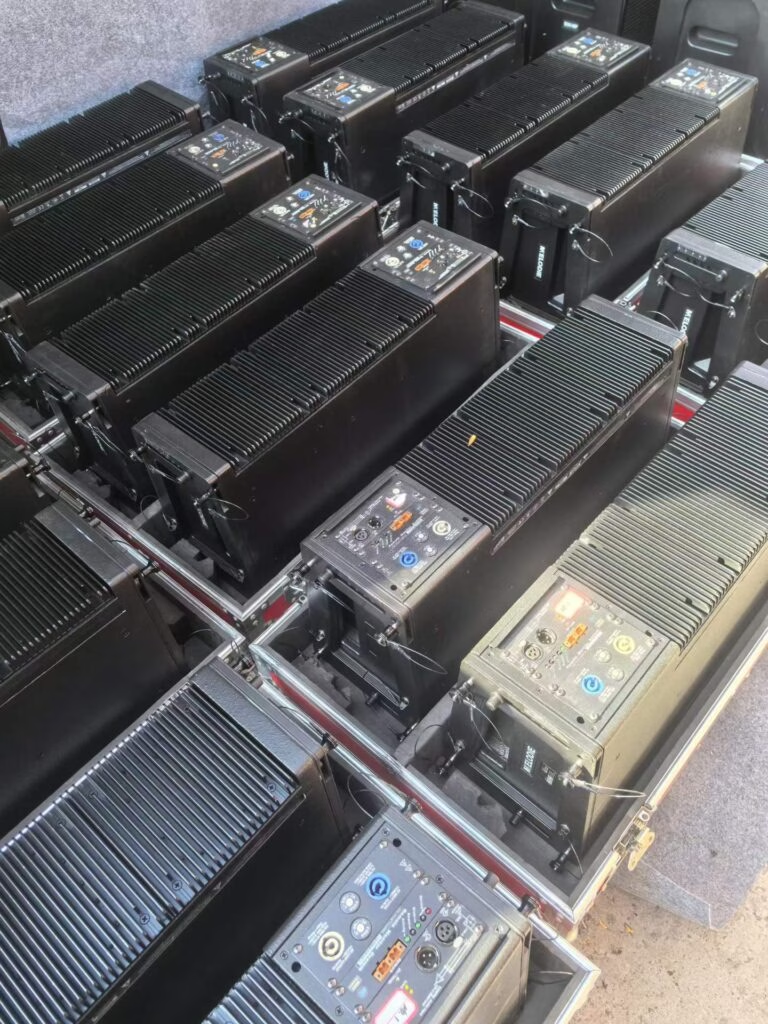
First, run a sine sweep from 20 Hz to 20 kHz through every input and listen for dropouts and sudden level changes. Second, push each channel to rated output and watch the clip indicators. A channel that clips early has a tired output stage. Third, measure DC offset at the speaker terminals with no signal; above about 50 mV on a power amp points at failing output devices or a leaking coupling capacitor. A four-channel touring amplifier like the Adamson PLM 20K44 should show all four channels within a few millivolts of each other.
On a mixer, add one more test. Turn every pot from stop to stop twenty times and listen for crackle. Crackle that fades is dirt and responds to contact cleaner. Crackle that stays, or a knob that feels gritty at one position, means a worn element that needs replacing. On a digital desk such as the Behringer X32 Producer, also confirm every channel and the full encoder range, since a dead encoder is not repairable with cleaner.
Is a recapped unit worth more than an original one?
Usually yes, but not automatically. A documented professional recap adds real value because it removes the likeliest failure in the next five years. A hobbyist recap with no records can subtract value, because you now own someone else’s soldering.
The premium I pay is 15 to 25 percent over a clean original of the same age, and only with an invoice. Otherwise compare against the cost of the recap itself: a proper power supply recap on a large-format console runs 400 to 900 US dollars in parts and labour. If a seller wants 200 dollars more for a “recapped” desk with no paperwork, the arithmetic does not work.
When should I walk away?
Walk away when the seller refuses to open the lid, when the price sits close to new-old-stock without documentation, or when the story changes between messages. Walk away from anything repainted: fresh paint on a rack unit hides rack rash, and rack rash is the honest wear record of a piece that toured.
Two other signals matter. A unit sold “as-is, no returns” but priced like a serviced one is worth questioning. And a seller who cannot name a single replaced part has not refurbished anything, whatever the listing says.
Key takeaways
- “Refurbished” is unregulated in used pro audio; only an invoice naming replaced parts makes it mean something.
- Capacitor date codes prove whether a recap happened. New knobs prove nothing.
- Run a 20 Hz to 20 kHz sweep on every input and measure DC offset before you pay.
- A documented professional recap is worth 15 to 25 percent over a clean original; an undocumented one can be worth less.
- No lid access, no invoice, or fresh paint on a rack unit — walk away.