How do used and new prices actually compare?
| Monitor class | New | Used pair | Saving |
|---|---|---|---|
| 5-inch active, entry | $400 | $180 – $240 | 40 – 55% |
| 6-inch active, pro | $1,400 | $650 – $850 | 40 – 55% |
| Passive + separate amp | $1,600 | $600 – $900 | 45 – 60% |
| High-end passive pair | $4,000+ | $1,600 – $2,400 | 40 – 60% |
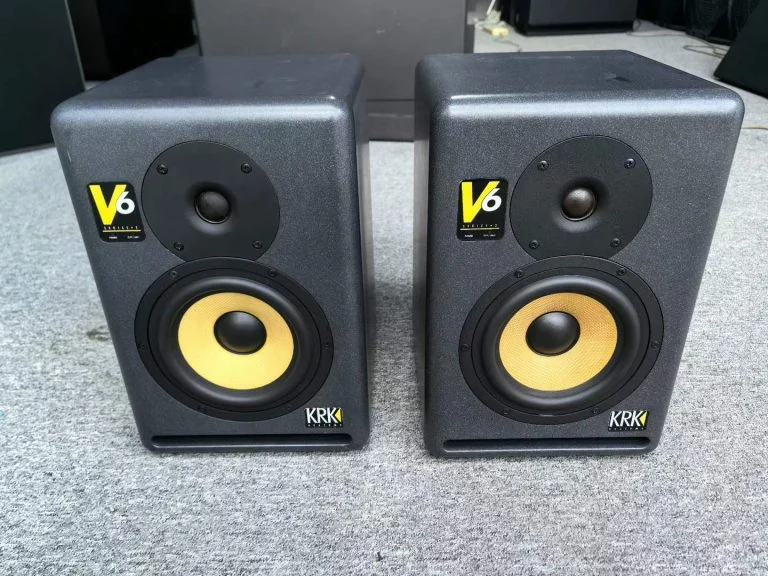
Two examples from real stock: a KRK V6 Series 3 active monitor pair and a Dynaudio Acoustics BM5 passive pair. The Dynaudio is the kind of passive monitor that will still measure clean in 2035.
When is new actually the better buy?
When you need calibration software and a warranty, or when the model is only 15 percent cheaper used. At that discount, the warranty and the unpacking certainty are worth more than the saving. New also wins if you are building a room around a specific monitor and need four or six matched units.
One more thing: monitors are the single most room-dependent purchase in a studio. A used pair that sounded wrong in someone else’s room is not evidence of anything. Judge the unit, not the room.
Key Takeaways
- Passive monitors age well; active monitors need a capacitor check past 10 to 15 years.
- Buy matched pairs with near-consecutive serial numbers, or skip them.
- Listen for idle hiss and a level mismatch between units — both signal amp trouble.
- Used saves 40 to 60 percent, which is worth it above a 25 percent gap.
- Below a 15 percent saving, buy new and take the warranty.
Driver condition, amp health, and whether the pair is a genuine matched set. Age matters far less than people think — a passive monitor from 2009 can be perfect, while a 2018 active monitor with bulging capacitors is a paperweight. Used studio monitors save 40 to 60 percent, but only on verified pairs.
Studio monitors are the one category where buying used is genuinely low risk, because the failures are visible and cheap to test. That is different from microphones or consoles.
Does age matter as much as people say?
Not for the parts you hear. A paper or poly cone degrades slowly, and a soft-dome tweeter from 2010 is usually still accurate. What ages badly is the electronics inside an active monitor: electrolytic capacitors dry out after 10 to 15 years, and the first symptom is hiss or an uneven high end.
So the question is not “how old”, it is “is this passive or active”. Passive monitors age gracefully. Active ones need a cap check past a decade.
What should you check on a used active monitor?
- Idle hiss. Power on with no input. Audible hiss at 1 m means a tired amp or cap.
- Level match. Feed the same signal to both units. A 1 to 2 dB difference means one amp is weak.
- Cone inspection from low angle. Look for creases, glue lines from a recone, or pushed-in dust caps.
- Cabinet joints. Press the corners; movement or a buzz means a loose cabinet.
- Volume pot. Sweep it fully — scratchy volume on a powered monitor is common and cheap to fix.
Why is the matched pair more important than the price?
A single used monitor is close to worthless for mixing, because you cannot trust the stereo image. Sellers often split pairs after one unit fails, and the surviving unit gets sold cheap. If you buy it and later find a partner, the serial numbers will not be close and the tweeter may be a different revision.
Always ask for both serial numbers in the same photo. Consecutive or near-consecutive numbers mean they left the factory together.
How do used and new prices actually compare?
| Monitor class | New | Used pair | Saving |
|---|---|---|---|
| 5-inch active, entry | $400 | $180 – $240 | 40 – 55% |
| 6-inch active, pro | $1,400 | $650 – $850 | 40 – 55% |
| Passive + separate amp | $1,600 | $600 – $900 | 45 – 60% |
| High-end passive pair | $4,000+ | $1,600 – $2,400 | 40 – 60% |
Two examples from real stock: a KRK V6 Series 3 active monitor pair and a Dynaudio Acoustics BM5 passive pair. The Dynaudio is the kind of passive monitor that will still measure clean in 2035.
When is new actually the better buy?
When you need calibration software and a warranty, or when the model is only 15 percent cheaper used. At that discount, the warranty and the unpacking certainty are worth more than the saving. New also wins if you are building a room around a specific monitor and need four or six matched units.
One more thing: monitors are the single most room-dependent purchase in a studio. A used pair that sounded wrong in someone else’s room is not evidence of anything. Judge the unit, not the room.
Key Takeaways
- Passive monitors age well; active monitors need a capacitor check past 10 to 15 years.
- Buy matched pairs with near-consecutive serial numbers, or skip them.
- Listen for idle hiss and a level mismatch between units — both signal amp trouble.
- Used saves 40 to 60 percent, which is worth it above a 25 percent gap.
- Below a 15 percent saving, buy new and take the warranty.