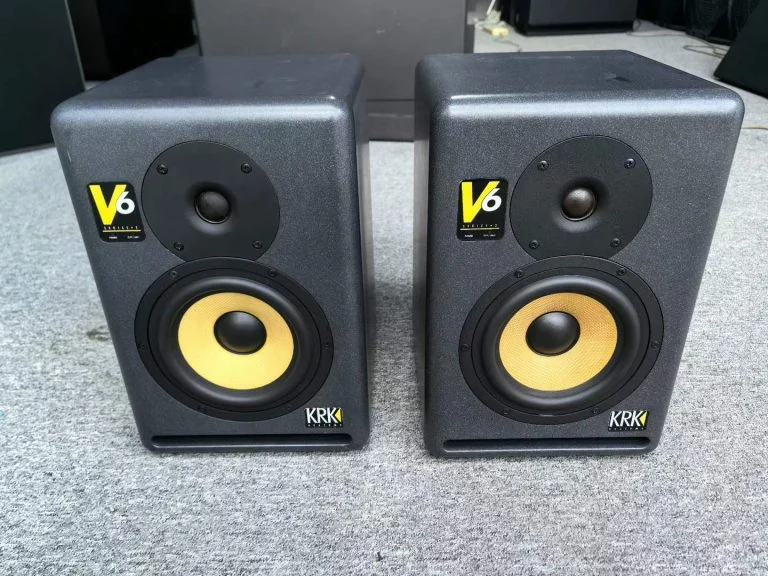
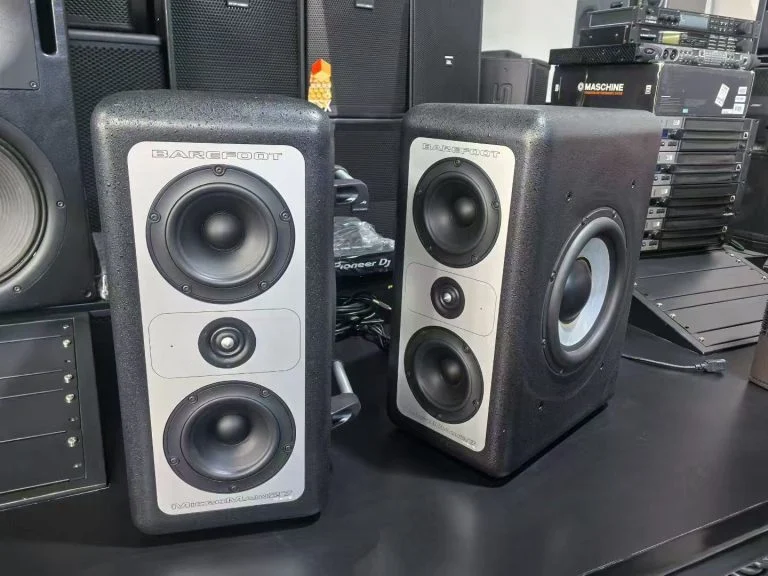
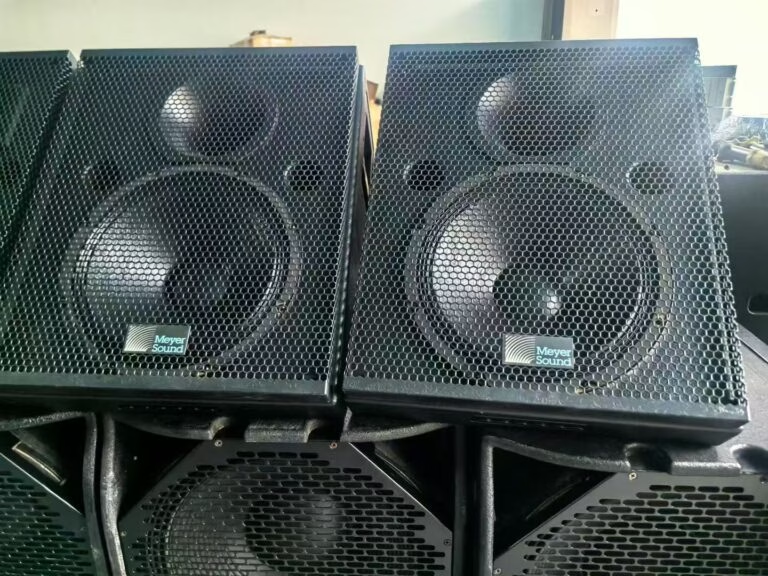
On used monitors, cone condition and cabinet integrity matter more than brand or model year. A pair with original drivers and no cabinet rattle beats a newer pair that has been reconed twice, and most listening tests never check either.
What actually degrades on a studio monitor?
Three things, in order of how often they cost you money. The surrounds on the woofer, the ferrofluid in the tweeter, and the capacitors in the crossover or amplifier.
Surrounds harden over 8-12 years depending on humidity. A hardened surround reduces excursion, so the low end thins and the midrange gets a little shouty. You will not hear it as a fault, you will hear it as a monitor that sounds tiring.
The fourth is the cabinet. MDF swells at the joint if the monitor sat in a damp room, and a swollen joint changes the internal volume and therefore the tuning. Run your thumbnail along the front edge seam; a lip you can feel is a swollen joint.
Ferrofluid in a 2005 tweeter dries out and thickens. The tweeter loses level and the top end rolls off 2-3 dB. Most people compensate with EQ and never notice until they hear a fresh pair.
Does brand matter less than I think?
Yes, on the used market. A Dynaudio Acoustics BM5 passive pair with original drivers is a better recording tool than most 900 USD new pairs, because it has a flat midrange and no port chuffing. A bad example of the same model is worse than a cheap new pair.
What brand buys you is consistency and parts. A brand that still stocks a replacement tweeter for a 2008 model is worth a 20% premium. A brand that folded is not.
There is one used-market advantage nobody talks about. Monitors that were made in Denmark, Germany or the UK before 2010 used plywood or heavy MDF and crossovers with air-core inductors. The modern equivalent at 400 USD uses a plastic front baffle and iron-core coils. You can hear the difference on a kick drum, and it is not subtle.
Ignore model year. A 12-year-old monitor built with a sealed cabinet and a good crossover can outlast a new budget model, because the expensive part was never the driver.
How do you check cabinets in a shop?
Knuckle-test the side panels. Tap the middle of each side. A dull thud is fine. A hollow ring at a specific pitch means the panel resonates, and you will hear it as a boxy note in the low mids on every mix.
Then check the front baffle screws. On most nearfields the baffle is screwed into the cabinet, and loose screws are audible as a buzz on low notes. Tighten one and you will feel whether the thread is intact or the hole has stripped.
Press the corners. Any movement or creak is a joint that is separating, usually from being dropped or stored damp.
Look at the port. Cracks around the port edge are common on MDF cabinets that have been moved a lot, and they change the tuning.
What about the amplifier on active monitors?
Active monitors hide the amplifier inside, which makes it both protected and impossible to test. Listen at low level with no signal for hiss, and at high level for a hum or a rattle.
Look at the mounting. Active monitors hang a lot of weight on four threaded inserts, and stripped inserts are common on used pairs that were wall-mounted. Check each one with the screw out; if the insert spins, the cabinet needs a repair before it goes on a stand.
Heat is the tell. Run a pair hard for fifteen minutes and then feel the back panel. Very hot means the bias is off or the supply is tired. Both fail later, and the repair usually means a whole board.
Class AB monitors from 2000-2010 run hotter and last longer than early Class D ones. That sounds backwards until you remember the early modules had marginal thermal design.
Where does new gear win?
Warranty, DSP and room correction. Modern monitors with onboard DSP let you fix a room mode that no used passive pair can address without extra gear.
And service life. A new pair carries a two or three year warranty, which on an active monitor covers the amplifier board that is the most expensive thing inside. On a used pair, that board is your problem the day it fails.
Placement flexibility. New nearfields often come with better mounting and trim options, and small details like a front-ported design matter in a spare bedroom.
The price gap has also narrowed. A used pair at 600 USD versus a new pair at 900 USD is a 300 USD difference, and if the used pair needs one tweeter at 150 USD plus labour, the gap is gone.
Key Takeaways
- Surrounds harden in 8-12 years and ferrofluid dries out; both quietly thin the low end and roll off the top.
- Cone condition and cabinet integrity matter more than brand or model year on the used market.
- Knuckle-test side panels for resonance and press the corners for separating joints.
- On active monitors, heat after 15 minutes hard use is the best predictor of a failure to come.