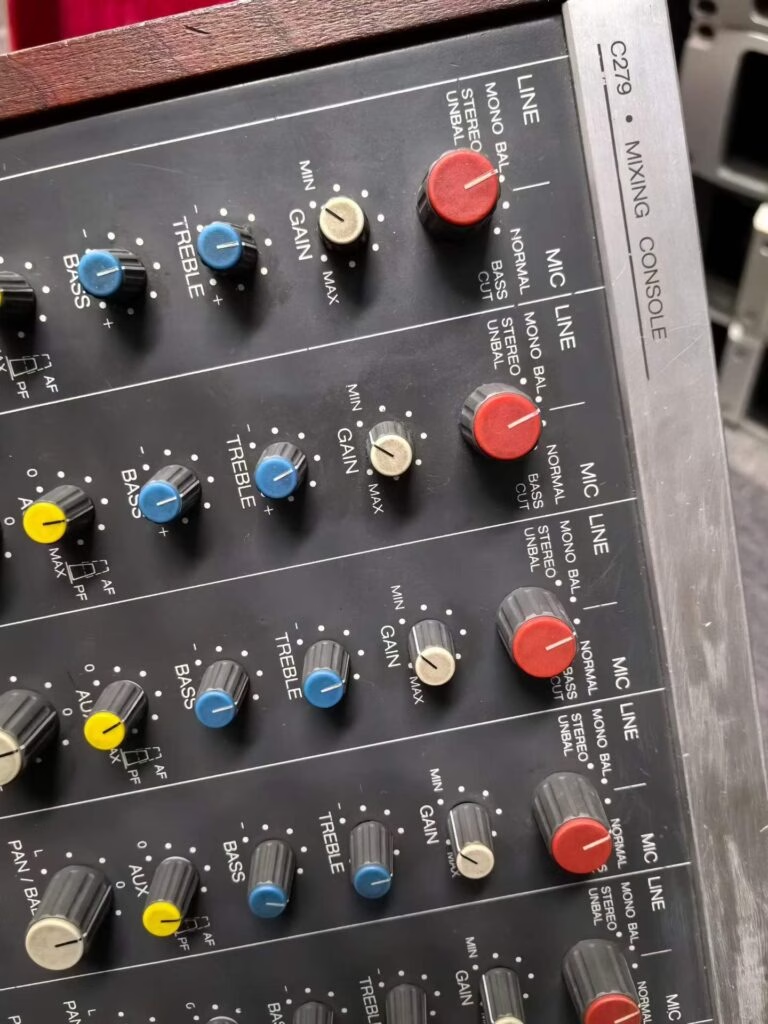
Description
The short answer: this is a genuine REVOX (Studer) C279, a small-format analog mixing console built in West Germany for studios that wanted a hand-wired signal path and simple controls rather than a screen. Six balanced mic/line channels, VCA faders, a 400 Hz calibration tone generator and switchable 48 V phantom power. Price on request, stock available now.
What is the ReVox C279?
The C279 is the compact mixing console that came out of the Studer/REVOX stable in Regensdorf and Löffingen, built under the ReVox nameplate. Where the Studer 900 and 961 consoles were 19-inch broadcast installations, the C279 is a desktop-sized frame with the same philosophy: transformer-friendly balanced inputs, conservative audio circuitry, and a layout a musician can learn in an evening.
People confuse it with consumer ReVox gear. It is not. The B77 and A77 were home tape machines; the C279 was a studio tool, and it is one of the very few cheap ways to get a Swiss-designed signal path into a home studio today.
How many channels does it have?
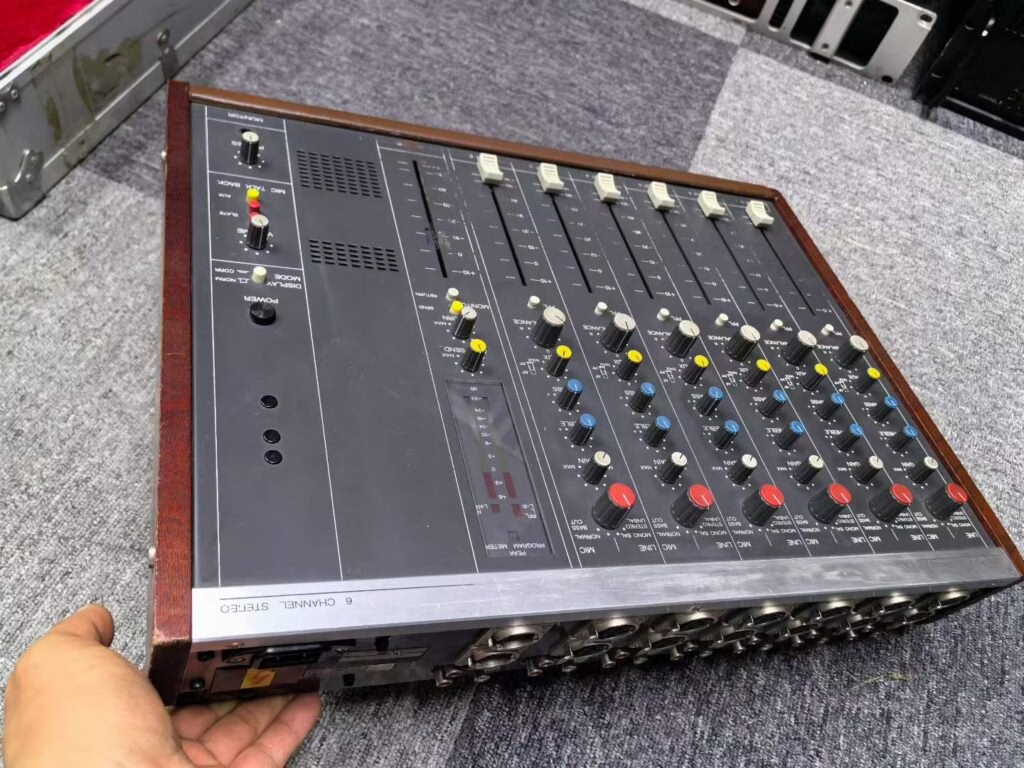
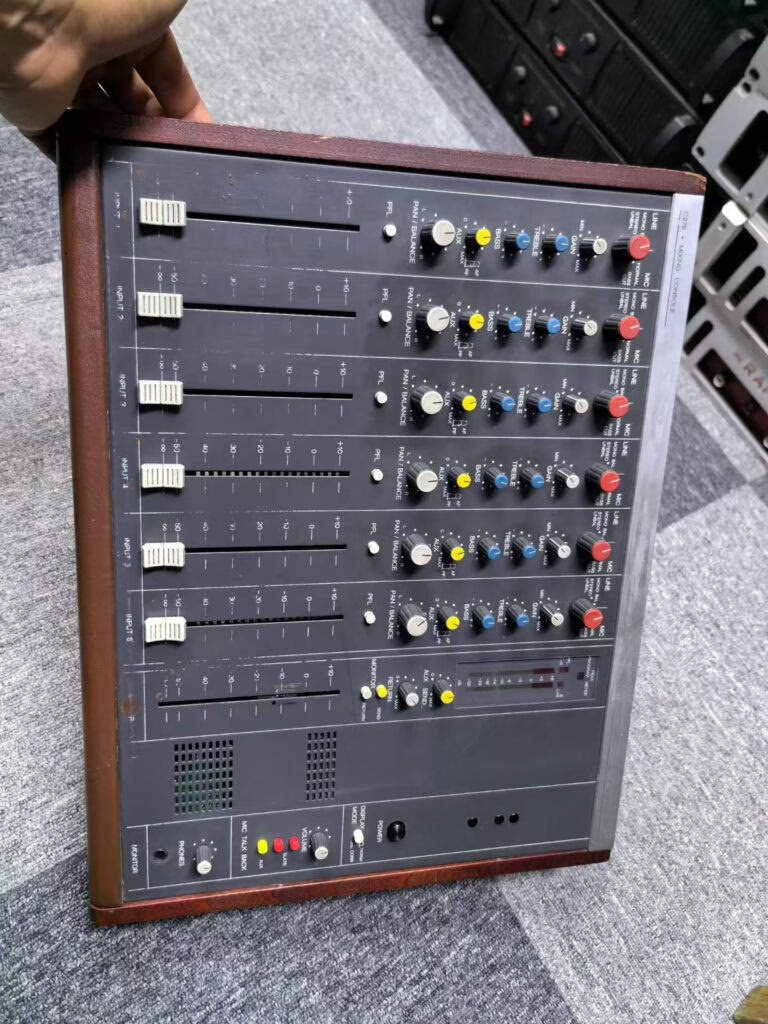
Six balanced XLR mic inputs, each switchable between MIC and LINE, with per-channel gain, two-band EQ (bass and treble), pan, and PFL. That is the classic arrangement, and it is enough to record a drum kit close-miked, a full band on a live take, or a stereo summing setup.
The channel strips can also be used as six stereo unbalanced inputs, which is worth understanding: it gives you twelve single-ended inputs in total when you count both sides. Not many small consoles of this age will do that.
Other features on the frame:
- Switchable high-pass filtering (Bass Cut) on each channel
- Switchable 48 V phantom power, applied to the mic inputs as a group
- Talkback microphone for communication with the live room
- 400 Hz calibration tone generator, built in
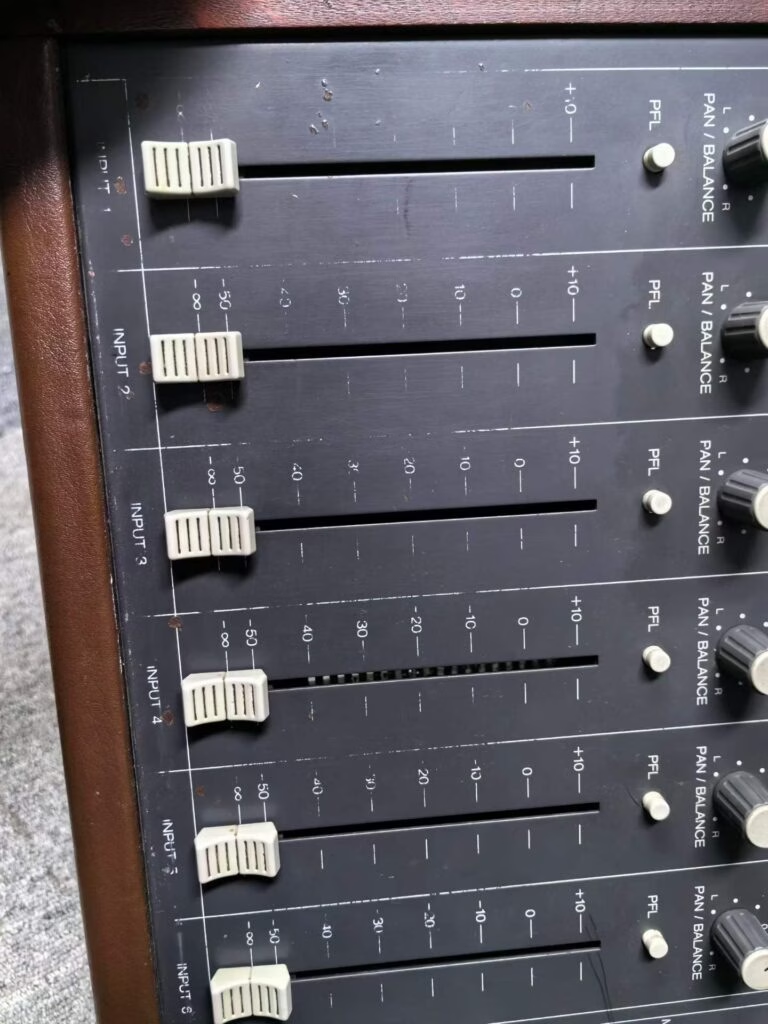
- VCA faders rather than mechanical slide faders, so the fade curve is electronic and more repeatable
What are the outputs, and how do you use it?
The console produces a balanced XLR stereo main output and an unbalanced RCA stereo main output in parallel. There is an AUX send with an AUX return, switchable between pre-fader and post-fader, and a headphone output with its own level control. Those are the connections you need to feed a tape machine, a digital interface, or a PA system at a small venue.
For summing work, the RCA main out is the convenient path: run stems out of your interface into the console, ride the VCA faders, and record the stereo return. This is why the C279 is bought today, more often than for live sound work.
Can you still get parts and service?
Here is the honest part. REVOX and Studer are no longer one company. Studer still exists as a Harman brand; ReVox parts for consoles of this era are not manufactured. Nobody makes the VCA faders, the phantom supply capacitors or the original switches any more.
What you can get is component-level service. Any experienced tech who works on analog desks can replace capacitors, clean and re-lubricate faders, and re-cap the power supply. The circuitry is conventional and documented, unlike a digital desk where a dead ASIC means a dead console.
When you buy a C279 from us, we test every channel for signal on mic and line, confirm phantom power is within tolerance, and photograph the internals before the unit goes into its case. If a channel is weak, we say so.
What is the C279 worth, and who should buy it?
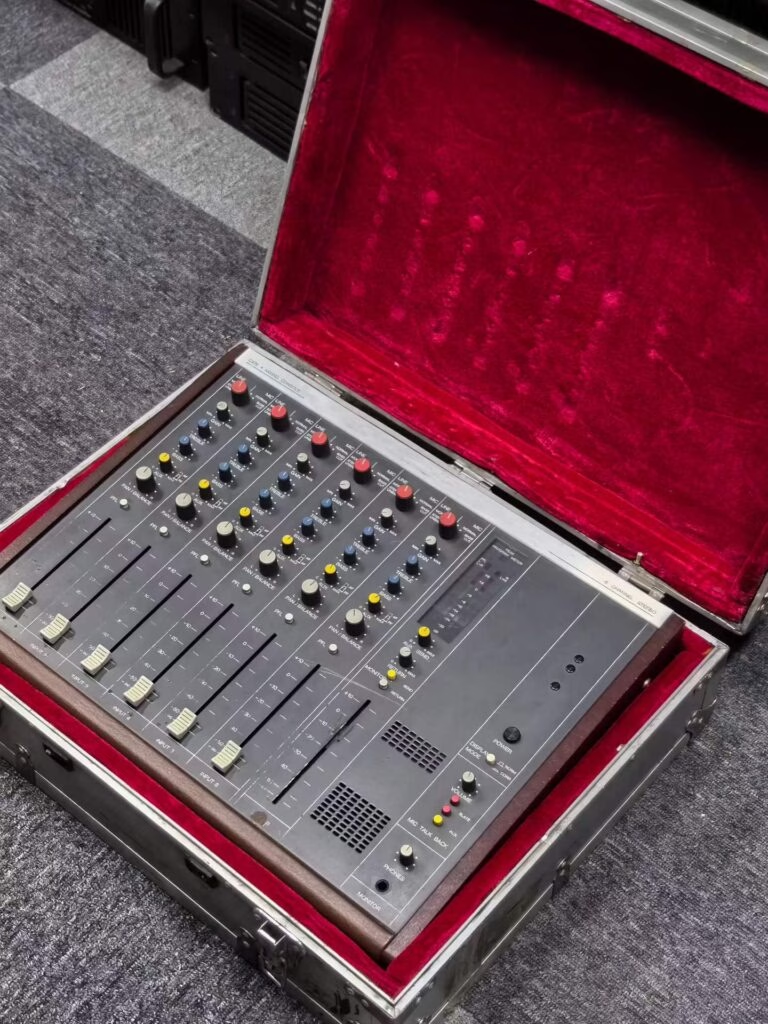
Prices for the C279 range widely, from a few hundred dollars for an untested unit to around two thousand USD for one that has been serviced, with a flight case, and with correct phantom power behaviour. The one in the photos is in a rugged flight case with its original foam interior, which is a large part of the value with a console this fragile.
We sell this unit with the price on request. If you ask us for a number, we will quote based on condition and what is included.
The people buying C279s now are:
- Producers who want a colored summing path, not transparent digital summing
- Small studios with a tape machine or an 8-channel interface that need a board for tracking
- Collectors of Studer/ReVox equipment who want a console from the same family as their tape machine
- Live engineers with a small venue who need six good mic inputs and a talkback
Who should not buy it: anyone expecting automation, anyone who needs more than six channels, anyone in a hurry who cannot wait for a technician. And anyone who will not maintain a 40-year-old power supply.
How does it sound?
Warm, and not because of marketing. The input transformers and the discrete op-amp stage add second-harmonic content that softens transients. Kick drums get a rounded thump rather than a click; vocals sit forward without needing heavy compression; synths smooth out.
It is not a clean desk. That is the point. If you need clinical accuracy, buy a modern interface; if you want your recordings to sound like the records that made you want to do this, the C279 will get you part of the way there.
What do you get when you buy this one?
The console as photographed, in its flight case, tested channel by channel. Voltage is selectable between 100–140 V and 200–240 V, so it will run in Europe, the UK, the Americas, and much of Asia without an external transformer. Total consumption is 50 W, so it runs cool and can sit on a desk without heating your room.
Available options historically offered for this frame include a DBX noise-reduction module and fader-start switching. Ours is photographed without them, and we will confirm exactly what is fitted before shipment if you ask.
Buying and shipping notes
Shipping an analog console is different from shipping a speaker. It needs a rigid case, foam padding, and a crate if it is going by sea. We load in Guangzhou and ship worldwide; if you tell us your destination, we will quote crating and freight with the console.
For buyers in Europe, expect import VAT and duty on arrival. Ask us for a landed price rather than negotiating a shipping figure in the dark.
Key Takeaways
- REVOX C279: six-channel analog console, West German build, VCA faders, balanced XLR in/out.
- Six balanced mic/line channels, or twelve single-ended inputs in stereo mode.
- Switchable 48 V phantom power, 400 Hz tone generator, talkback, Bass Cut filter.
- Serviced with a flight case; price on request, stock available.
- Best for summing and tracking; not a clean modern desk, and it needs a technician’s care.
Ask for the channel test notes, internal photos and a landed price to your port. We reply with a quote, not a range.