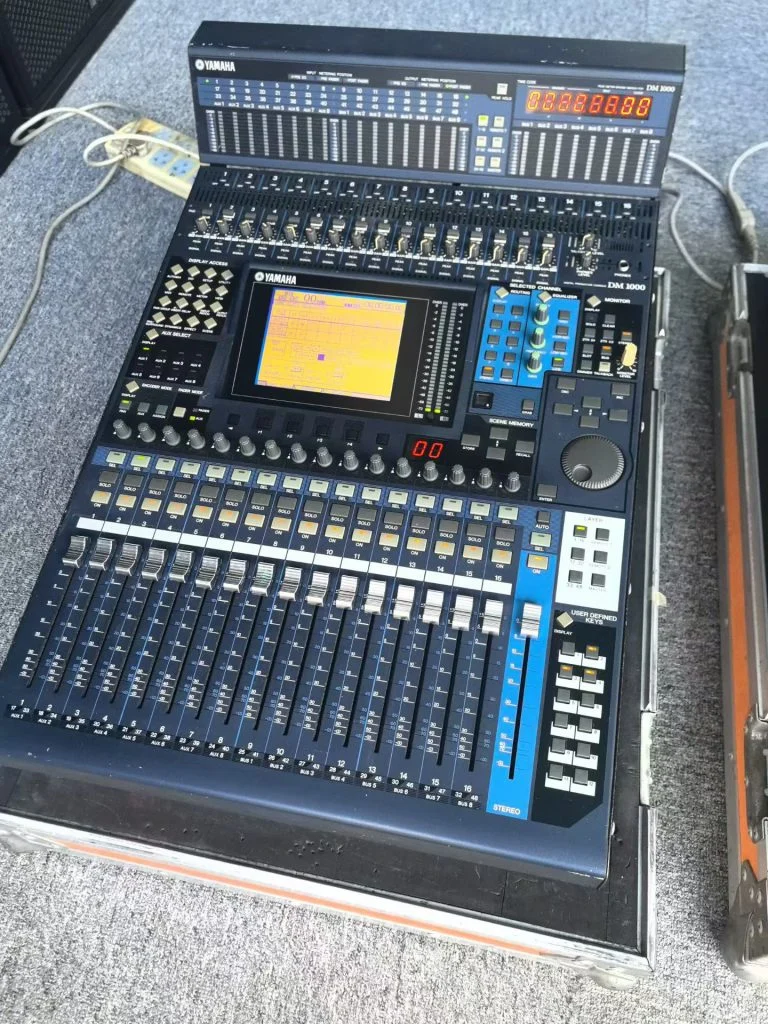
Short answer: for club and theatre work, yes. For anything with a Dante network or more than 48 inputs, no. The DM1000 is a 48-channel digital desk from the mid-2000s with 96 kHz-capable internal processing, a solid metal chassis, and an installed base large enough that faders, encoders, and PSUs still turn up.
What does the DM1000 still do well?
- 48 input channels and 16 mix buses, with 8 matrix outputs — enough for a theatre with a full vocal cast.
- Scene memory with recall safe — you can lock the vocal channels while recalling band scenes.
- 96 kHz operation on the internal path, which is still respectable in 2026.
- Built-in ADAT, TDIF, and AES/EBU, plus optional Mini-YGDAI cards for analog and digital expansion.
- Metal chassis. A 2006 DM1000 has outlived many 2018 plastic desks.
Where does it fall short in 2026?
No Dante. That is the main gap. You can add a Dante card in a Mini-YGDAI slot, but the desk’s own routing was designed around point-to-point digital, so network integration is bolted on rather than native. If your tour’s FOH and monitors share a network, you are working around the desk constantly.
The display is also a risk. LCD panels fade, and replacements are salvage-only at $400–700 when you can find one. Many rental companies keep a dead DM1000 purely as a parts donor.
What should you carry as spares?
| Spare | Cost | Why |
|---|---|---|
| 2 fader motors | $40–60 each | Most common failure |
| PSU | $150–250 used | Rarely fails, but fatal |
| CMOS battery (CR2032) | $2 | Dead battery loses scenes |
| Mini-YGDAI analog card | $150–250 | Restores 8 inputs if a card fails |
How does it compare to newer used desks?
A used X32 at $950 has native USB, more modern firmware, and far more spare parts on the market. A used DM1000 at $1,100–1,600 sounds better on the preamps and gives you 48 channels, but it is a 20-year-old desk. Choose the DM1000 if you need channel count and preamp quality; choose the X32 if you need modern connectivity and easy servicing.
Is it worth the money for a fixed install?
Often yes, because the demands are lower. A church or theatre that runs 40 inputs and never moves the desk will get years out of a DM1000. The display risk is smaller when the desk sits in a temperature-stable booth. Our listing — a tested Yamaha DM1000 with flight case — is the fixed-install case rather than a touring case.
What kills a DM1000 fastest?
Heat and vibration together. Desks in road cases under stage decks see 40 °C and constant vibration, which loosens ribbon connectors and cooks capacitors. Keep it out of the amp rack bay, use a proper shock case, and check the internal fan annually. A well-kept desk lasts 25 years; one living in a hot rack lasts 10.
Key Takeaways
- 48 channels, 16 mix buses, and 96 kHz keep the DM1000 usable for theatre and clubs in 2026.
- No native Dante is the real limitation for modern touring networks.
- Carry two fader motors, a PSU, and a CMOS battery — they cover most failures.
- For fixed installs it is excellent value; for arena tours, pick something newer.