Short answer: ‘Excellent’ should mean the unit works 100% and looks close to new from two metres away; ‘Like New’ means under roughly 100 hours of use with original box and accessories. Nobody enforces those words. If a seller posting ‘excellent used speakers for sale UK’ will not send a photo of the rear panel and a driver count, the label tells you nothing.
Is there an actual industry standard for used audio grades?
No. There is no ISO, no trade body, nothing. Every dealer invents their own scale, and most copy each other’s words. Some use A/B/C, some use 1-5 stars, some use ‘mint’, ‘excellent’, ‘good’, ‘fair’. Two sellers can both write ‘excellent’ about the same JBL KP4010 pair and mean completely different things.
That is why you should treat grades as a prompt for questions, not as a spec. The grade gets you to the listing. The questions get you to the truth.
What should ‘Excellent’ actually include?
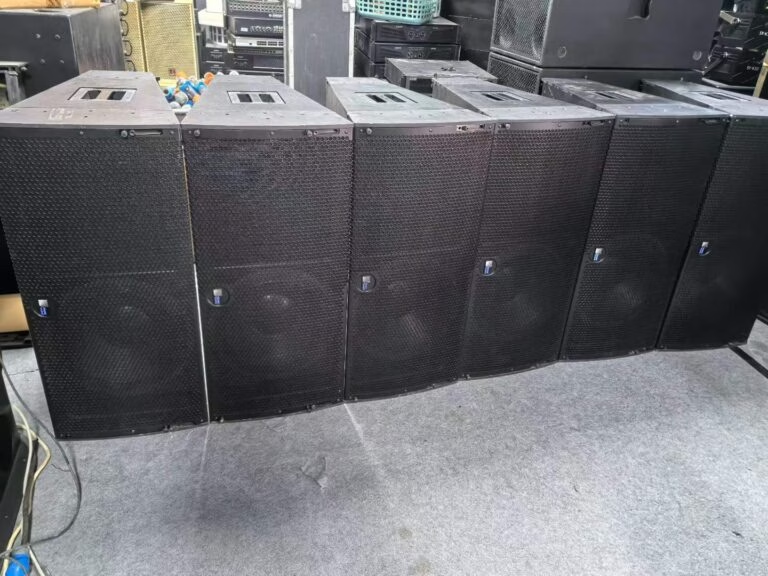
Fair definition: everything works, no missing parts, cosmetic wear you can see in photos before you pay. On a passive box like the JBL KP4010 10-inch two-way, ‘excellent’ ought to cover four checks:
- Both drivers play at full level, no scratch or rattle on a 60-second sweep.
- Cabinets have corners intact; a cracked corner means the box got dropped.
- Grilles present and not pushed in; foam intact on the older models.
- Speakon or jack sockets grip tightly, not loose or corroded.
Ask for a video of the speaker playing music, not silence. A 30-second clip at moderate volume exposes a rubbing coil faster than any description.
Where does ‘Like New’ stop being honest?
‘Like New’ suggests a short service life – think rental stock that came back after one festival, or a studio pair sold when the owner moved. Practical cutoff is under 100 hours and factory packaging still in the picture. Once a cabinet has flown on a truss for two summers, it is not like new no matter how clean the front looks.
One warning: foam surrounds. A speaker stored in a humid warehouse in Guangzhou for three years can look immaculate and still have surrounds that crumble when you push them. Age beats cosmetics every time.
How do grades map to price?
Rough working numbers from export stock in 2026, for passive 10-inch two-way boxes:
| Grade | Typical discount vs new | What you are accepting |
|---|---|---|
| Like New | 40-50% off | Almost nothing, original box |
| Excellent | 55-65% off | Scuffs, no box, full function |
| Good | 70-80% off | Visible wear, maybe one replaced driver |
| Fair / as-is | 85%+ off | Needs recone, refoam or a socket repair |
If a seller wants ‘Like New’ money for an ‘Excellent’ box, walk. The gap between those two grades is roughly 15 percent of the new price, and it exists for a reason.
What should you ask before accepting a grade on a used powered speaker?
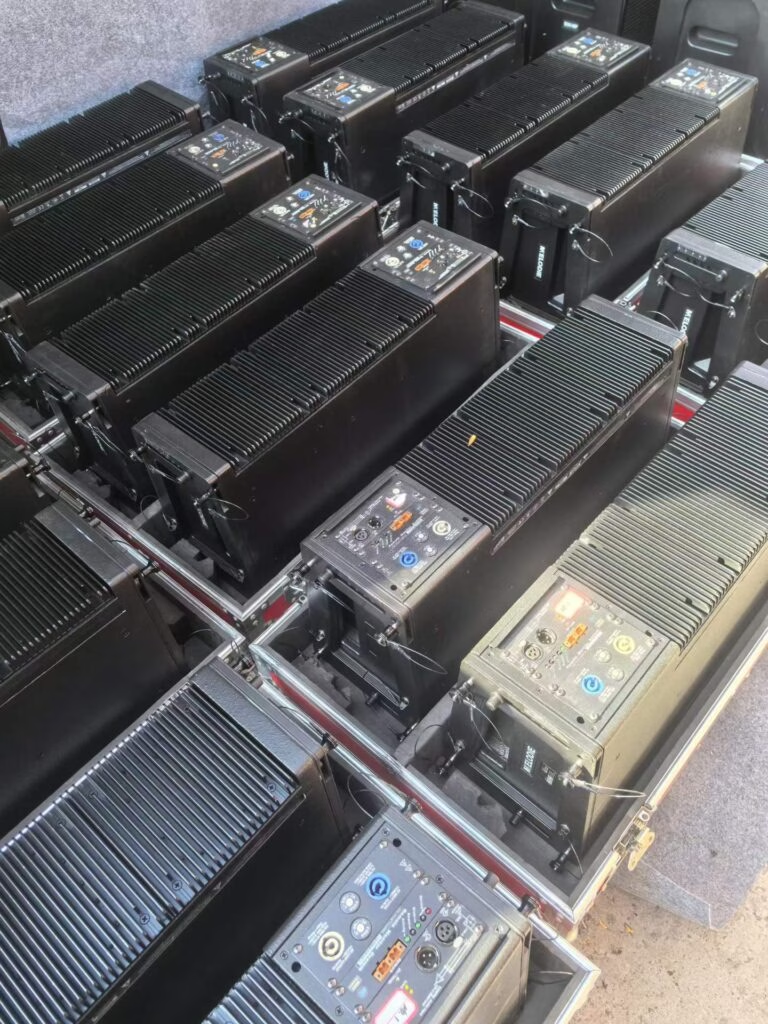
Powered boxes carry risk the passive ones do not: amplifier modules. On a self-powered two-way like the K-array KF12, ask specifically whether the plate amp has been serviced, what the fan sounds like after 10 minutes, and whether both channels still deliver rated power to the woofer. Module failures are the number one reason powered speakers get sold used.
Also ask for the serial on the module. A replaced module with a different serial is fine if the seller says so up front, and a red flag if it shows up unmentioned.
Should you ask for the original accessories?
Yes, and count them. Original Speakon cables, rubber feet, grille badges and the power lead all disappear first, and buying replacements individually usually costs $25-60 per cabinet. Ask for a photo of everything included, laid out on the floor. If the seller photographs only the front of the box, they are skipping the boring questions because the boring questions have bad answers.
On powered boxes, also ask which power cable type the module uses. Some Chinese-market units ship with a fixed 220 V lead and no voltage selector, which matters the moment the speaker leaves Asia.
Does service history beat a better grade?
Consistently. A ‘Good’ box with a receipt showing a recone by a known tech in 2024 is safer than an ‘Excellent’ box with no history and a shiny front. Recone cost on a 10-inch two-way runs $40-80 in parts plus labour; a driver replacement with a non-original part is harder to detect and changes the sound permanently.
Key Takeaways
- ‘Excellent’ and ‘Like New’ are marketing words, not standards. Ask four questions: play test, corner photos, driver count, socket condition.
- ‘Like New’ implies roughly under 100 hours and original packaging. Anything with two festival seasons on it is Excellent at best.
- Rough 2026 pricing for used passive 10-inch boxes: 40-50% off new for Like New, 55-65% for Excellent, 70-80% for Good.
- On powered speakers ask about the amp module, fan noise and serial number – module failure is the usual reason they are on the market.
Shopping now? Browse the full used speaker category or message us with a model number and we will send a play-test video before you commit.