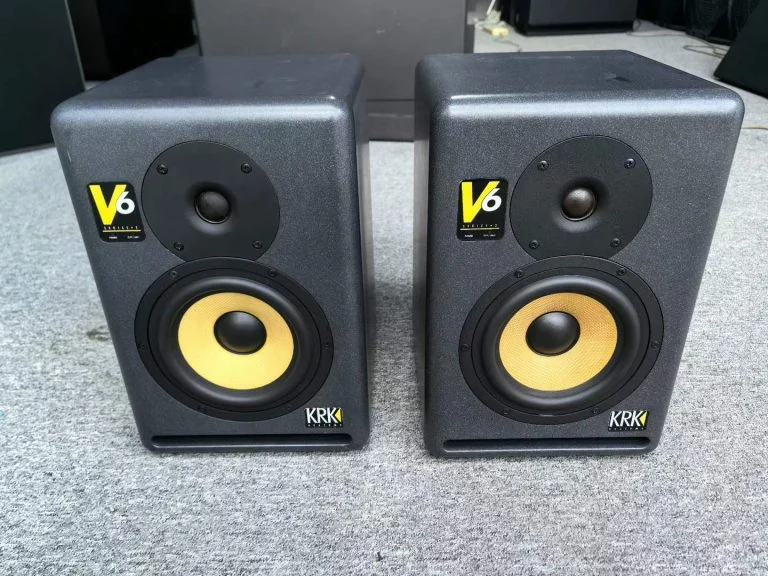
Driver matching and amplifier age decide it. Two used KRK V6s that still measure within 1dB of each other will translate mixes better than a new pair of $250 speakers with 5-inch woofers, because a matched pair in a treated room beats a cheap pair in a spare bedroom every time. Cosmetics do not enter the equation.
What breaks the “used is better” logic?
One thing: a failed driver that has been replaced with a non-original unit. A pair of monitors where one woofer is original and one is a generic replacement will never image properly. The seller usually does not know, and the resulting sound is subtle enough that you might mix on it for a year without understanding why the centre image feels wrong.
Check serial numbers on the back of each cabinet. Close serials and matching date codes mean a factory pair. A gap of thousands means someone paired two singles, and the drivers may have different hours.
How do you test a used monitor pair?
- Mono both speakers one at a time. Play a familiar vocal. If the voice sits in a different place for left and right, the drivers are mismatched.
- Play a 50Hz-60Hz sine sweep. Rattles and buzzes show up immediately, and port noise reveals a damaged cabinet gasket.
- Check the amp plate temperature. Twenty minutes of playback and a warm plate is fine. Hot enough to be uncomfortable after 10 minutes means the amp is failing.
- Look at the surrounds. Foam surrounds on older models perish; rubber ones last. Foam that crumbles under a fingernail is a re-cone job on both drivers.
When is new the better buy?
Three situations. First, room correction. Modern active monitors under $600 increasingly ship with DSP and room-compensation profiles, and a 12-year-old analog-powered pair cannot do that. Second, warranty on amplifiers, which are the expensive failure point. Third, small rooms where a 6-inch driver is already borderline: a new 5-inch with better tuning beats a used 6-inch on the wrong side of its limit.
If you mix in a treated room and can test before buying, used wins on value. If your room is untreated, buy the cheapest decent pair and spend the rest on acoustic panels. A $300 treatment budget changes monitoring more than a $600 monitor upgrade.
What should you pay for a used pair?
Active studio monitors hold value reasonably well because the buyer pool is steady. Expect 45-60% of the current street price for a pair in good working order, and 35-45% for a pair with cosmetic damage. A pair of KRK V6 Series 3 active monitors that sells new around $1,100 should land at $500-650 used. Above $750 you are paying new prices for a discontinued model with no warranty.
Note the word “pair”. Buying two singles separately usually costs 15-25% more than a matched pair, and you risk mixing generations. KRK changed the V-series amp design between generations, so a Series 2 cabinet with a Series 3 in the same room will not image correctly.
Does shipping kill the deal?
Active monitors are heavy for their size: a V6 weighs about 8.5kg each, and a pair in a double-boxed crate runs 22-26kg volumetric. Air freight on a 25kg pair from Shenzhen to Frankfurt is roughly $140-220. Sea freight drops that to $55-90 but takes 30-40 days.
Add freight before you decide you got a bargain. A $500 pair plus $180 air freight plus 6% duty is $710 landed, which brings a new pair at $1,100 much closer to the decision.
Key Takeaways
- Matched original drivers decide whether a used pair is worth buying; check serials and date codes.
- Test one speaker at a time in mono to hear driver mismatch.
- Used active monitors trade at 45-60% of street price; above 70% makes new the better buy.
- New monitors win when you need DSP room correction or amplifier warranty.
- An untreated room benefits more from $300 of panels than from $600 of monitors.