Used studio monitors are worth it at 40-55% of new price, with one condition: original drivers. Mixing depends on trusting the speaker, and a recone changes the response by 1-2 dB in the low-mid, which is exactly where your mix decisions live. Buy original, buy a known model, and skip anything that was repaired.
Does a 10-year-old monitor still sound good?
Yes, if the capacitors in the amp are healthy. Electrolytics drift with age, and a 12-year-old active monitor can lose low-end extension and gain a hum. Test at idle with no input: put your ear 30 cm from the tweeter and listen. A faint hiss is normal. A 50 Hz hum or a buzz is a failing power supply, and that is a USD 80-200 fix or a bin.
Driver surround foam is the other ageing item. Foam surrounds on 5-6 inch woofers typically last 12-18 years, then crumble. When they do, the woofer needs a refoam, and a refoam is not a recone, it is far less invasive. Ask which one was done.
Used monitors vs new: the honest cost comparison
| Used pair (USD) | New pair (USD) | |
|---|---|---|
| 6″ active, known brand | 350-550 | 800-1,100 |
| 8″ active | 550-850 | 1,200-1,800 |
| Recone risk | USD 150-250/side | none |
| Warranty | 0-90 days | 2-3 years |
Even after one recone, used is still cheaper than new. That is the honest math: a USD 480 used pair plus a USD 200 recone is USD 680 against USD 950 new. The saving is smaller than the headline, but it is real.
Which specs actually matter for mixing?
- Low-frequency extension, not “watts”. A 6-inch monitor honest to 45 Hz beats an 8-inch that claims 30 Hz and cannot deliver it.
- Front port vs rear port. Rear ports need 60 cm of wall clearance, which most bedrooms do not have.
- Volume detent. Stepped level controls let you match a pair exactly. Continuous ones drift.
- RCA vs XLR/TRS. Balanced inputs run 6 m without noise; unbalanced does not.
Why do people buy the wrong used monitor?
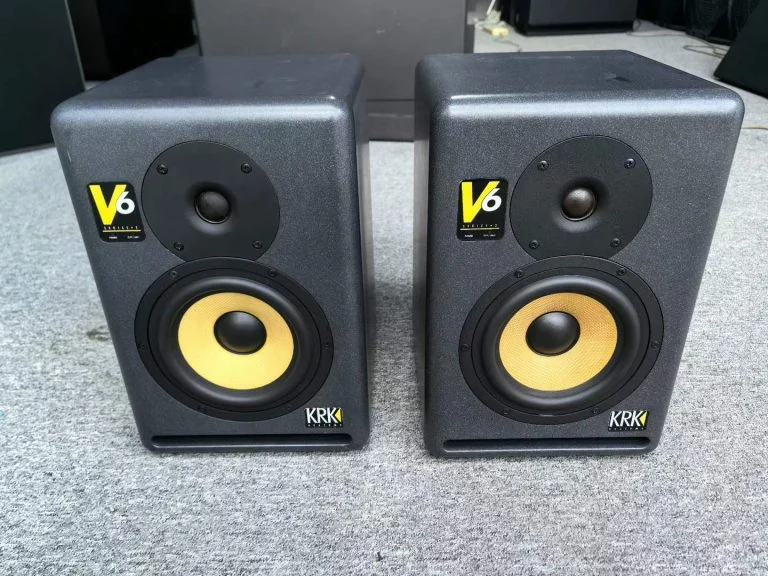
They buy the impressive one. A monitor that flatters your work makes you mix badly for months. The right used monitor sounds slightly boring, and reveals a problem at 250 Hz before you turn it into a mixing habit. A used KRK V6 Series 3 pair is a good example of a plain, honest 6-inch monitor that does not flatter.
Should you buy one or a pair?
Always a pair, and always the same production year if possible. Two monitors from different runs can differ enough in the tweeter that your stereo image never locks. If you find a single unit, only buy it as a backup for an existing pair you already own.
How do you place them in a small room?
Tweeters at ear height, forming a triangle with your head at the apex, and at least 30 cm off the back wall. Rear-ported monitors want 60 cm. Most small studios break this rule and then blame the monitors. A pair of stands costs less than a speaker upgrade and fixes more of your low-mid confusion.
Key Takeaways
- 40-55% of new is the fair range for used monitors.
- Original drivers are the whole deal, a recone kills the reference.
- Listen for hum at idle, it exposes a failing power supply.
- A refoam is fine, a recone is not.
- Buy a matched pair from the same production year.