At the same budget, used wins — if the drivers are intact. A $400 used pair of nearfields often outperforms a $400 new pair, because the used money buys a better class of monitor. The catch is that you absorb the wear risk, and monitor wear is invisible until you hear it.
What actually matters, in order: driver condition, amplifier age, room treatment, then the brand. Most buyers get that order backwards and buy a famous name with dried-out foam.
What should you look for on a used monitor?
Check the surround foam, the cone, and the tweeter dome. Foam surrounds degrade in 10-15 years and are the single most common used-monitor fault. A cracked or crumbly surround means re-foaming, which costs $70-150 per pair in parts.
- Foam surround rot: $70-150 per pair to re-foam.
- Dented tweeter dome: sound still works, resale drops hard.
- Blown amp module in active monitors: $100-250.
- Scratchy volume pot: $10-25.
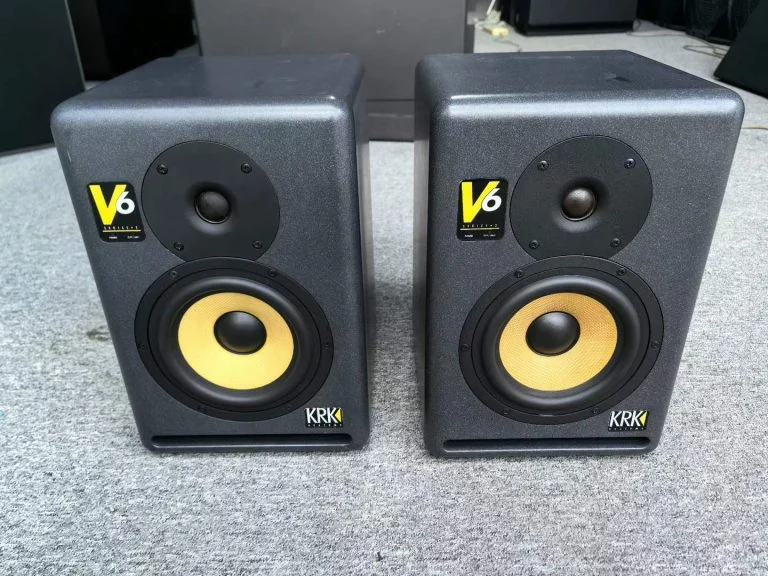
A KRK V6 Series 3 active monitor pair is a good example of what to look for: Kevlar woofers survive better than paper, and the amp module is serviceable rather than sealed.
Do used monitors actually sound different from new ones?
Not if the drivers are healthy. Monitor drivers do not “wear in” in a way that changes their character measurably — the changes happen in the surrounds and the capacitors, not the motor assembly. A 12-year-old monitor with intact foam and good caps measures within a decibel of a new one.
The real difference is in active designs, where amp module capacitors dry out. An active monitor at 12 years may have lost top-end clarity and gained a slightly soft low end. That is a $150 recap, not a new pair.
How much should each option cost?
| Budget | New gets you | Used gets you |
|---|---|---|
| $250 | 5-inch entry pair | 6-inch pair, 8-12 years old |
| $500 | 6-inch pair, basic | 7-8 inch pair, prosumer class |
| $900 | 7-inch pair, good | 8-inch pair, ex-studio |
| $1,600 | 8-inch pair, premium | Professional mains, older |
Used typically runs 50-65% of new. The premium buyers pay for new is warranty and certainty, not sound.
Why is the room more important than the monitors?
A $1,600 pair in an untreated 3x4m room will lie to you more than a $400 pair in a treated one. First-reflection panels and bass traps run $200-500 and change the result more than any monitor upgrade at that budget.
If you are buying your first real monitors on a tight budget, spend 65% on monitors and 35% on treatment. Skipping treatment is the most common reason people blame their gear.
When is new actually the right call?
Buy new when you need matched pairs with a warranty for client work, or when the model is so new that no used stock exists at a discount. Also buy new if the used price is above 70% of new.
And buy new if you cannot inspect the drivers. Used monitors bought sight-unseen without a driver close-up photo are a gamble, because foam rot is invisible at a distance.
Do active or passive monitors suit a used purchase better?
Passive monitors age better because there is no amp module to fail. You bring your own amplifier, which you can replace cheaply. Active monitors are more convenient and more common used, but the amp is the part that fails.
For a first used pair, active is still the simpler route. Just budget $100-250 for a potential module repair and check that both sides play at matched volume.
How do you test monitors you cannot hear first?
Ask for a photo of each driver with the grille off, plus a short recording of a swept sine from 40Hz to 16kHz. A rattle at one frequency points to a surround or dust cap problem, and it is audible in a phone recording.
Does room size change which monitors you should buy?
Yes, and it is the most common buying mistake. An 8-inch monitor in a 2.5m-wide room excites room modes so badly that mixes translate worse than a 5-inch pair would. Under 12 square metres, stay at 5-6 inches.
Above 20 square metres, a 5-inch pair runs out of headroom and you end up mixing quietly to avoid distortion. Match driver size to the room before matching it to your taste.
What does the crossover point tell you?
A crossover in the 1.5-2.5kHz range lands in the most sensitive part of human hearing. Cheap monitors often cross over there to save on the tweeter, and that is audible as a slight hardness in vocals that you cannot EQ out.
Key Takeaways
- Used monitors cost 50-65% of new for the same class of speaker.
- Foam surround rot is the top fault; budget $70-150 per pair.
- Driver and capacitor condition beats brand and age.
- Spend 35% of a starter budget on room treatment before upgrading monitors.
- Skip the deal if used pricing exceeds 70% of new.