Daily Q&A

Used studio monitors vs new: what actually matters

Answered on November 6, 2026

Used studio monitors are usually the better buy — a $1,200 pair of active nearfields costs $450–$650 second-hand and sounds identical if the drivers are original. What matters is not the brand badge: it is driver originality, cabinet seal, and whether both amps still deliver equal output at the same gain setting.

Buying new guarantees a warranty. Buying used gets you 50% more speaker for the same money. For a project studio, that trade is usually right.

What actually matters in a used monitor?

  • Driver originality — mismatched replacements kill stereo imaging and resale value.
  • Cabinet seal — a loosened back panel or a cracked port makes bass boomy and vague.
  • Amplifier balance — play mono pink noise; both speakers should hit the same SPL at the same gain.
  • Cone condition — foam surrounds rot in 10–15 years; check for cracks with a torch.
  • Inductor hum — a quiet buzz with no signal means a failing filter capacitor.

Why is driver originality the big one?

A reconed driver in a studio monitor is not always a bad outcome, but it must be a matching part. Two different replacement woofers in a pair will image differently and you will chase phantom problems in your mixes. Ask for a photo of both drivers, front and back, and compare part numbers.

Used vs new: what do you actually gain?

NewUsed (Excellent)
Price for a 6–7 inch active pair$900–$1,400$400–$700
Warranty2–3 yearsNone or 30–90 days dealer
Resale after 2 years-40%-10%
Risk of driver mismatchNoneReal, check part numbers
Break-in time40–80 hours neededAlready done

That last row is a real benefit. Speakers do change character over the first 50 hours of use, and a used pair is already settled. Mixes translate slightly better on the first day.

Which used monitors are safe bets?

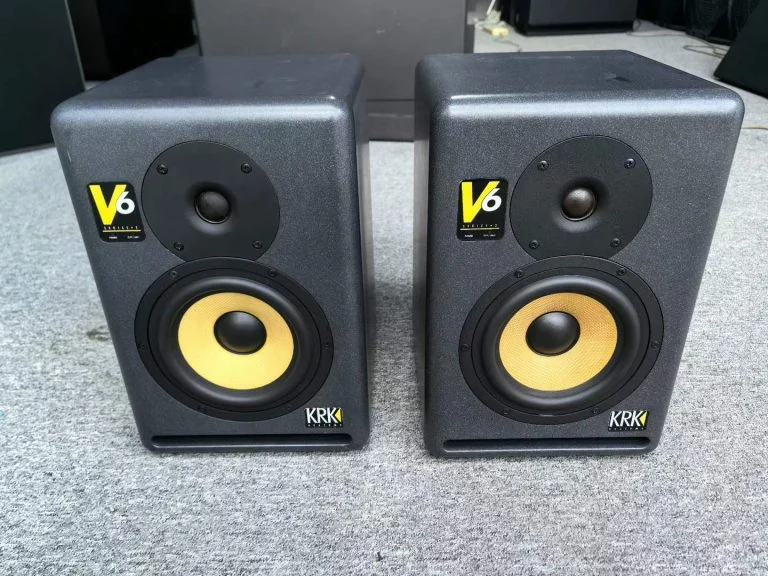
Look for a brand with a long production run and accessible spare parts. The KRK V6 Series 3 active studio monitor pair is a reasonable example: 6-inch Kevlar woofers, long production run, and drivers still available. Small two-way actives with sealed amps and no DSP screens tend to outlast monitors with onboard processing.

What about cheap used monitors from classifieds?

Two traps. First, home-theatre speakers sold as ‘studio monitors’ — they are tuned for a smiley curve and will not translate. Second, monitors sold without their power transformers for 110 V markets being used on 220 V. Check the voltage label on the rear panel before you buy, not after it fails.

How do you test a used pair in 10 minutes?

  1. Play mono pink noise through both, one at a time, at the same gain.
  2. Sweep 40 Hz to 16 kHz and listen for buzz at specific frequencies.
  3. Put your ear within 10 cm of each tweeter and compare hiss levels.
  4. Press gently on the woofer cone — no scraping means the voice coil is centred.
  5. Check that both cabinets sit flat and the ports are free of foam or tape.

More tested pairs are listed in our studio gear category. Each listing records a mono pink-noise test on both units, so you know the pair matches before it ships.

Key Takeaways

  • Used studio monitors give 50% more speaker for the same money with no sound penalty.
  • Driver originality matters most — mismatched replacements ruin imaging.
  • A used pair is already broken in over its first 40–80 hours of use.
  • Test with mono pink noise at matched gain and compare hiss at 10 cm.
  • Check the voltage label; 110 V units on 220 V mains fail silently.
Daily Q&A

Used studio monitors vs new: what actually matters

Answered on October 19, 2026

Used monitors win on drivers and cabinets, new monitors win on amp modules and warranty. If you can hear a used pair before buying and the cones are intact, buy used and save 40-60%. If you cannot hear them first, buy new.

That is the whole decision. Everything else — brand, size, ported vs sealed — matters less than whether the pair still matches each other and whether the amps are healthy.

What actually fails on a used studio monitor?

  • Foam surrounds on the woofer — degrade at 10-15 years, and refoaming costs $60-120 per driver.
  • Class-AB amp modules running hot in sealed cabinets — capacitors dry out.
  • Volume pots that get scratchy after years of small adjustments.
  • Power switches that arc, especially on older models with mechanical toggles.
  • Cabinet resonance if the MDF got damp — knock on the side, listen for a dull thud.

Foam rot is the big one. Push the cone gently — if the surround cracks or flakes, it needs refoaming before you use it at volume.

Why does pair matching matter so much?

Studio monitors are used in stereo, close range. A pair with different serials has had different lives, different hours and probably different amp aging. You will hear it as an unstable centre image, and you will chase it for months thinking it is your room.

Check serials. Ask whether they were bought together. If the seller cannot say, assume they were not.

Used vs new: the actual numbers

FactorUsedNew
Price, 5-inch pair$300-600$700-1,200
Price, 8-inch pair$600-1,100$1,400-2,400
WarrantyNone to 30 days2-3 years
Driver life remaining10-15 years if foam is goodfull
Resale at 3 years60-70% of what you paid50%

What should you listen for in a test?

Play a track you know well at low volume. Then sweep the volume knob slowly through its whole range — crackle means a dirty pot, a $5 part but a bench job on sealed monitors. Then play something with deep bass and listen for a rattle or a buzz that is not in the recording.

Also check both monitors separately with a mono source. If one is 2dB quieter, you have an amp or driver problem, and matching a replacement driver on a discontinued model is painful.

When is new the right call?

Three cases. One: you cannot audition them. Two: the model is discontinued and drivers are gone, so any failure is fatal. Three: you mix for clients and need to bill a room that meets a spec — a warranty has real value there.

For a home setup, used is almost always the smarter buy. For a commercial room, the 40-60% saving often does not cover the risk.

How do monitors fit with the rest of a rig?

Monitors are the cheapest part of a studio and the most over-debated. A $400 pair of used 5-inch monitors in a treated room beats $1,200 of new monitors against a bare wall every time. Spend the difference on bass traps first.

If you are building a small control room alongside a live rig, look at the used studio gear range and pair it with a Yamaha DM1000 digital mixing console for monitoring and routing. That combination covers most small-room needs for under $2,500.

Key Takeaways

  • Used monitors save 40-60%, but check foam surrounds before anything else.
  • Mismatched serials mean mismatched history — the centre image will never lock.
  • Refoaming costs $60-120 per driver; amp module repair can exceed the monitor’s value.
  • Buy new if you cannot audition the pair or the model is discontinued.
  • A treated room matters more than the used/new decision.