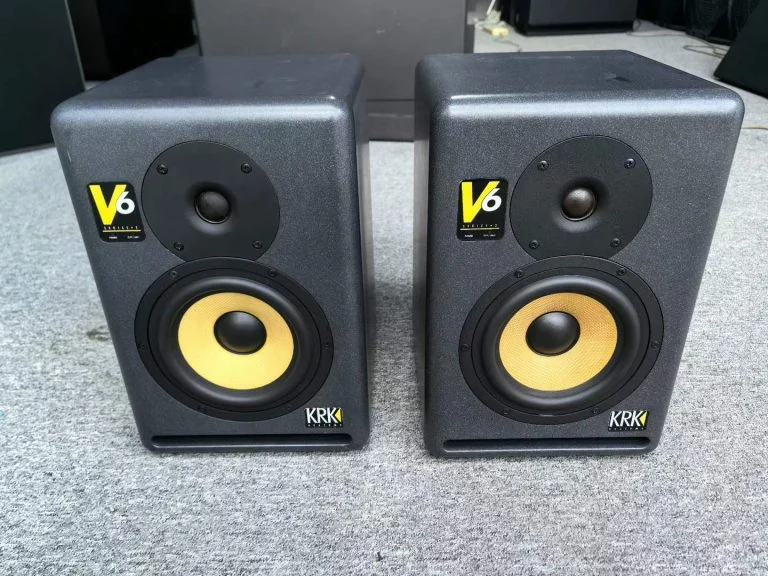
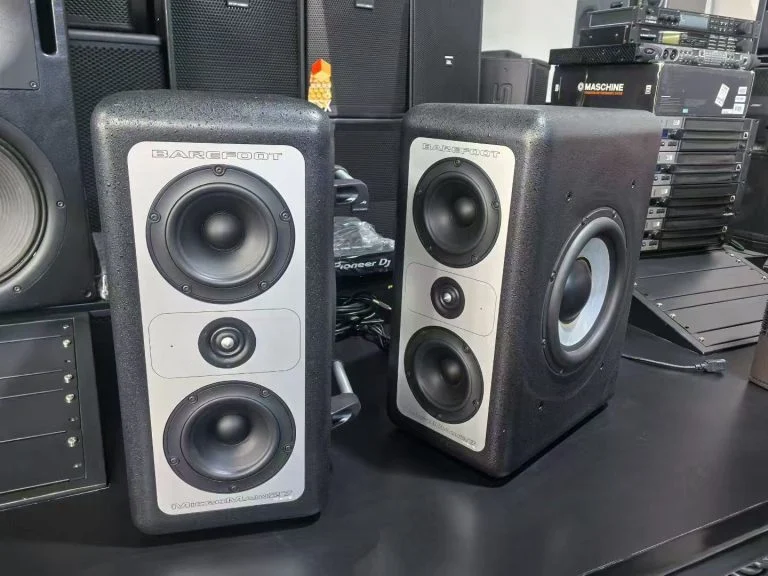
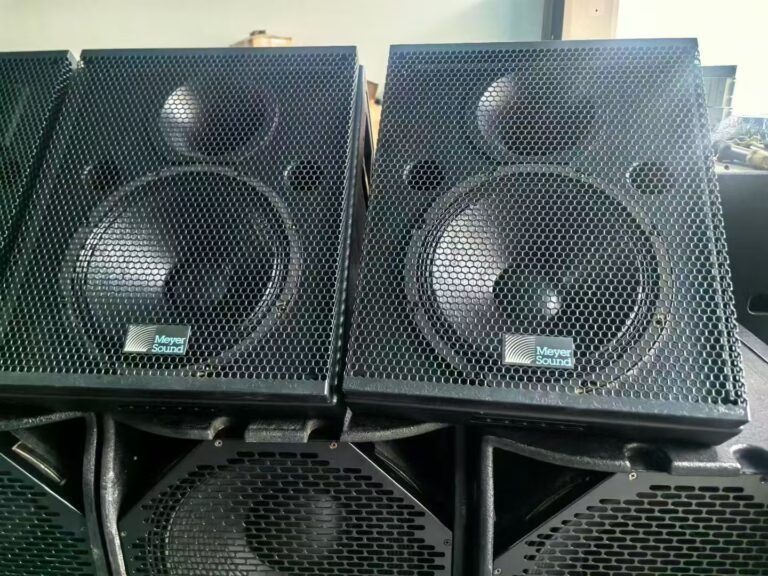
Used monitors usually win. There are no moving parts in a nearfield monitor except the driver itself, so a 2019 pair with clean cones sounds the same as new. A used KRK V6 Series 3 pair runs $520–700 against $1,100 new. The risks are foam rot, idle hiss and mismatched output — all three visible in ten minutes. See our used equipment stock.
Room treatment matters more than the monitor choice below about 30 m². A used pair in a treated room beats a new pair against a bare wall every time, and that is not a sales line.
What about placement in a small room?
keep monitors off the desk and 30–40 cm from the front wall. Desks reflect more than any difference between two used models in the same price band, and desks do not show up in the spec sheet.
Why do monitors age better than other audio gear?
Because the failure modes are physical, not electronic. A monitor is an amp board, a crossover and two drivers in a sealed box. Capacitors do drift after 10–15 years, but a nearfield monitor crossed at 2 kHz puts far less stress on its amplifier than a PA speaker crossed at 1.2 kHz at 130 dB.
What should you check before buying a used pair?
- Foam surrounds: press gently, any cracking means a refoam kit is needed
- Idle hiss with the volume at zero and nothing connected
- Output match between left and right at the same gain setting
- Cone dents: a pushed-in dust cap changes the response subtly but audibly
- Rear port condition on rear-ported models — foam plugs often missing
If one monitor hisses and the other does not, the amp modules are drifting apart. That is a matched pair becoming two singles, and the price should drop by 30%.
How much cheaper is used in 2026?
Roughly 45–60% off new. A pair that sold for $1,100 new sits at $520–700 used. High-end models hold value better: a pair that sold for $2,500 new may still fetch $1,500 used, so the discount narrows as you move upmarket.
When should you buy new instead?
If you need a warranty for client-facing work, or if the model is under 2 years old and the used discount is only 15%. Also buy new if you need DSP room correction — those firmware tools are often tied to the original purchaser’s account and cannot be transferred on used units.
Do old monitors need a subwoofer?
Not automatically. A 6-inch nearfield in a small treated room reaches about 45 Hz with usable output, which covers most mixing decisions. Add a sub only if you mix bass-heavy material or your room is over 30 m². A badly integrated sub creates more problems than it solves.
Key Takeaways
- Used monitors sell for 45–60% of new; a $1,100 pair goes for $520–700.
- Check foam surrounds, idle hiss and left/right matching — 10 minutes work.
- Buy new if you need transferable DSP room correction or a warranty.
- A sub is optional below 30 m²; a 6-inch nearfield reaches about 45 Hz.