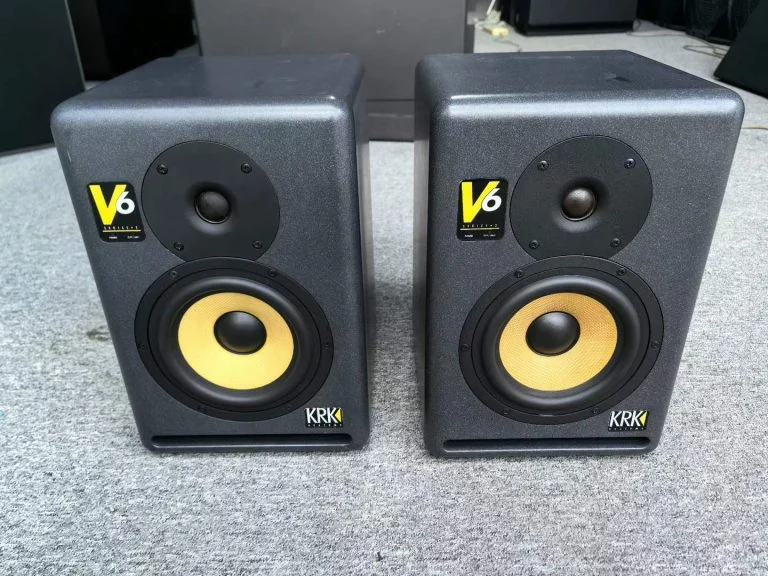
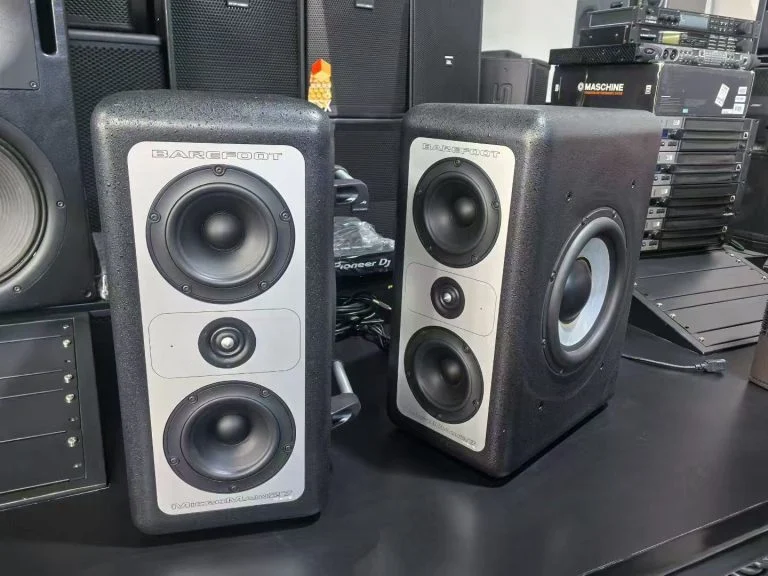
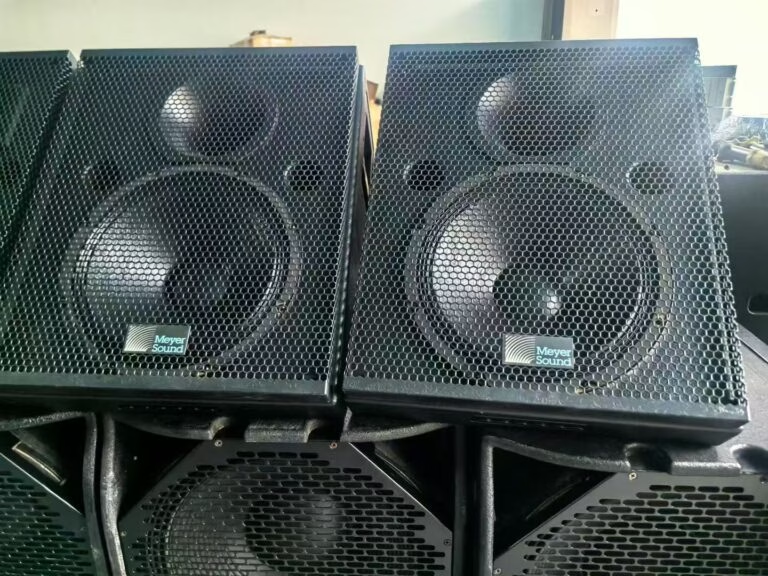
Used studio monitors make sense above $500 a pair, and rarely below it. A $1,200 pair of nearfields at $600 used is a real saving. A $350 pair at $220 is not, because aged surrounds and drifted capacitors change the frequency response in ways that defeat the point of a monitor. Monitors are for accuracy; a monitor that’s 2 dB off is a decoration.
Foam surrounds rot in 8-12 years in humid climates and 15 in dry ones. That’s the first thing to look at, and it decides whether the price is good.
What should you inspect physically?
- Surround foam: pinch it gently. If it crumbles or feels sticky, it’s due for replacement, $60-$180 per driver plus labor.
- Cone: look for dents, tears, and any sign of repair glue. A repaired tear subtly changes the driver.
- Cabinet: press the corners for separation at the seams, and check that the port isn’t stuffed with foam by a previous owner.
- Amp module on active monitors: same rules as powered PA speakers, capacitors and fan first.
- Level controls: scratchy gain knobs mean dirty pots, common after 10 years of small adjustments.
- Serial pair match: nearfields are sold in matched pairs. Mismatched serials mean mismatched drivers, and the stereo image will drift.
That last point gets skipped constantly. Two monitors of the same model but different production years can sound different, and you can’t hear it until you’re mixing and nothing sits in the centre.
How much does age actually change the sound?
| Age | Typical change | Audible? |
|---|---|---|
| 0-5 years | Negligible | No |
| 5-10 years | Surround softening, cap drift under 1 dB | Barely in a treated room |
| 10-15 years | Surround rot starts, cap drift 1-2 dB | Yes, on low end and crossover |
| 15-20 years | Surround replacement due, tweeter ferrofluid drying | Yes, and the tweeter sounds duller |
| 20+ years | Recap and re-surround needed | Yes. Price a rebuild, not a monitor |
Practically: below 10 years old, buy used and don’t worry. Above 15, price in a $150-$300 service per pair or walk.
When is new actually the better buy?
Three cases. One, budget nearfields under $400 a pair — the used market for these is thin on quality and the savings are $80-$150. Two, any monitor where you can’t hear it before paying. Three, active monitors from brands that stop stocking amplifier modules after 7-8 years, because that turns a $600 pair into a $600 pair of cabinets.
Also: if you’re treating a room at the same time, spend the money on treatment. $400 of bass traps changes your monitoring more than $400 of monitor upgrade. Room first, always.
Does a used monitor rig work with used PA gear?
They serve different rooms. A studio monitor is a nearfield, designed for 1-2 metres; a PA box is designed for 10-30 metres. If you need a small room to sound right, monitors. If you need to fill a bar with 100 people, a 12-inch powered box like the K-array KF12 does the job at 122 dB peak, and a nearfield does not.
Don’t mix the categories to save money. People buy a pair of monitors for a 150-cap venue, then buy a subwoofer, then another subwoofer. A single powered PA box per side is cheaper than that stack and works better.
What’s the resale angle?
Monitors hold value poorly compared to PA. A 10-year-old nearfield sells for 35-45% of new, while PA boxes hold 40-55% and dynamic mics hold 65-75%. If you might sell in three years, buy PA. If you’re keeping it for a decade, monitors used are fine.
One more: in untreated rooms, the difference between a $600 used pair and a $1,400 new pair is smaller than the difference between either of them and having a rug. Buy used, buy treatment, buy a measurement mic.
Key Takeaways
- Used nearfields are worth it above $500 a pair; under $400 the saving doesn’t cover a repair.
- Foam surrounds rot in 8-12 years in humid climates. Pinch them before you commit.
- Above 15 years old, price a $150-$300 service per pair, not just the speakers.
- Room treatment changes your monitoring more than a monitor upgrade at the same budget.