How do you test a pair before buying?
Play the same material through each speaker separately and switch. A matched pair should sound identical. Any difference in level or brightness of more than about 1 dB means one driver has aged differently, and you cannot fix that with EQ.
Then run 15 minutes of bass-heavy material at moderate level and feel the cabinet. Buzz or rattle at the port means a loose baffle. Check the cone edges for cracks with a torch – surround rot starts at the outer ring.
What is the price picture?
| Monitor size | New pair | Used pair, fair | Risk |
|---|---|---|---|
| 5″ two-way | $400 – $700 | $180 – $350 | Low |
| 7-8″ two-way | $700 – $1,400 | $300 – $650 | Medium |
| 3-way mid-field | $1,800 – $4,000 | $700 – $1,800 | Medium-high |
| Vintage passive + amp | $500 – $1,500 total | $250 – $700 | High (caps) |
When is new the better call?
When the monitor has DSP and room correction, because firmware support matters. When you need a matched pair for mastering and cannot verify driver history. And when the used price is above 60% of new – at that point the warranty is worth more than the saving.
Studio monitors are the one category where we rarely stock used units. Our used inventory leans toward live sound: self-powered K-array KF12 speakers and the Yamaha DM1000 console. For monitoring in a live context, a clean used pair of 7″ monitors at $300-$650 is the sensible buy.
Key Takeaways
- Driver surrounds and amp capacitors age in 12-18 years – both change the sound.
- A matched pair should be within about 1 dB across the range.
- Front-ported designs are easier to place in small rooms.
- Above 60% of new price, buy new for the warranty.
Buy used if the original drivers are intact and the amp section runs clean for 20 minutes. Buy new if the model is discontinued and you plan to keep it 10 years. Driver aging is the real variable, not the spec sheet – a used monitor with a reconed woofer is not the monitor that got the good reviews.
What actually degrades in a used studio monitor?
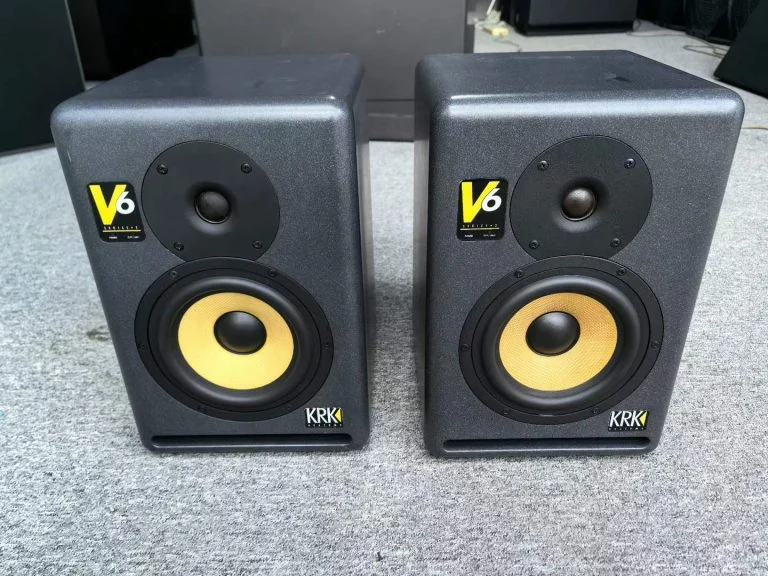
Four things. The woofer surround dries out and cracks after 12-18 years. The electrolytic capacitors in the amp drift, changing the crossover balance. The ferrofluid in some tweeters thickens. And the cabinet seals shrink, causing a small air leak that robs low-end output.
None of these show up in a 30-second listen. They show up as a hollow midrange or a top end that sounds 2 dB dull next to the other speaker of the pair.
Which specs matter in a small untreated room?
- Low-frequency response, honestly stated: a monitor rated “38 Hz – 22 kHz” in a 12 m² room will not deliver 38 Hz. Room modes dominate below 120 Hz.
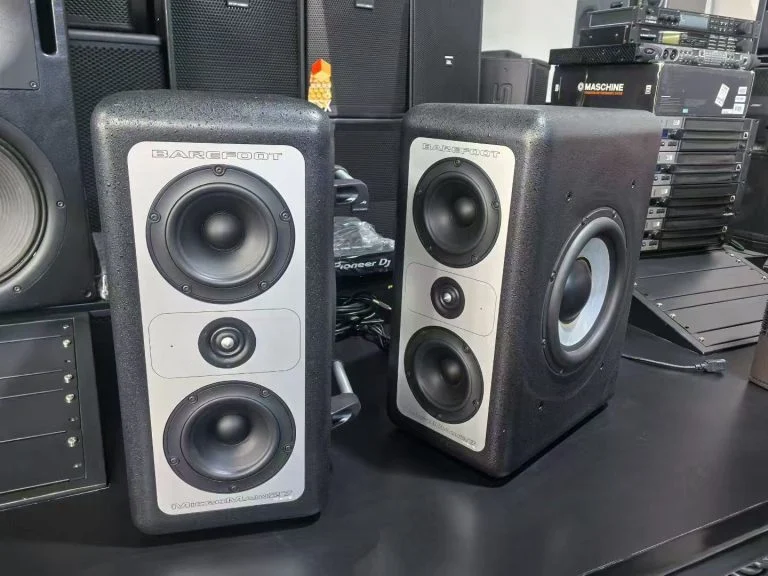
- Cabinet size and port tuning: front-ported monitors are far easier to place near a wall.
- Power and headroom: 50 W per driver class is plenty at 1 m. More power mostly buys headroom you will not use.
- Room correction: only relevant if the monitor has DSP. Analog monitors cannot fix your room.
How do you test a pair before buying?
Play the same material through each speaker separately and switch. A matched pair should sound identical. Any difference in level or brightness of more than about 1 dB means one driver has aged differently, and you cannot fix that with EQ.
Then run 15 minutes of bass-heavy material at moderate level and feel the cabinet. Buzz or rattle at the port means a loose baffle. Check the cone edges for cracks with a torch – surround rot starts at the outer ring.
What is the price picture?
| Monitor size | New pair | Used pair, fair | Risk |
|---|---|---|---|
| 5″ two-way | $400 – $700 | $180 – $350 | Low |
| 7-8″ two-way | $700 – $1,400 | $300 – $650 | Medium |
| 3-way mid-field | $1,800 – $4,000 | $700 – $1,800 | Medium-high |
| Vintage passive + amp | $500 – $1,500 total | $250 – $700 | High (caps) |
When is new the better call?
When the monitor has DSP and room correction, because firmware support matters. When you need a matched pair for mastering and cannot verify driver history. And when the used price is above 60% of new – at that point the warranty is worth more than the saving.
Studio monitors are the one category where we rarely stock used units. Our used inventory leans toward live sound: self-powered K-array KF12 speakers and the Yamaha DM1000 console. For monitoring in a live context, a clean used pair of 7″ monitors at $300-$650 is the sensible buy.
Key Takeaways
- Driver surrounds and amp capacitors age in 12-18 years – both change the sound.
- A matched pair should be within about 1 dB across the range.
- Front-ported designs are easier to place in small rooms.
- Above 60% of new price, buy new for the warranty.