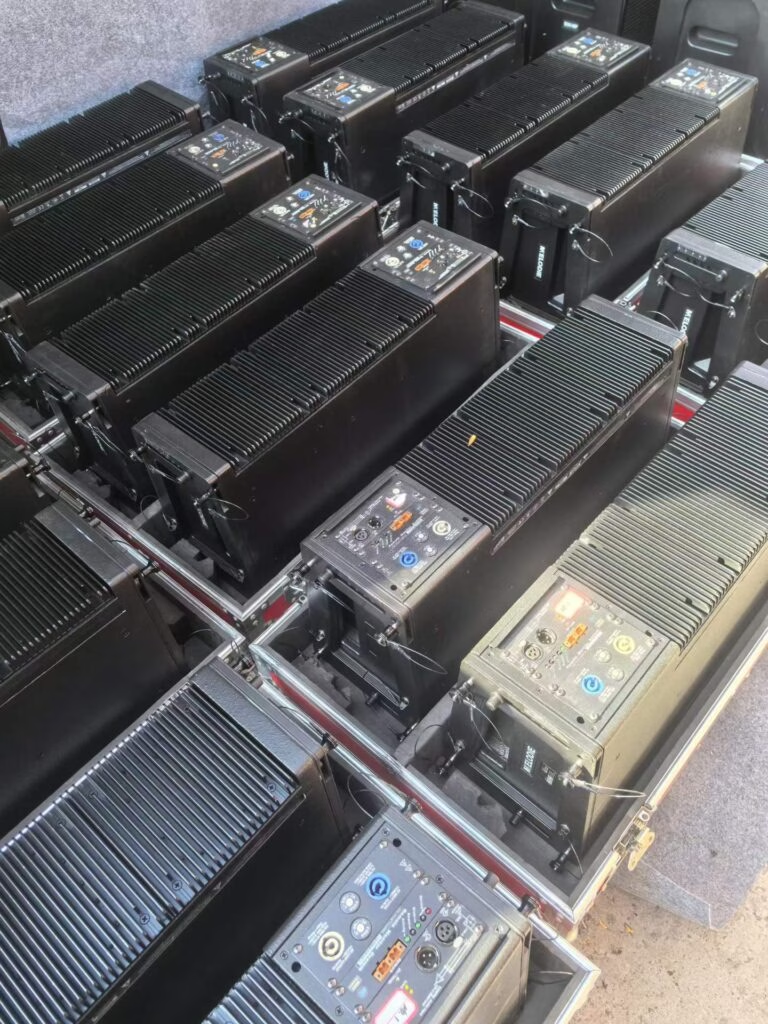
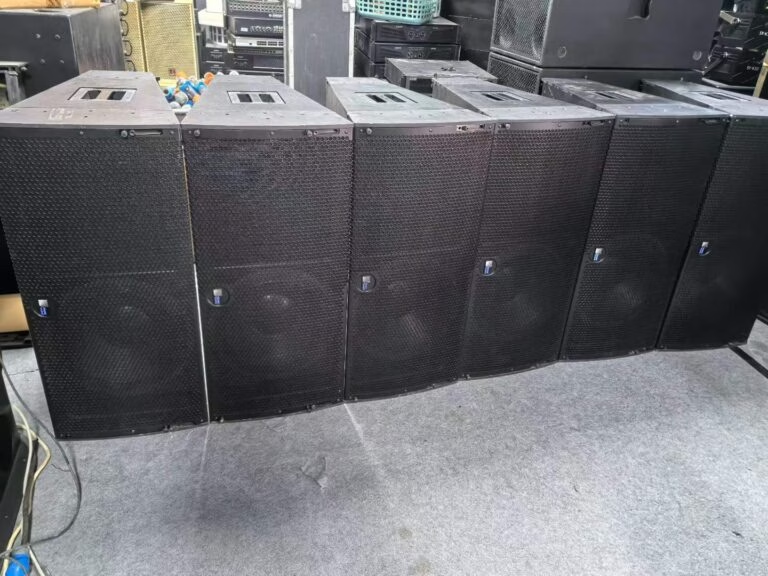
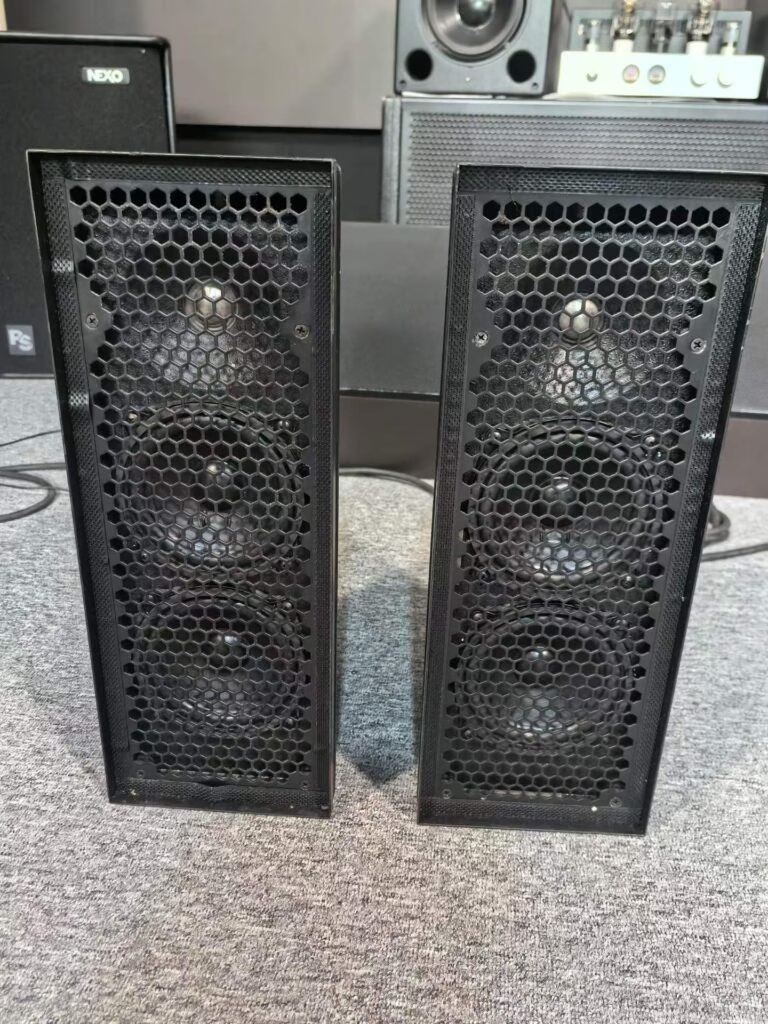
Yes, bulk buying works, but not for the reason most importers think. A 40ft container of used 10-12 inch PA speakers from Guangdong typically lands at $95 to $210 per unit including sea freight, against $420 to $650 for equivalent new retail. The real question is not price per box. It is how many boxes arrive sounding like a speaker.
What does a real used PA speaker lot cost per unit?
Numbers from a 2026 lot of 240 passive boxes, mixed JBL and generic Chinese 10 inch, loaded in Foshan:
| Cost line | Per unit |
|---|---|
| Unit price at loading | $58 |
| Sea freight 40ft, 240 units | $14 |
| Export packing, pallets | $6 |
| Duty and local clearance | $17 |
| Landed cost | $95 |
The same container with active boxes costs more, because amp modules carry their own failure rate and the shipping weight doubles. Landed cost lands closer to $180 to $210 per powered unit.
Which speakers survive shipping and which do not?
Passive boxes with stamped steel baskets survive a sea crossing far better than most people expect. Cone damage is the main risk, and it is visible before you pay: push a thumb gently near the surround, listen for scraping. Active boxes are different. Amplifier boards with old electrolytics tend to fail during weeks of unheated container conditions, not during testing at the factory.
Plastic-shell speakers are the weak link. In a 2026 lot I handled, 11 of 120 ABS-bodied boxes arrived with cracked baffles at the mounting screw bosses. Cabinet damage like that cannot be repaired cheaply.
What does “tested” actually mean on a bulk order?
Almost nothing, unless you define it. Sellers will happily write “all tested working” on a lot of 200 and mean they plugged in a handful. Ask for a written protocol: sine sweep at 100 Hz and 1 kHz, impedance measured with a meter, and a photo of the number on each unit that failed.
A serious supplier will show you grade B ratio, not just the good units. Budget 10 to 15 percent dead or degraded per lot. If a seller claims 2 percent failure on 15-year-old gear, walk away. They are either guessing or hiding something.
How many units do you need before bulk makes sense?
Under 20 units, the shipping and clearance overhead eats the saving. At 20 to 60 units, a shared container or groupage booking works and you keep one grade of speaker. Above 100 units, buy a full container. You will save about $12 to $18 per unit on freight alone and control the packing yourself.
- 20-60 units: groupage or shared box, mixed grades acceptable
- 100-240 units: 40ft container, all one SKU if possible
- 240 units and up: two containers, one as spares donor pool
What should you refuse to accept?
Refuse lots where the seller will not photograph serial labels. Refuse reconed drivers without documentation, because a recone changes the sound and resale value. Refuse any lot where the boxes have been repainted over the original grille dents. Repaint is cheap, and it hides dents you will find later.
If you want a single known-good unit to benchmark the lot against, start with a JBL KP4010 passive 2-way 10 inch speaker or the JBL KP4010 bulk lot and compare against what the container delivers.
Key Takeaways
- Landed cost on a 240-unit passive lot ran $95 per unit in 2026, roughly a quarter of new retail.
- Expect 10 to 15 percent dead or degraded units and price the lot accordingly.
- Active boxes cost nearly double landed, and their amp modules fail silently in transit.
- Demand a written test protocol and serial photos before paying a deposit.
- Below 20 units, shipping overhead kills the deal.
How do you price a lot you have not seen in person?
Work backwards from resale, not forwards from the asking price. If your customers pay $240 for a working 10 inch passive box and you can sell 85 percent of a lot, then your ceiling for the whole container is 240 times 0.85 times the unit count, minus freight, duty and two months of storage. Anything above that ceiling is a donation.
A concrete example. 240 boxes, 85 percent sellable at $240, gives a gross of $48,960. Subtract freight and duty of $8,880 and about $2,000 of storage and handling, and your maximum landed offer is roughly $38,000, or $158 a unit. If the seller wants $130 a unit at loading, the deal works. At $175, it does not.
What does packing actually look like for a speaker container?
Four to six units per pallet, upright, cones facing each other with a 40 mm foam separator. Do not stack pallets of cabinets on top of each other without a rigid deck, because the bottom row takes the load through the grille. A 40ft container typically holds 40 to 50 pallets of this kind, which lands around 220 to 280 boxes.
Ask for photos of the actual loading, not a stock image of a tidy warehouse. Loading photos show whether the crew used corner protection, and corner protection is the difference between a scuffed cabinet and a cracked one.
Where do buyers usually lose money?
- Underestimating duty: 8 to 12 percent on many HS codes for loudspeakers
- Ignoring the cost of 30 to 45 days of warehouse rent at destination
- Buying one grade and discovering it needs two repair benches
- Paying a deposit before serial photos exist