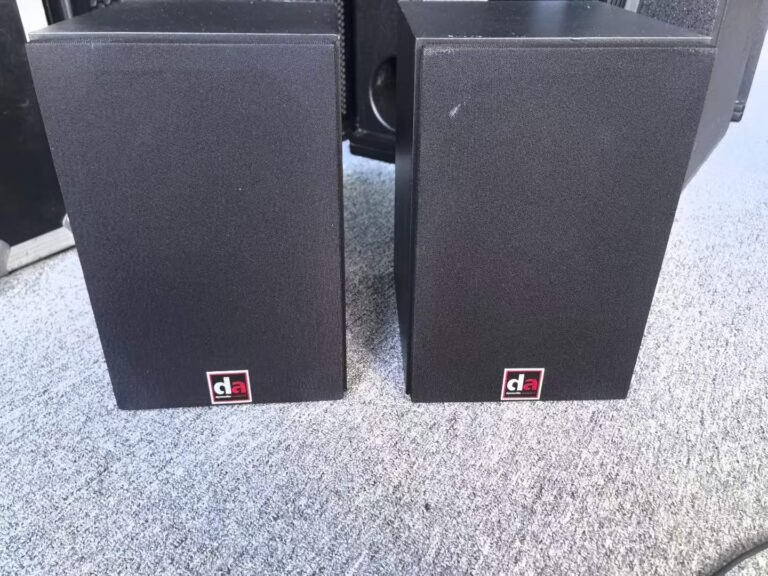
A used Dynaudio BM5 passive studio monitor pair costs $500 to $850 in 2026. The passive version is the safer second-hand buy: there is no amplifier module inside to fail, so the only wear items are the drivers and the crossover capacitors.
Dynaudio builds in Skanderborg, Denmark, and the BM5 has been through several generations. The passive BM5 and BM5A share the same 1.1-inch soft-dome tweeter and a 6.9-inch mid-woofer. Cabinets are heavy MDF with a real veneer on the older runs.
What does a used BM5 pair cost?
| Version | Pair price (2026) | Note |
|---|---|---|
| BM5 passive, older run | $500 – $650 | Veneer, no XLR lock |
| BM5 passive, recent run | $600 – $850 | Cleaner cabinets, better connectors |
| BM5A active pair | $700 – $1,100 | Check amp modules carefully |
Why buy passive monitors instead of active ones?
Fewer parts to break. An active monitor has an amp board, a transformer and a switch-mode supply inside a sealed box that runs at 40 °C. Those die, and a replacement module can cost more than the monitor is worth. A passive BM5 needs only an external amp, which you probably already own and can replace in a day.
The trade-off: you need a decent amplifier. A cheap 2×50 W amp will make a BM5 sound duller than its reputation. Budget $200 to $400 for a clean 2×100 W amp and the total still lands under a new pair of budget studio monitors.
What should I listen for when testing a used BM5?
- Play a solo piano track and listen for a buzz in the tweeter — a pushed-in dome is common and unfixable.
- Put your ear close to the woofer at low volume; a rubbing coil makes a dry scraping sound.
- Check both monitors at the same level; a 2 dB difference usually means a tired crossover capacitor.
- Inspect the cabinet corners for water damage — MDF swells and never recovers.
- Confirm both tweeters are original Dynaudio units, not aftermarket replacements.
Is the BM5 still relevant for mixing in 2026?
Yes, with a caveat. The BM5 is a nearfield monitor with limited low-end — it rolls off around 50 Hz. That is fine for vocal, guitar and podcast work and bad for bass-heavy electronic production. If you mix sub-bass on it you will guess wrong.
Its soft-dome tweeter is forgiving in untreated rooms, which is why small studios keep buying them. A pair in a bedroom with a desk and a bookshelf will sound more honest than a brighter modern monitor that reveals every reflection.
Where can I see a tested BM5 pair?
The Dynaudio Acoustics BM5 passive monitor pair listing shows cabinet condition and driver photos. If you want an active pair that needs no amp, the KRK V6 Series 3 active pair is a fair comparison at similar money.
Which amplifier pairs well with a BM5?
Something neutral with 80 to 120 W per channel into 4 ohms. A used Bryston, a decent Rotel, or a Crown class-AB will all work. Avoid guitar-amp style power amps and avoid anything with a loud fan — nearfields sit a metre from your head.
Spend the money on clean power rather than watts. A 60 W amp with a stiff supply beats a 150 W amp with a weak one on these monitors, and the difference is audible on piano and voice.
What is the honest downside of buying old BM5s?
Spare drivers. Dynaudio no longer makes every variant, and a replacement tweeter for an older run can be hard to find. If one tweeter dies, you may end up hunting for a single unit for months. That is a genuine risk on a ten-year-old pair.
Buy a pair anyway if the price is right and both tweeters test clean. Just know that you are buying a working pair, not a serviceable platform.
Key Takeaways
- Used BM5 passive pair: $500–$850 in 2026.
- No internal amp means far fewer failure points.
- Budget $200–$400 for a clean 2×100 W amplifier.
- Low end rolls off near 50 Hz — not a bass-mixing monitor.
- Soft-dome tweeter stays calm in untreated rooms.