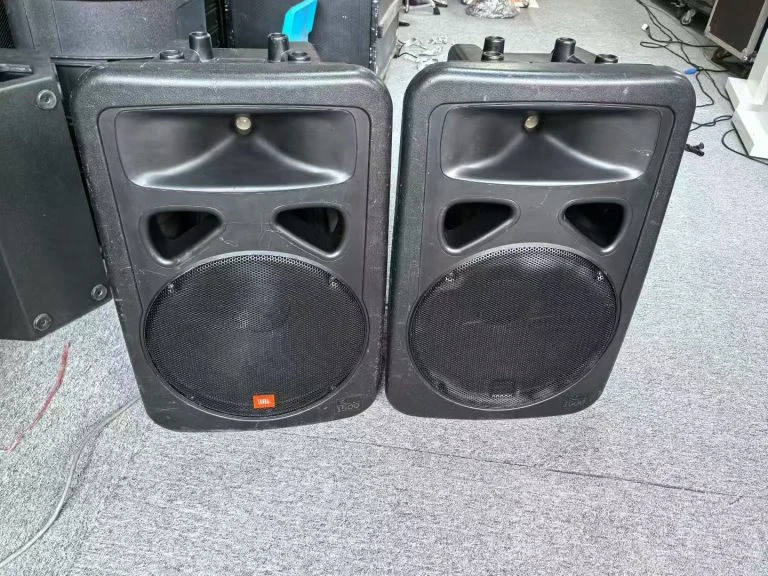
Mostly no, with one big exception. A pair of 10-inch passive boxes handles 150 guests for speeches, acoustic duos and light background music. Add a DJ with sub-bass and you will hit the limiter before the first chorus. The exception is genuine acoustic work; the rule is that 10-inch boxes are a support box, not a main box, for anything beat-driven.
Here is the physics in plain numbers. A 10-inch cone has about 40% of the cone area of a 15-inch. To match the same low-frequency output it must move 2.5 times as far, which it cannot do without distortion. That is not a brand problem; it is geometry.
How loud can a 10-inch PA speaker actually go?
A typical passive 10-inch box with a 1-inch compression driver peaks around 118-122 dB SPL at 1 m. At 20 m from the front of a 150-person room you lose roughly 26 dB to distance. That leaves 92-96 dB at the back wall, enough for speech at head height and nowhere near enough for dance music at 100 dB plus.
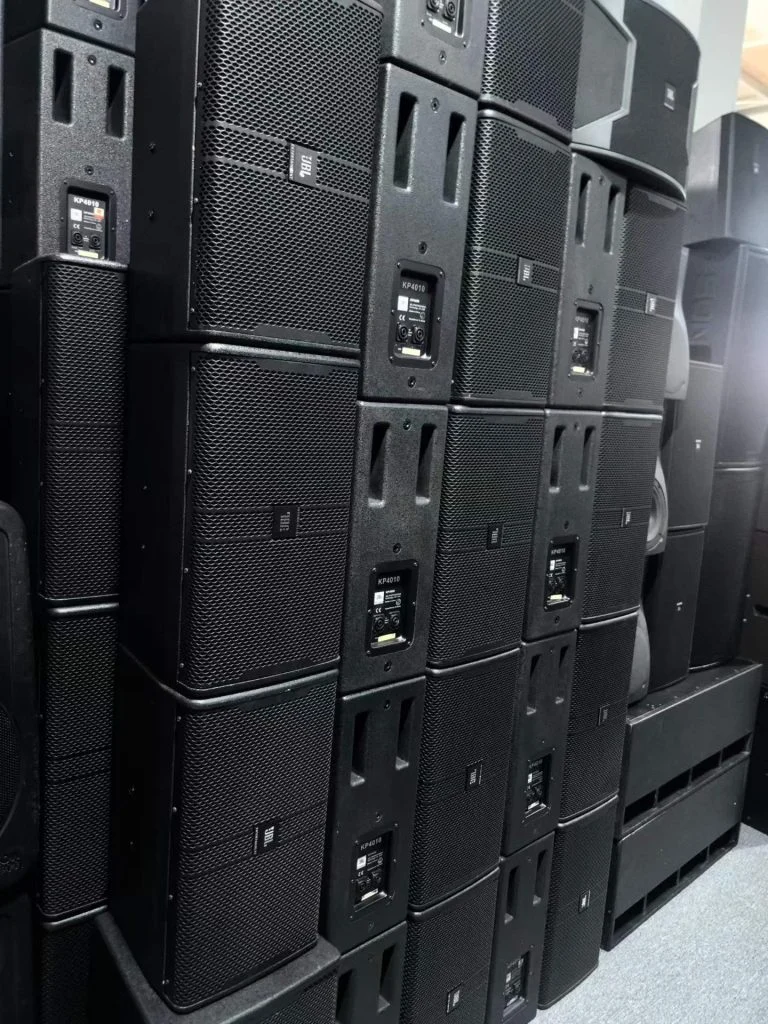
A JBL KP4010 class box paired with a decent 350 W per channel amp will do this all night without stress. Push it to 105 dB at the back and the compression driver dies.
When do you genuinely need a bigger box?
| Event type | 10-inch pair OK? | Why |
|---|---|---|
| Wedding ceremony, speeches | Yes | Peaks at 95 dB, mostly speech |
| Acoustic trio | Yes | Guitar and vocals sit above 150 Hz |
| Conference and panels | Yes | Speech clarity beats level |
| DJ party, 150 people | No | Needs 100 dB+ down to 45 Hz |
| Live band with drums | No | Kick and bass demand cone area |
| Outdoor party | No | No room gain, more distance |
What is the minimum system for a 150-guest DJ set?
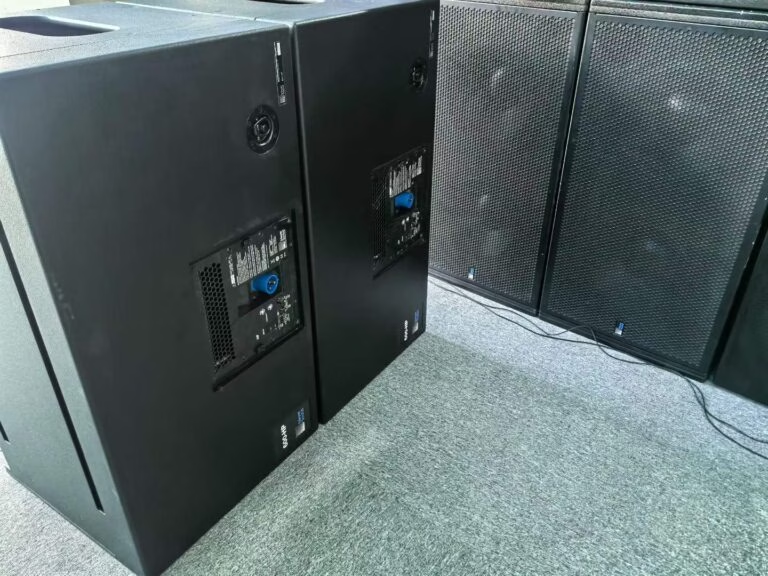
Two 12-inch tops over two 18-inch subs, or four 10-inch tops plus two subs. The second option works and costs less. Run the 10s high-passed at 120 Hz, hand everything below to the subs, and you will get the level without cooking the smaller drivers.
If you already own 10-inch boxes, do not replace them. Add subs and keep the 10-inch boxes as tops. That is how a lot of working DJs in Lagos and Nairobi run 150-capacity rooms on a budget.
How much does either route cost used?
- Used pair of 10-inch passive boxes: USD 200-320 tested.
- Used pair of 18-inch active subs: USD 800-1,700.
- Used pair of 12-inch active tops: USD 700-1,400.
- Amplifier and cabling for passive route: USD 300-500.
For a 150-guest room, USD 1,000-1,500 of used gear is a realistic budget. That is a third of what a comparable new system costs, and the results are close enough that most guests cannot tell.
What about the mixing side?
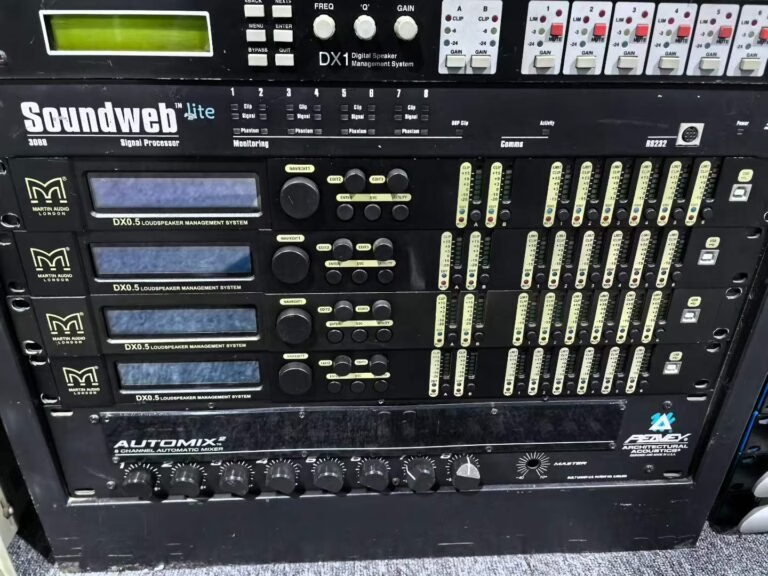
You do not need 48 channels for 150 people. A 16-channel analog desk is fine. If you plan to grow into corporate work, a Yamaha DM1000 is overkill on channel count but useful for its scene recall and matrix outputs. Buy it only if you will use those features.
Key Takeaways
- A tested used pair of 10-inch passive boxes covers 150 guests for speech and acoustic work.
- For DJ or band use, 10-inch tops need subs crossed at 120 Hz.
- A 10-inch cone has roughly 40% of the area of a 15-inch; physics limits bass, not brand.
- Realistic used budget for a 150-guest room: USD 1,000-1,500.