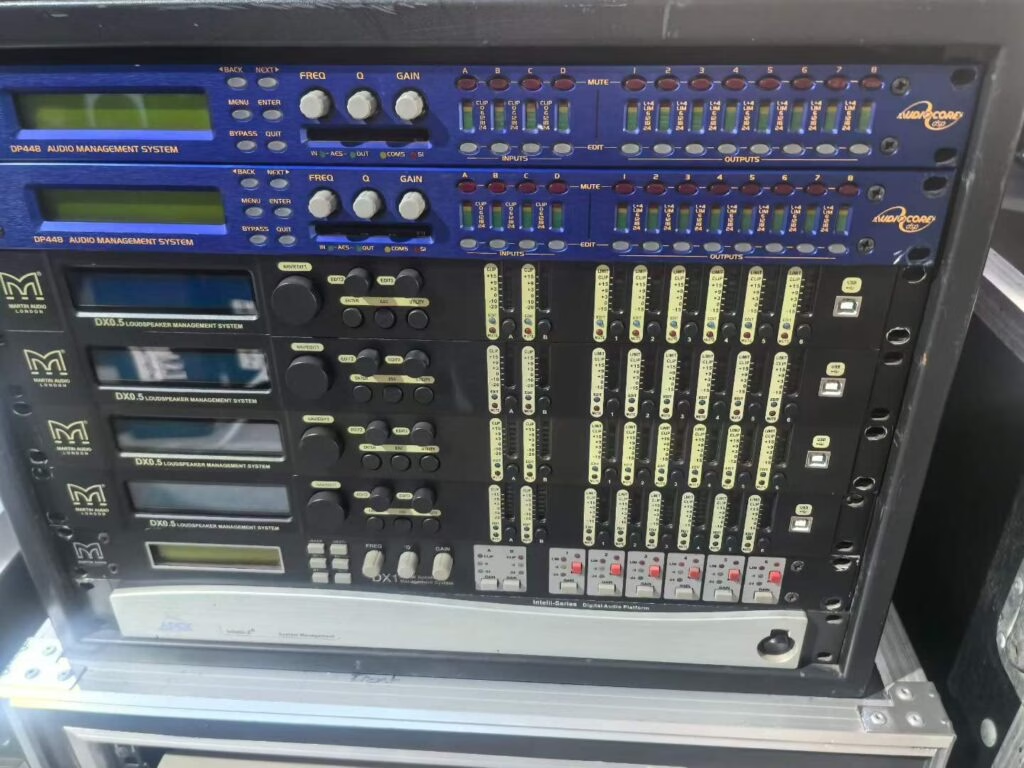
Description
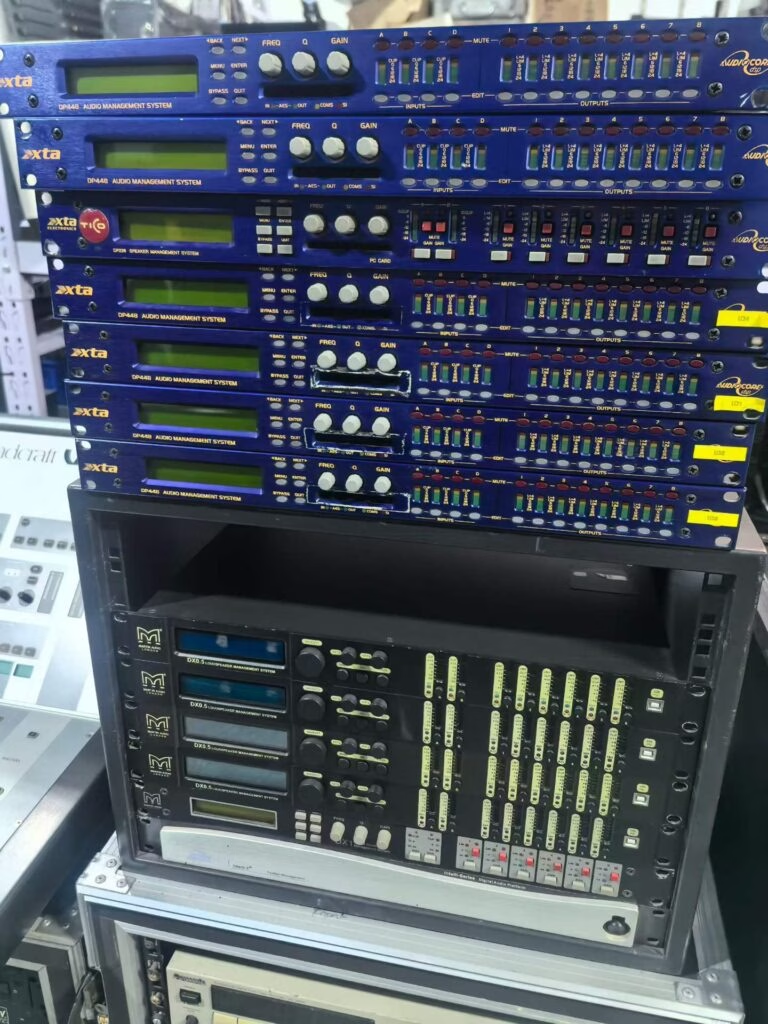
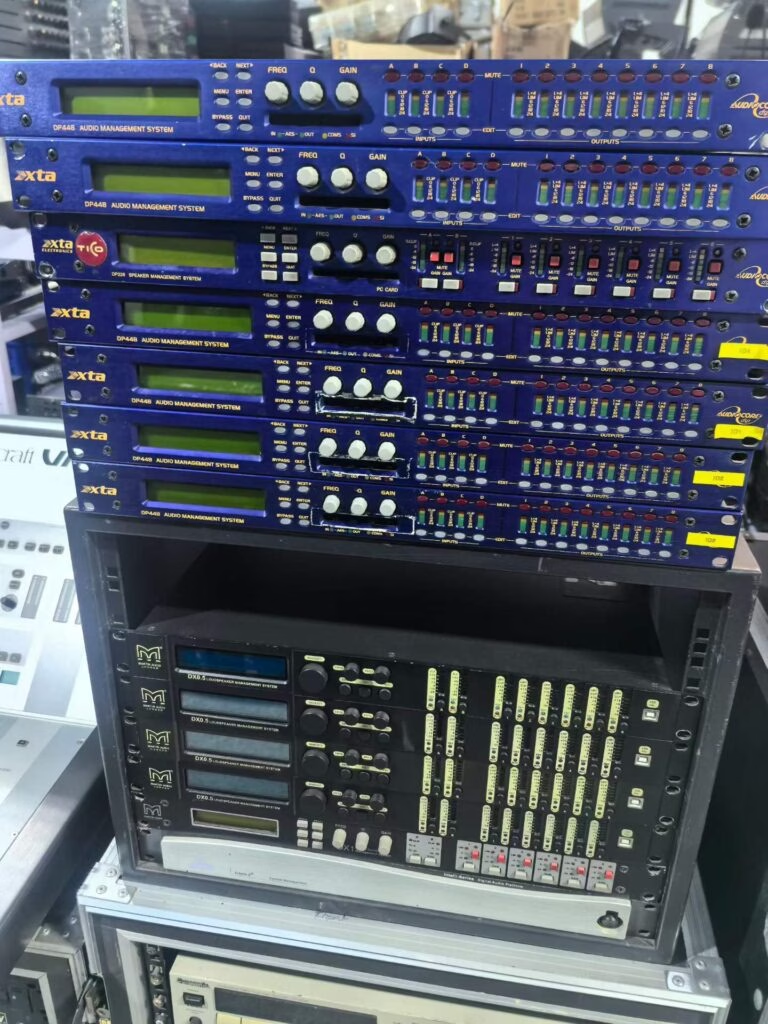
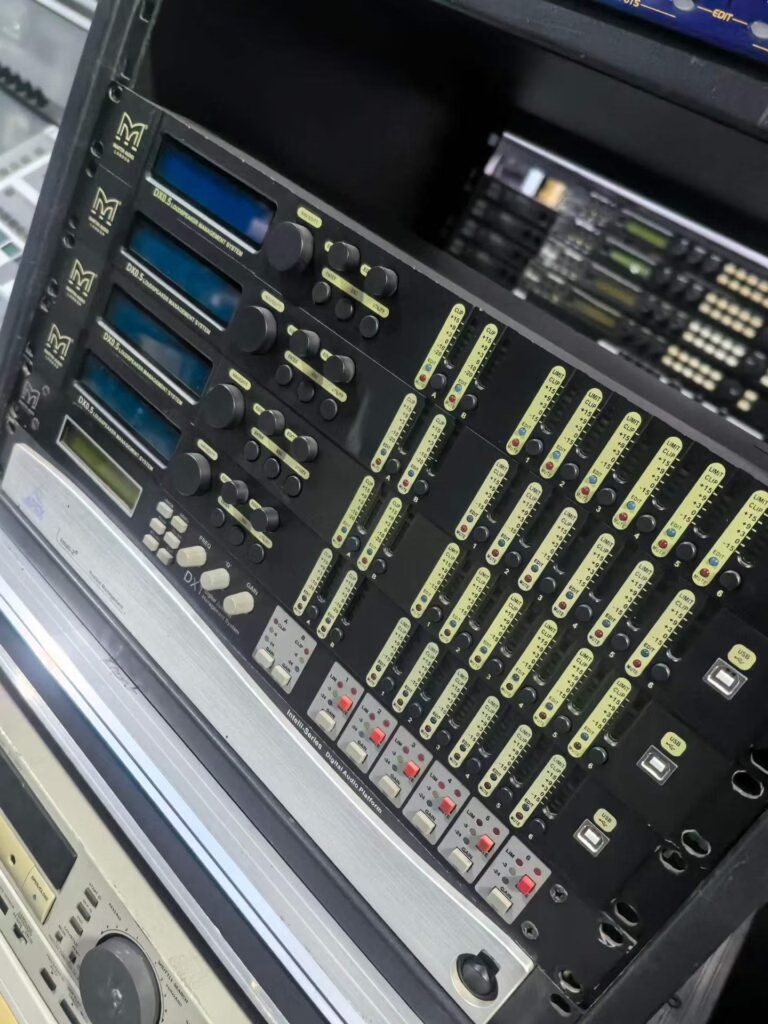
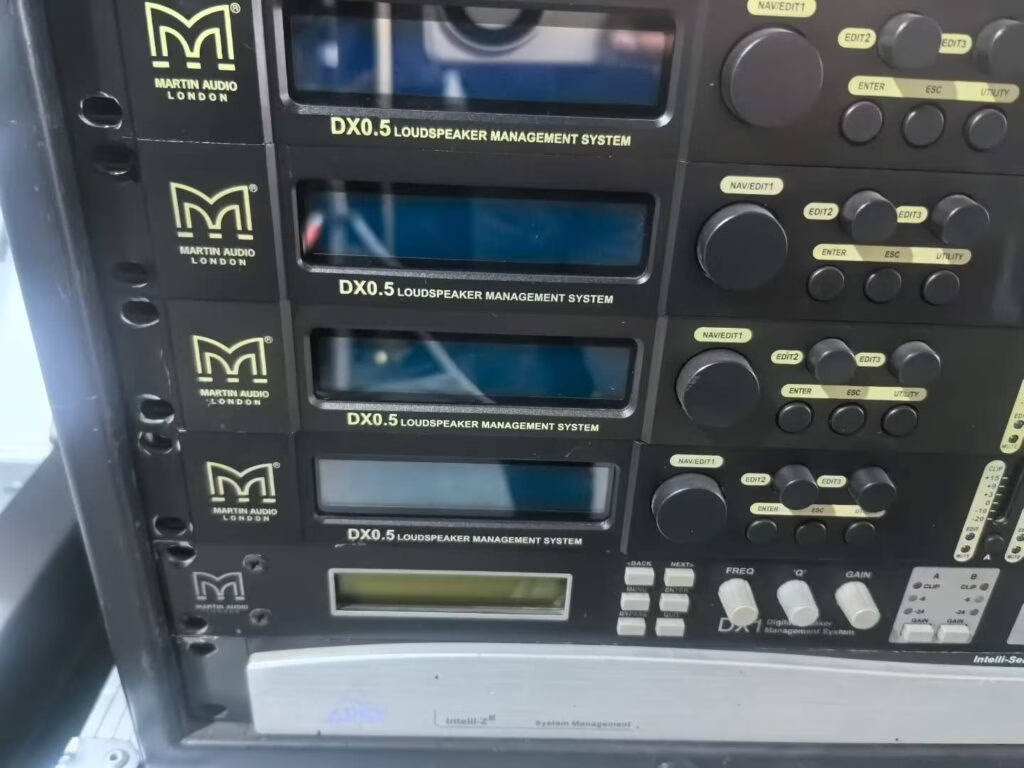
The short answer: Martin Audio DX0.5 loudspeaker management processors, in stock, price on request. Each unit is 2-in / 6-out, 24-bit AKM conversion at 96 kHz with 120 dB dynamic range, five bands of parametric EQ on the inputs and seven on every output, plus limiters and up to 600 ms of delay per channel. This is the processor Martin designed to sit in front of its own line array and point-source systems.
What is the DX0.5, in plain terms?
It is the box between the console and the amplifiers. You feed it a left and right mix, and it hands back six individually shaped outputs — typically left, right, subs, front fills, delays and a spare — each one with its own crossover, EQ, level, delay and limiter. Without a unit like this, none of that shaping happens and you are sending a full-range signal into a subwoofer.
The DX0.5 is a 1U, 19-inch rack unit and it belongs to the same generation of Martin Audio processing as the rest of the DX series. If you have ever looked at the back of an installed Martin system and found a black processor with a pair of XLR inputs and a row of outputs, it was probably one of these.
What are the actual specifications?
These are the numbers that matter for system design, and they are the ones to quote when you are sizing a rack:
| Parameter | DX0.5 |
|---|---|
| Channels | 2 in / 6 out |
| Conversion | 24-bit AKM A/D and D/A |
| Sampling rate | 96 kHz |
| Dynamic range | 120 dB |
| Input EQ | 5-band parametric |
| Output EQ | 7-band parametric per output |
| Crossovers | High-pass and low-pass per output |
| Delay | Up to 600 ms per channel, independently set |
| Protection | Output limiter per channel |
| Format | 1U, 19-inch rack |
The 600 ms delay figure is the one worth pausing on. Six hundred milliseconds is roughly 200 metres of sound travel. No delay speaker in a real venue needs anything close to that — a delay ring 40 metres back needs about 120 ms. The headroom exists because the DX0.5 is also used for drive-unit alignment in large arrays, where you are trimming fractions of a millisecond between a high pack and a low pack, and the total budget has to accommodate everything chained together.
Why 96 kHz and 120 dB rather than 48 kHz?
Because the DX0.5 was built to sit in front of Martin’s larger systems, and there is a practical argument for the higher sample rate. At 96 kHz the anti-aliasing and reconstruction filters can be gentle and placed well above the audio band, which means less phase shift near 20 kHz. On a line array with a 1.4-inch compression driver crossing at 1.2 kHz and running to 18 kHz, that phase behaviour is audible as the difference between a system that images and one that sounds slightly smeared at the top.
The 120 dB dynamic range is a conversion-stage figure, not a system figure — once you add the amplifiers and the room, your real-world noise floor is set by the noisiest link. But a quiet converter means you are not adding hiss at the front of the chain, and in an installed system running 14 hours a day that is worth something.
How does the DX0.5 behave as a Martin-specific processor?
This is the part that makes the DX0.5 more than a generic crossover. It carries factory presets for Martin Audio loudspeaker systems, so if you are driving a Blackline, AQ, WPM or similar box, the crossover points, EQ curves, limiter thresholds and driver alignment are already in the unit and selected by name rather than typed in by hand.
That matters more than it sounds. A generic processor can be made to sound identical, but only by someone who has the measurement gear, the time and Martin’s own alignment data. Buying the DX0.5 means that work is already done, and it stays done if somebody factory-resets the unit at two in the morning.
How many outputs do I actually need?
Six outputs covers the majority of real rooms, and it is worth walking through a typical allocation so you can see whether it fits yours:
- Outputs 1 and 2 — main left and right, full range or crossed to subs.
- Output 3 — subwoofers, with its own low-pass and a limiter set for the cabinet.
- Outputs 4 and 5 — front fills and a delay ring, each with its own alignment delay.
- Output 6 — monitors, a foyer feed, or a spare kept configured but muted.
If you need a stereo three-way main plus subs plus fills plus delays, that is eight outputs and you need two units or a larger processor. If you are running a club, a church, a conference room or a small-to-mid theatre, six is usually enough and one spare output is a luxury rather than a limitation.
What should I check before buying used?
A used processor is mostly a question of whether the conversion and the memory are healthy. These are the checks worth making, and they are the ones we can run on request:
- Power-up and display. The front panel should light, show the boot sequence and settle on a preset name rather than a fault or a blank screen.
- Preset retention. Power the unit down for an hour and back up; the stored configuration should survive. A unit that forgets its presets has a failing memory battery.
- Every output alive. Feed a known signal into input 1 and confirm audio at all six outputs, one at a time, muted and unmuted.
- Encoder and buttons. Menu encoders that skip or double-step make a unit painful to use on site even though the audio is fine.
- XLR connectors. Look for bent pins and for any that feel loose; these are through-panel connectors and they take abuse in a rack.
We have not performed a full frequency-response sweep on these units. If you need sweep data, a per-output level check or photos of the rear panel and serial labels before you commit, tell us and we will run those tests and send the results.
What does the DX0.5 make sense for in 2026?
Newer processors have web interfaces, Ethernet control and remote monitoring. The DX0.5 has none of that, and for an installed venue where the system is tuned once and left alone, that is not a drawback. What it does have is Martin’s alignment data inside it, a converter stage that is still competitive, and a front panel a local technician can operate without a laptop or a software licence.
The economics are straightforward. One current-generation processor costs more than a pair of these, and a pair of these covers a stereo three-way system with room to spare. If your amplifiers are already Martin-matched and your cabinets are Martin, this is the cheapest route to a correctly aligned system.
If you are building out a rack rather than replacing one processor, it is worth looking at what else we have in stock — we carry matched PA systems and power amplifiers, and we can quote processing, amplification and cabinets together as a single shipment rather than three separate orders.
Availability and how to ask about these units
These DX0.5 units are in stock now, in black, priced on request. Multiple units are available, so if you need two or three for a rack we can quote them together. We ship worldwide from China and we can consolidate with amplifiers, cabinets or cabling from the same warehouse.
Tell us how many units you need, where they are going, and which Martin cabinets they will be driving. If you have a specific preset requirement or you need the units configured before they ship, say so and we will confirm what is possible. Photos of the actual units in stock, rear panels included, are available on request.