Used studio monitors are usually the better buy — a $1,200 pair of active nearfields costs $450–$650 second-hand and sounds identical if the drivers are original. What matters is not the brand badge: it is driver originality, cabinet seal, and whether both amps still deliver equal output at the same gain setting.
Buying new guarantees a warranty. Buying used gets you 50% more speaker for the same money. For a project studio, that trade is usually right.
What actually matters in a used monitor?
- Driver originality — mismatched replacements kill stereo imaging and resale value.
- Cabinet seal — a loosened back panel or a cracked port makes bass boomy and vague.
- Amplifier balance — play mono pink noise; both speakers should hit the same SPL at the same gain.
- Cone condition — foam surrounds rot in 10–15 years; check for cracks with a torch.
- Inductor hum — a quiet buzz with no signal means a failing filter capacitor.
Why is driver originality the big one?
A reconed driver in a studio monitor is not always a bad outcome, but it must be a matching part. Two different replacement woofers in a pair will image differently and you will chase phantom problems in your mixes. Ask for a photo of both drivers, front and back, and compare part numbers.
Used vs new: what do you actually gain?
| New | Used (Excellent) | |
|---|---|---|
| Price for a 6–7 inch active pair | $900–$1,400 | $400–$700 |
| Warranty | 2–3 years | None or 30–90 days dealer |
| Resale after 2 years | -40% | -10% |
| Risk of driver mismatch | None | Real, check part numbers |
| Break-in time | 40–80 hours needed | Already done |
That last row is a real benefit. Speakers do change character over the first 50 hours of use, and a used pair is already settled. Mixes translate slightly better on the first day.
Which used monitors are safe bets?
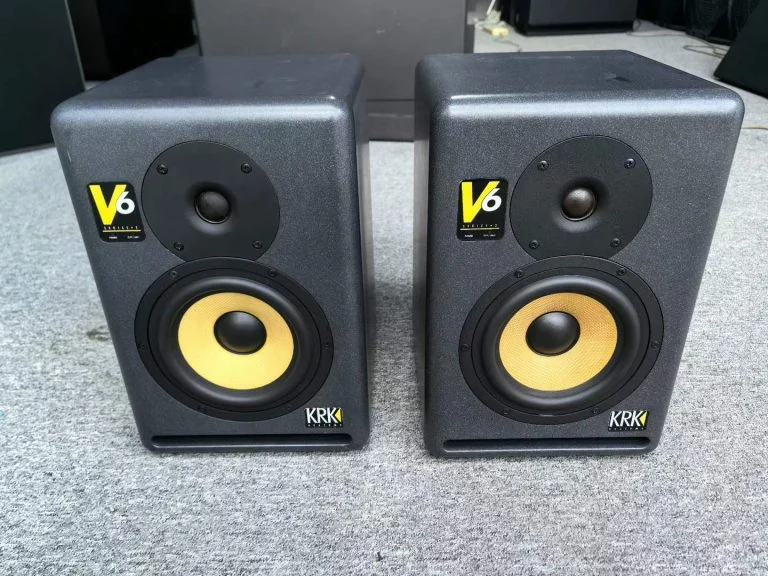
Look for a brand with a long production run and accessible spare parts. The KRK V6 Series 3 active studio monitor pair is a reasonable example: 6-inch Kevlar woofers, long production run, and drivers still available. Small two-way actives with sealed amps and no DSP screens tend to outlast monitors with onboard processing.
What about cheap used monitors from classifieds?
Two traps. First, home-theatre speakers sold as ‘studio monitors’ — they are tuned for a smiley curve and will not translate. Second, monitors sold without their power transformers for 110 V markets being used on 220 V. Check the voltage label on the rear panel before you buy, not after it fails.
How do you test a used pair in 10 minutes?
- Play mono pink noise through both, one at a time, at the same gain.
- Sweep 40 Hz to 16 kHz and listen for buzz at specific frequencies.
- Put your ear within 10 cm of each tweeter and compare hiss levels.
- Press gently on the woofer cone — no scraping means the voice coil is centred.
- Check that both cabinets sit flat and the ports are free of foam or tape.
More tested pairs are listed in our studio gear category. Each listing records a mono pink-noise test on both units, so you know the pair matches before it ships.
Key Takeaways
- Used studio monitors give 50% more speaker for the same money with no sound penalty.
- Driver originality matters most — mismatched replacements ruin imaging.
- A used pair is already broken in over its first 40–80 hours of use.
- Test with mono pink noise at matched gain and compare hiss at 10 cm.
- Check the voltage label; 110 V units on 220 V mains fail silently.