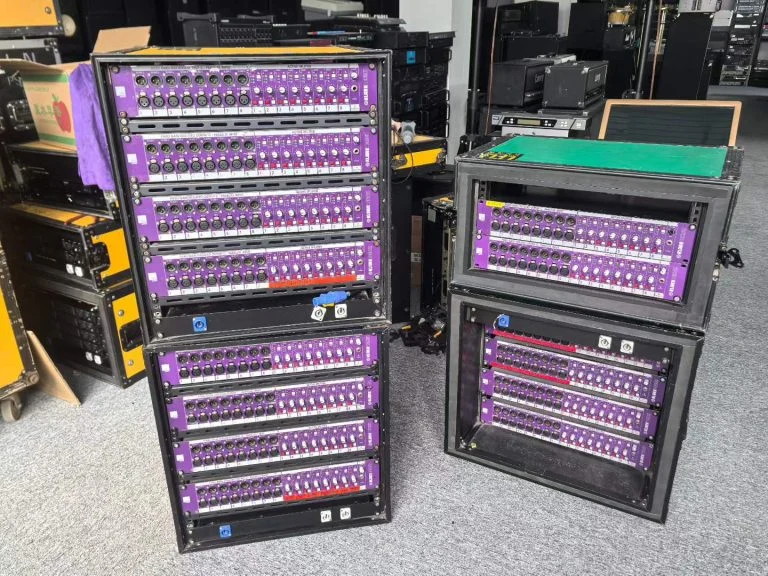
You probably do not need 48 preamps but you want the routing. A 1,000-capacity club with a house band plus support acts usually runs 32-40 live inputs, and a 48-channel stage rack lets you keep the analogue snake under 5 metres, split signals to front-of-house and monitors, and carry a broadcast or recording feed without repatching.
What does a real club input list look like?
For a four-piece band with a guest: drums 8-10 channels, bass 1-2, guitars 4-6, keys 2-4, vocals 4-6, playback 2, talkback and ambient 2. That is 23-31 before you add a support act or a horn section. Add monitors and a second console split and you are at 40 fast.
A 32-channel system works until the night a band brings their own engineer with a 16-channel playback rig. Then it does not.
Why MADI instead of analogue?
- One cable, 64 channels. A single coax or fibre carries the whole rack, so the run from stage to FOH is one thin cable instead of a 30-metre, 25kg analogue multicore.
- Cleaner splits. Digital split to a second desk is a copy of the same samples, not a passive transformer split with level loss.
- Cheaper cable. A 100m fibre run is around $150 against $900-1,500 for a 32-way analogue snake of the same length.
- Remote gain. Once the preamp gain is set at the rack, you adjust it from the console without walking to the stage.
The trade-off is that the rack becomes a single point of failure. If the rack power supply dies, you lose everything. Budget for a redundant PSU, which is why touring racks are built with two.
What does a used 48-channel rack cost?
A used 48-channel MADI stage rack from a touring inventory runs $4,000-9,000 depending on brand and condition, against $12,000-25,000 new. Add $400-800 for a proper tour case if it does not come with one. A DiGiCo MADI Rack with 48 channels is the kind of unit that shows up in these sales: it is designed for touring, it racks in 8U, and the preamps are the same ones used on DiGiCo consoles, so the gain staging is predictable.
What should you check before buying a stage rack?
- Every preamp, one at a time. Plug a mic into each channel and check for noise, gain range and phantom power on all 48. This takes an hour; budget for it.
- Both MADI ports. Primary and redundant. Half of the used racks on the market have one dead port.
- Power supply redundancy. Two supplies fitted and both tested, not one supply and a blanking plate.
- Fan noise. A rack that lives on stage needs quiet fans; a loudly humming rack is a problem for acoustic sets.
Is 32 channels enough instead?
For a 400-600 capacity venue with mostly DJ and small band nights, yes. A 32-channel rack saves $1,500-3,000 and takes less rack space. The 48-channel case really starts at venues that host touring acts with their own engineers, and those engineers will ask for 48 before they ask for anything else.
Key Takeaways
- A 1,000-capacity club uses 32-40 live inputs, so 48 channels is headroom, not waste.
- MADI puts 64 channels on one cable and makes digital splits clean and lossless.
- Used 48-channel MADI racks cost $4,000-9,000; new is $12,000-25,000.
- Test all 48 preamps and both MADI ports; dead redundant ports are common.
- Under 600 capacity, 32 channels is usually enough.