Passive speakers are the safest used purchase in professional audio and the numbers back it up. A used 15-inch passive full-range pair sells for $180-350 against $700-1,200 new, and the only electronics involved are the crossover, which is a handful of capacitors and a coil. Compare that with a powered box where a failed amp module can cost 40% of the purchase price to replace.
What actually fails in a passive speaker?
- Crossovers. Electrolytic capacitors in the crossover drift after 15-20 years, which shifts the crossover point and makes the top end dull. A cap kit is $20-40 and an afternoon.
- Diaphragms. Compression driver diaphragms fatigue with hard use. Replacements run $40-90 on common 1-inch drivers.
- Surrounds. Foam surrounds perish; most pro woofers use treated cloth or rubber and last decades.
- Connectors. SpeakON sockets wear out from repeated patching. $6 each.
Notice what is missing: there is no power supply, no DSP, no firmware, and no class-D module. That is why a passive speaker from 2005 can still be a working tool in 2026 while a powered speaker from 2013 is scrap.
How do you inspect one properly?
Push the cone gently with two fingers at opposite points and listen for scraping. A scratchy feel means the voice coil is rubbing, and that is a re-cone. Then use a multimeter on the terminals: a healthy 8-ohm driver reads 6.2-7.2 ohms DC. Open circuit or a reading under 4 ohms means a problem.
Then play music through it at moderate level and put your ear close to the horn at low volume. A rattle or buzz at low level is a loose diaphragm or a fatigued glue joint on the horn. That noise gets worse at high SPL, not better.
What should you pay?
| Model type | New pair | Used fair price |
|---|---|---|
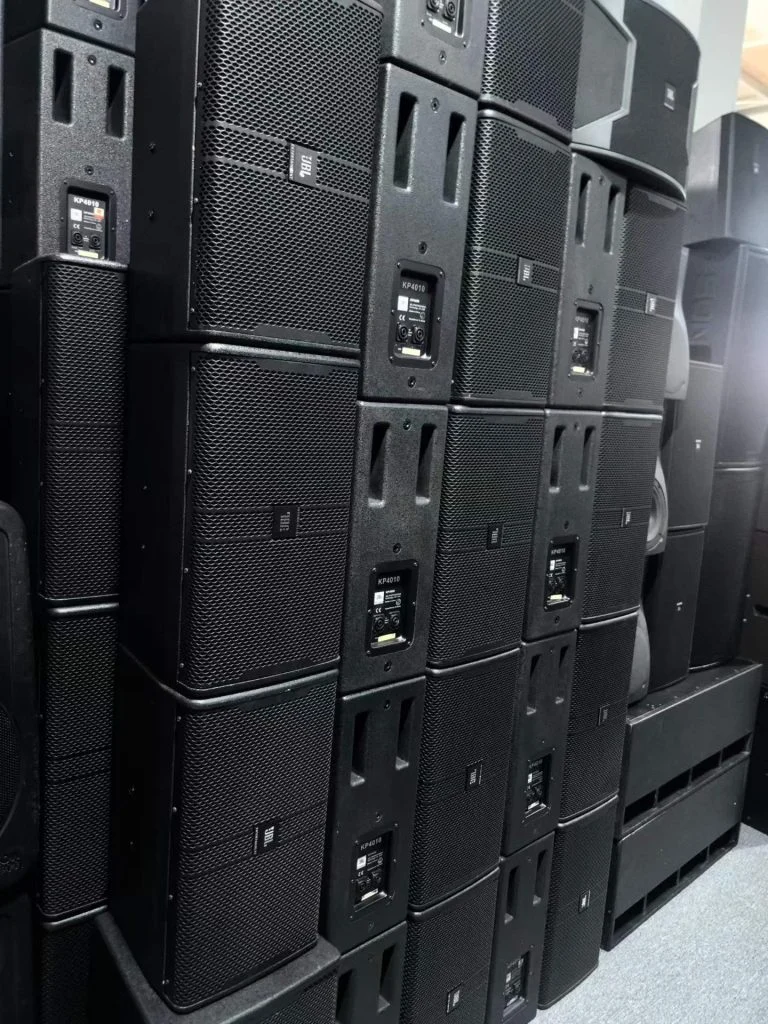
| 10-inch passive (JBL KP4010 class) | $700-1,000 | $180-320 |
| 12-inch passive two-way | $900-1,400 | $240-420 |
| 15-inch passive full-range | $1,000-1,600 | $280-500 |
| Line array element | $2,000-4,000 | $600-1,400 |
We list a JBL KP4010 passive 10-inch bulk lot for buyers who need volume rather than a pair. These are workhorse boxes: 10-inch woofer, 1-inch compression driver, plywood cabinet, SpeakON in and through. Nothing exotic and nothing hard to repair.
Do you still need to budget for amps?
Yes, and this is where passive setups get misunderstood. A passive speaker at $300 needs $400-800 of amplification to drive it properly, plus speaker cable. The total is often close to a powered speaker of the same output, so the saving is really about serviceability rather than sticker price.
Where passive wins decisively is redundancy. If one amplifier channel dies in a rack, you swap an amp and the show continues. If one powered speaker module dies on stage, that speaker is gone for the night, and a replacement module can take weeks.
Which brands hold up best second-hand?
JBL, Peavey, EV and RCF build cabinets that survive decades, and their driver parts are still available. Small boutique brands with proprietary drivers are the risk: a blown driver in an unknown brand is often unrepairable because no one stocks the replacement.
Ask one question before buying any passive speaker: can I buy a replacement diaphragm and a replacement woofer for this model today? If the answer involves hunting forums, price it as a disposable.
Key Takeaways
- Passive speakers are the safest used buy: no amp module, no DSP, no firmware.
- Used pairs trade at $180-500 depending on size; line array elements at $600-1,400.
- Multimeter test on terminals: 6.2-7.2 ohms means a healthy 8-ohm driver.
- Budget $400-800 of amplification for a $300 passive pair, so the real win is serviceability.
- Check that replacement diaphragms and woofers are still available before buying odd brands.