Description
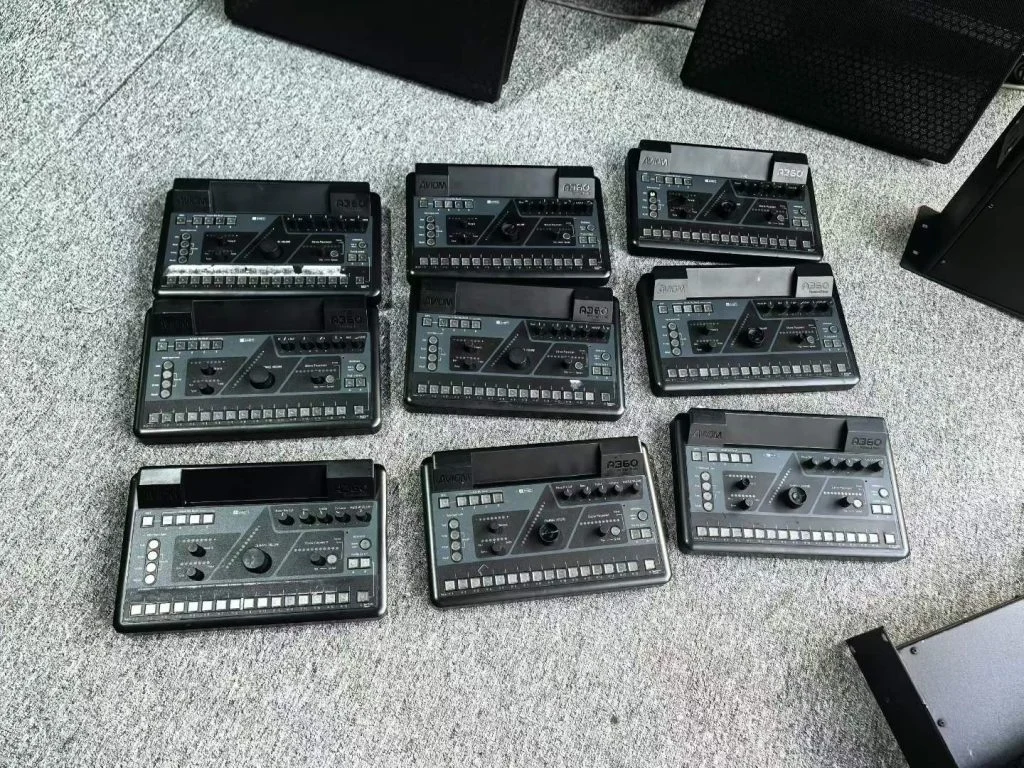
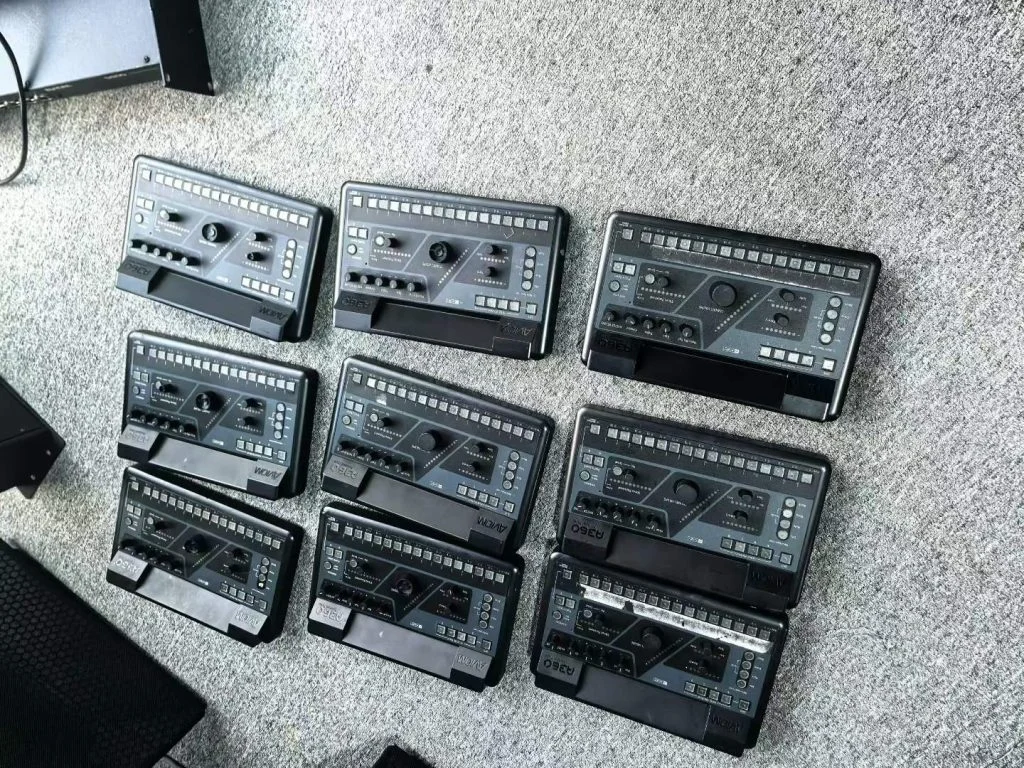
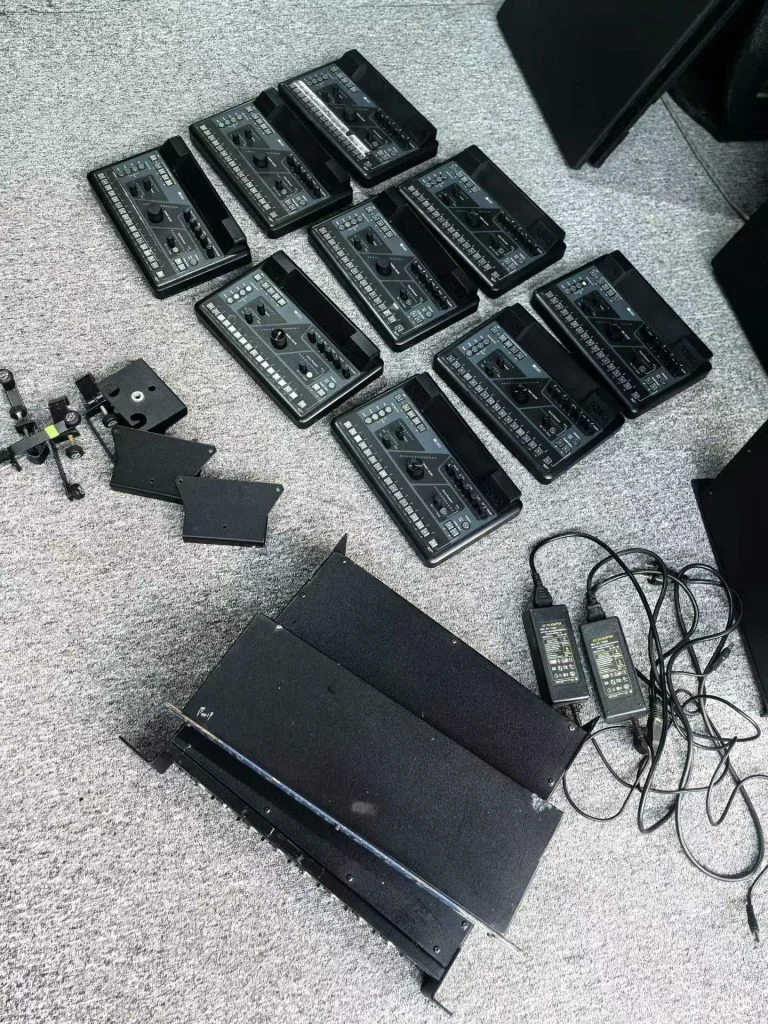
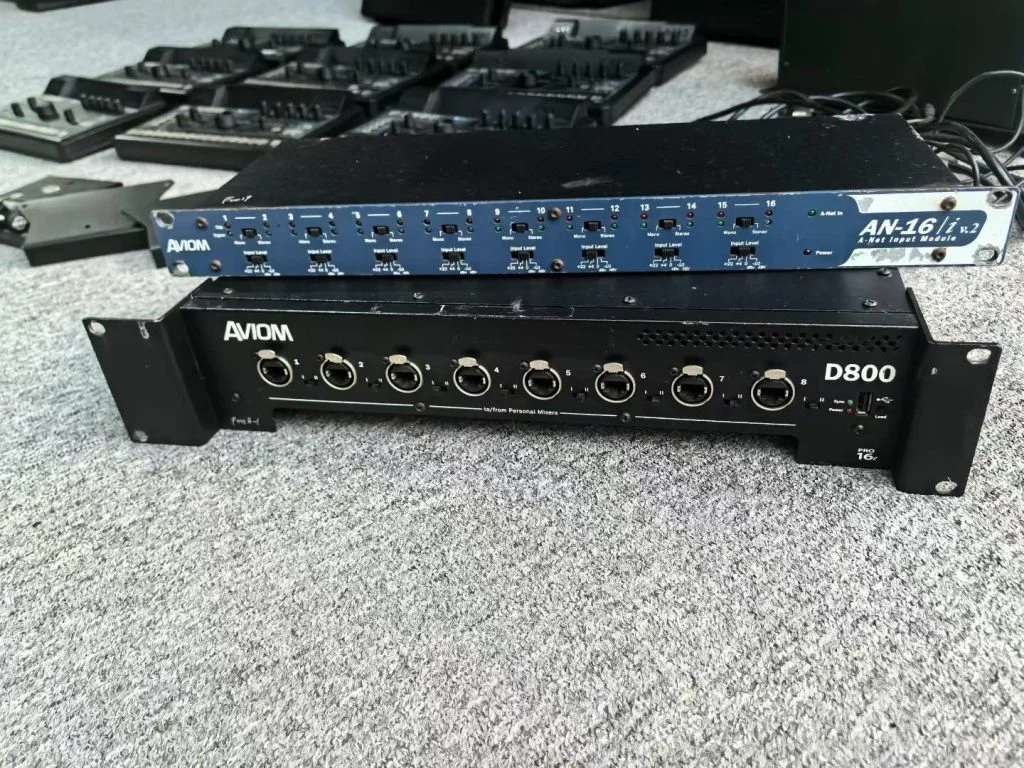
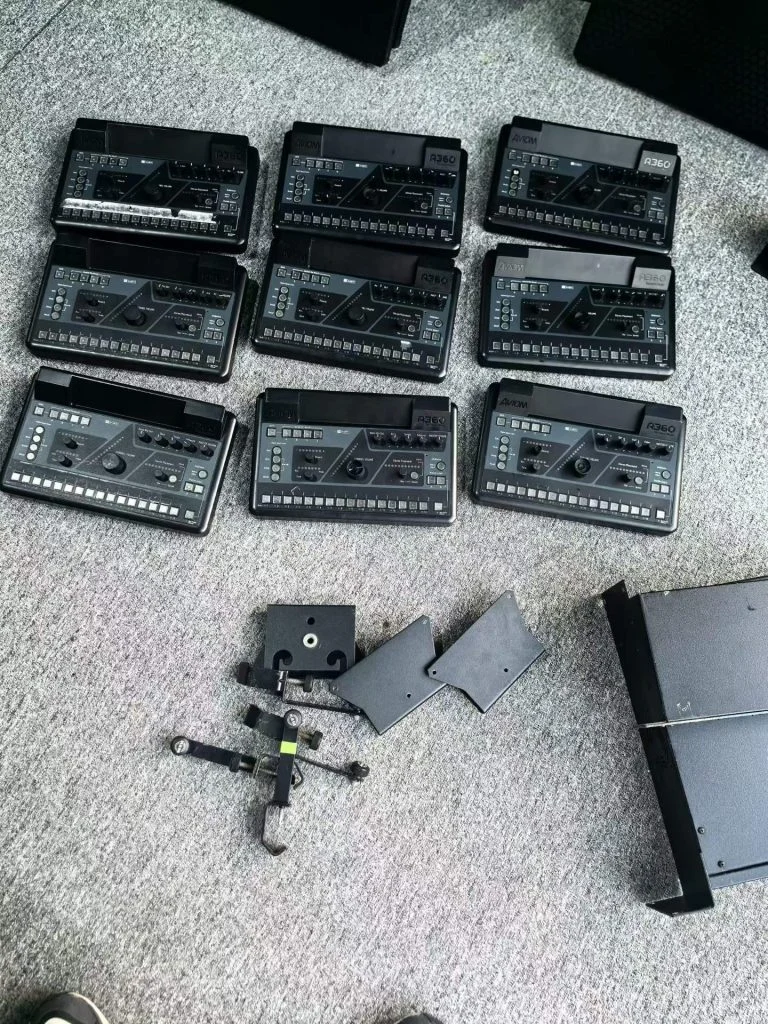
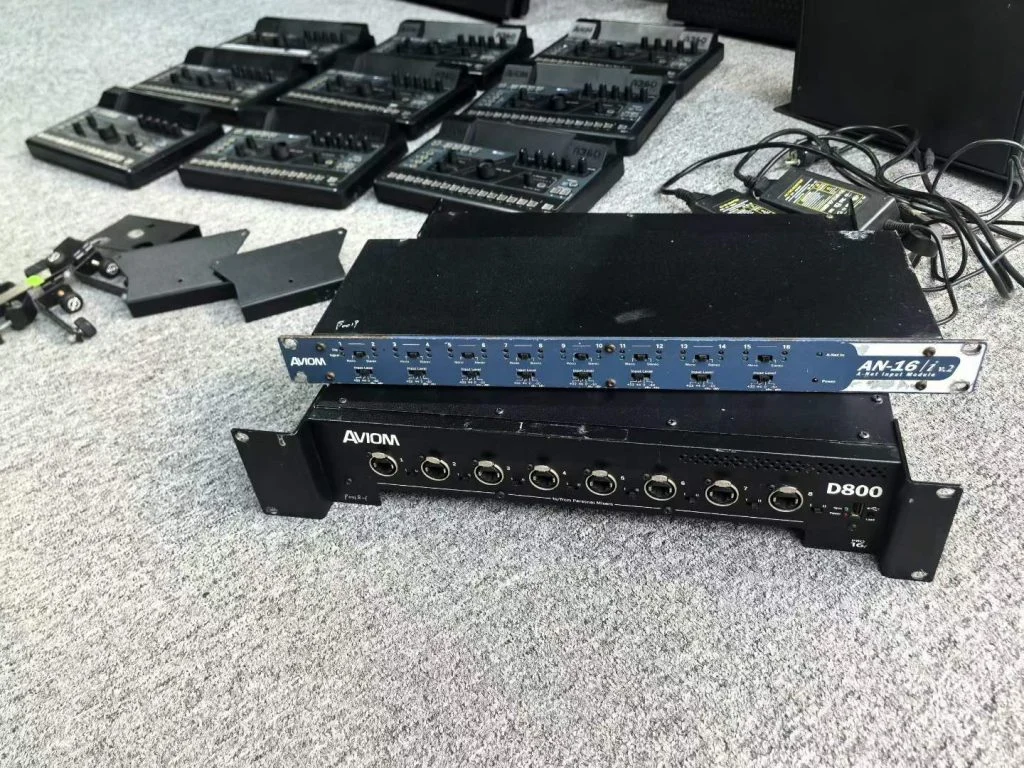
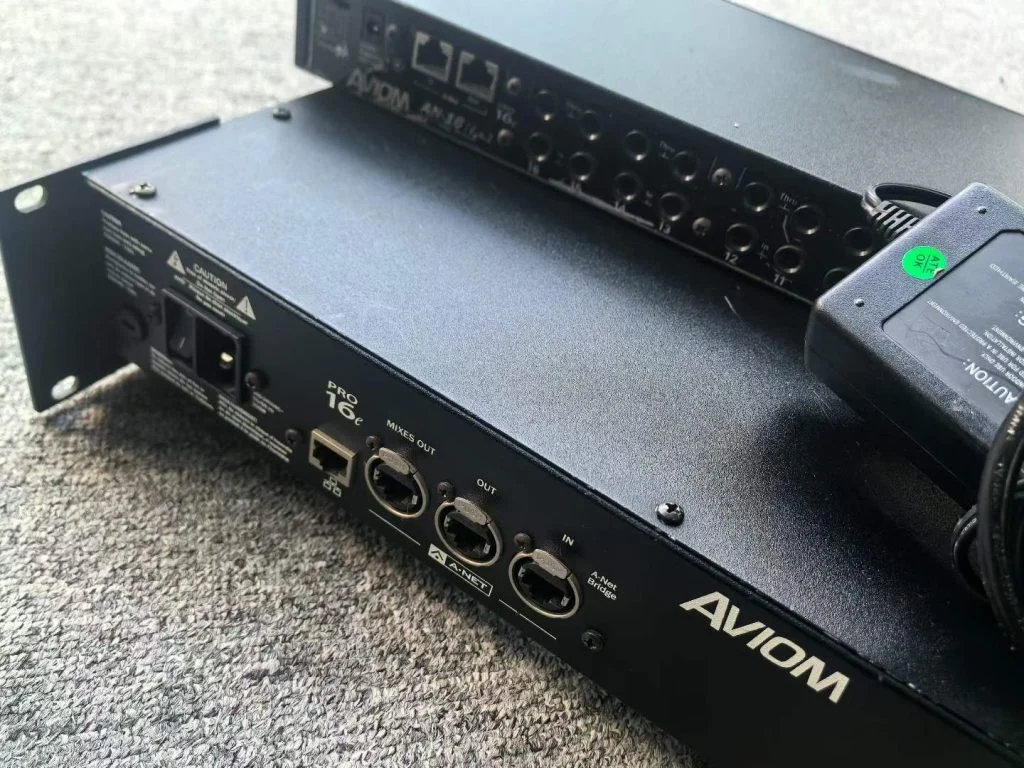
Nine AVIOM A360 Personal Mixers, pulled together with an AN-16/i v.2 input module and a D800 A-Net distributor. This is a working Pro16 personal monitoring rig, not a pile of loose boxes. Nine musicians get their own 36-channel mix engine; you feed the system 16 analog inputs and each player dials in what they actually want to hear. Price is on request because the quantity and the package matter here.
What arrived on the bench
The set came out of a venue that moved to a different monitoring platform. Nine A360 units, all with the same panel layout and the same firmware generation, plus the rack gear that feeds them:
- 9 × AVIOM A360 Personal Mixer — 36-channel mix engine, selectable from up to 64 network sources
- 1 × AVIOM AN-16/i v.2 A-Net Input Module — 16 analog inputs, switchable +22/+4/0/-10 input level, mono or stereo per pair
- 1 × AVIOM D800 A-Net Distributor — eight powered A-Net outputs, one Pro16e input, A-Net Bridge support
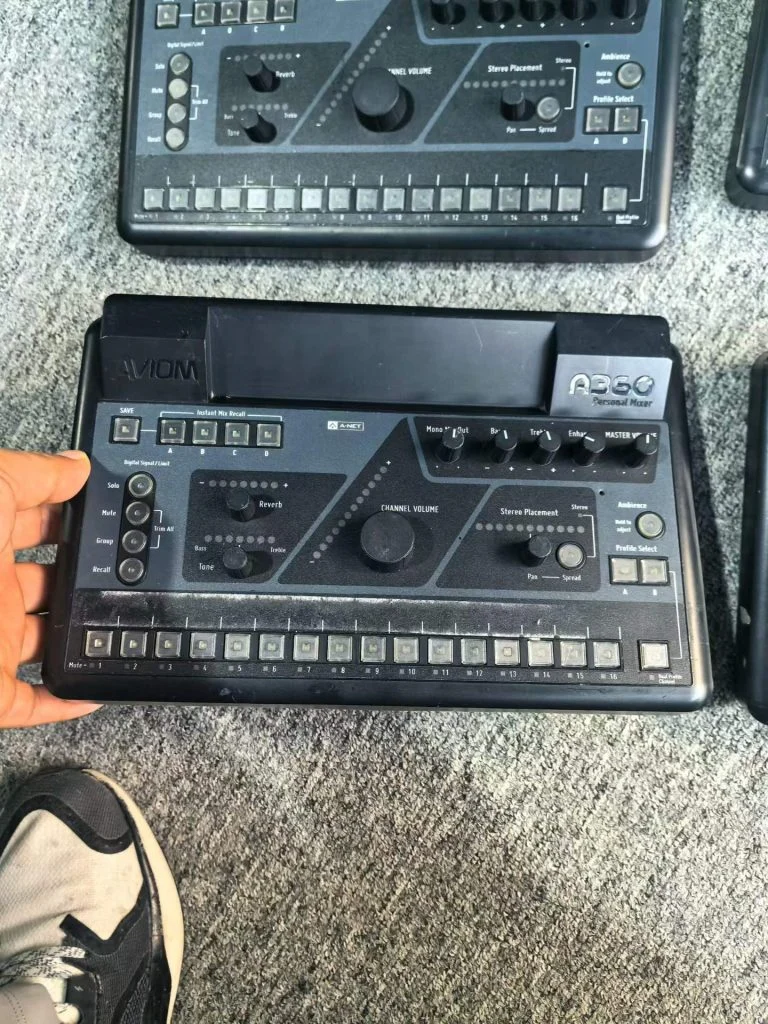
The A360 mixers show the usual handling: scuffs on the corner where the desktop stand rubs, sticker residue on a couple of bottom panels, and light finger shine around the channel volume knob. Nothing structural. No cracked housings, no pushed-in buttons, no damaged connectors. Two units carry desktop tilt stands; the rest came in without them.
Why the A360 still earns its place on stage
Aviom discontinued the A360 in favour of the A640, and that is exactly why these are interesting. The A360 is the mixer a lot of touring players learned on, and it does the job without a touchscreen or an app in the middle of a show:
- 36-channel mix engine with up to 17 mono or stereo sources plus ambience — a drum channel each, a vocal channel each, still room left
- Per-channel reverb with Size, Time and Tone, so in-ears do not feel like a sealed box
- Stereo Placement with independent pan and spread on stereo sources
- Four Instant Mix Recall presets plus 16 standard presets — one button gets you back to your own mix
- Dual Profile Channel with A/B profiles, so your main channel can be loud-and-bright or quiet-and-dry on a single touch
- Master Bass, Treble and Enhance tuned specifically for in-ear monitors rather than for wedges
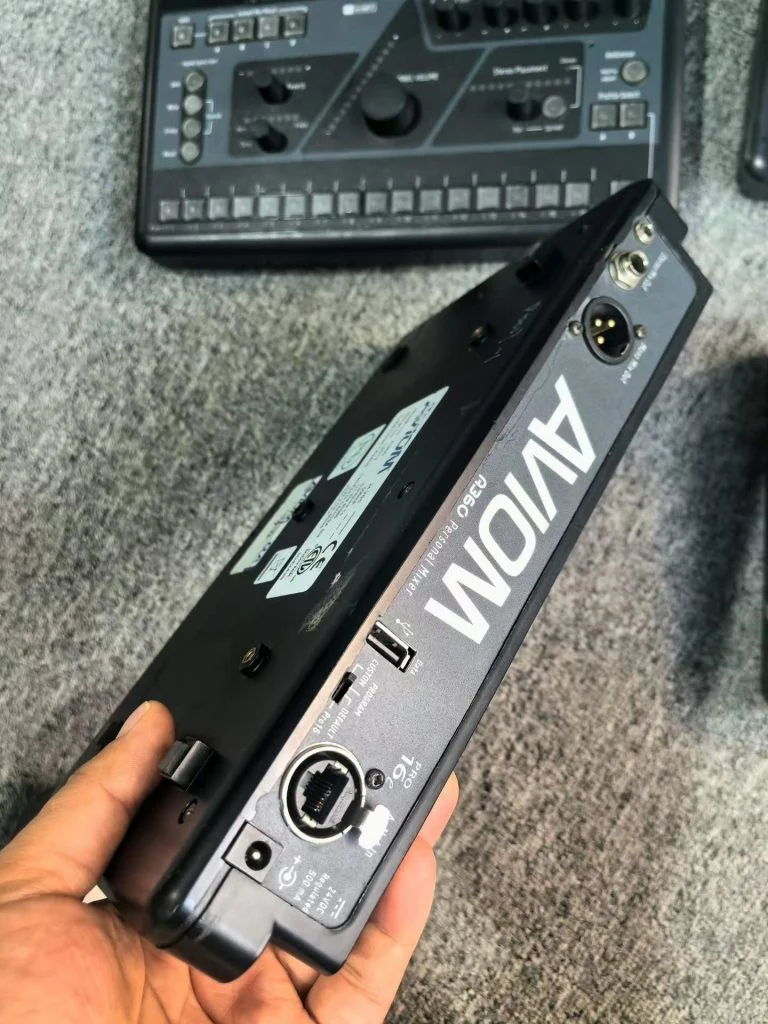
The rear panel gives you a 12 V DC input, a PoE-capable network port, a USB port for loading configuration files, a mic input and a headphone output. That USB port matters: you can build a channel map once in A360 Channel Manager and clone it across the whole band instead of dialling nine mixers by hand.
The rack half of the system
Nine personal mixers need something to feed them and something to distribute power, which is where the AN-16/i v.2 and the D800 come in.
The AN-16/i v.2 takes 16 analog inputs on the front — XLR, with per-input level switching and a mono/stereo choice for each pair — and puts them on the A-Net stream. Kick, snare, hats, bass DI, two guitars, keys L/R, three vocals, talkback and a couple of ambience mics and you are already at 16. If your room needs more than that, you pair it with a second module or feed the system from a console card.
The D800 is the distributor. One Pro16e A-Net input, eight locking RJ45 outputs, each of them carrying audio plus DC power to a personal mixer over Cat-5e, which is why nobody needs nine wall warts on stage. Its Mixes Out port carries the eight stereo mixes back into an AN-16/o for wireless IEM transmitters — the Network Mix Back feature. There is also an Ethernet port on the rear, so musicians can mirror their A360 screen onto an iPad with the free A360 Display app.
Setting it up without buying anything else
A 9-mixer system needs one D800 for power and distribution, and the D800 handles eight mixers directly. For the ninth you run the A-Net Out of the D800 into a second distributor — or drop to eight players and keep one A360 as a spare, which is what most buyers will do. Check whether your budget is better served by eight on stage and one on the shelf; it is an easier sell than a second distributor.
Cabling is Cat-5e or Cat-6 with ethercon shells. Do not use flat patch cables for the mixer runs; the D800 pushes power down those lines and thin conductors get warm. Cable length per mixer run is generous — the system was designed for stage distances, not rack-to-rack.
Compatibility is not a problem. The A360 works with the AN-16/i v.2, with Yamaha Y1 console cards, with partner console cards, and with the D800 and D400 distributors. It also runs alongside A640, A320 and A-16II mixers on the same network, so this set drops into a venue that already has older Aviom hardware in the rack.
What to check before you commit
Channel count first. Count your inputs honestly. Sixteen is enough for a club band, a church with a praise team, or a theatre pit with a click and two tracks. It is not enough for a 40-input festival stage, and in that case you want a console-to-A-Net card instead of an AN-16/i.
Then the player count. Nine A360s is a lot of personal mixers. Bands that run wedges for half the stage do not need nine. If your drummer, bassist and two vocalists are the only ones on in-ears, buy four and keep the rest as spares — A360s hold their value because Aviom keeps the A360 in active service.
Finally the stands. Seven of the nine mixers here ship without a desktop stand. If your players mount theirs on a mic stand or a clamp, that is fine. If they want it tilted on a keyboard rig, budget for the stands separately.
Common questions about this set
Is the A360 still supported now that the A640 exists?
Yes. Aviom lists the A360 as compatible with all current A-Net distributors and input modules, and it can be used simultaneously with A640, A320 and A-16II mixers. Firmware updates come through the USB port. Discontinued is not the same as orphaned.
Can we hear the room on in-ears?
That is what One-Touch Ambience does. The A360 has a built-in ambience mic, and you can also route a pair of room mics into the mix. Either way the player gets audience and room sound without taking the in-ears out.
Do we need the D800 if we only run a few mixers?
You need some distributor, because the personal mixers take their power over the Cat-5 line. The D800 is sized for up to eight. If you buy the whole package and only deploy four mixers, the D800 stays in the rack and you have headroom to grow.
What does “on request” mean on the price?
It means we quote per package. Nine mixers plus a distributor plus an input module is a system sale, and the number depends on whether you take all of it or part of it. Ask and we will send a price for the configuration you want.
Where this system usually ends up
Church stages with a praise team that rotates players. Theatre pits where the drummer needs click and the string players need a quieter mix than the brass. Club residencies where the house rig has been the same for a decade and the engineer is tired of wedges feeding back. Small touring packages where the monitor engineer would rather not mix six in-ear sends by hand every night.
In all of those, the A360 does the same thing: it hands control to the player and takes a job off the engineer. Nine of them plus the rack gear is a complete personal monitoring system, ready to cable up and go.
We have this set in stock at our warehouse. Price on request — message us with the configuration you need and we will come back with a quote and shipping options.