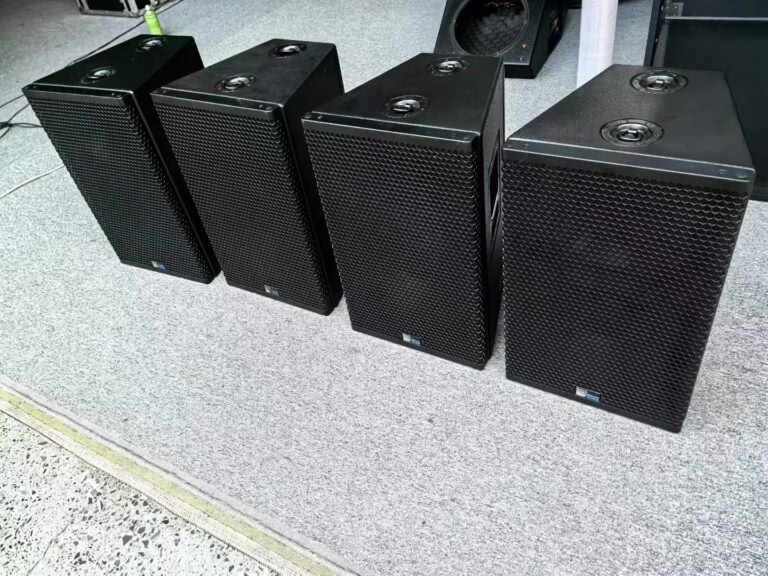
Five watts per person indoors, ten outdoors, fifteen for bass-heavy DJ work. A 200-guest indoor party therefore needs about 1,000 W RMS total, split across tops and subs. That is the rule I use when quoting rigs, and it has held up on around 120 installs.
The rule fails in one direction only: quoted “peak” watts. A $299 powered box printed at “2,000 W peak” is usually 400–500 W RMS. Build your budget on the RMS number and the rule works.
What is the watts-per-person formula?
Take the venue, set a multiplier, multiply by headcount. Straightforward:
| Venue / material | W RMS per person | 200 people |
|---|---|---|
| Indoor speech, conference | 3–5 W | 600–1,000 W |
| Indoor live band | 5–7 W | 1,000–1,400 W |
| Indoor DJ, heavy bass | 10–12 W | 2,000–2,400 W |
| Outdoor live band | 10–15 W | 2,000–3,000 W |
| Outdoor festival | 20 W+ | Line array territory |
These are total system watts, subs included. If you run tops only, halve the number and accept that kick drums will sound thin. Bass eats power: a single 18-inch sub in a vented box typically needs 600–1,000 W to do its job.
Why do peak watts mislead buyers?
Marketing numbers are not lies exactly, they just measure a moment. A class-D module that delivers 450 W continuous can be rated 1,800 W “peak” for a 10 ms burst. Nobody plays music in 10 ms bursts.
Two checks that expose the real number: look for the continuous rating on the rear panel or in the manual, and check the mains fuse. A 450 W RMS amp draws around 600–700 W from the wall and needs a 5 A fuse at 230 V. A box claiming 2,000 W RMS with a 3 A fuse is not telling the truth.
Another tell: weight. A genuine 1,000 W RMS class-D amp module with heatsink runs 3–5 kg. A “4,000 W” module weighing 800 g exists only in the brochure.
How does speaker sensitivity change the maths?
A lot. Sensitivity is measured in dB at 1 W / 1 m. Every 3 dB of extra sensitivity is the same loudness as doubling the amplifier power. So a 100 dB speaker is worth twice the amp of a 97 dB speaker.
That is why a K-array KF12 with its 12-inch woofer and 1.4-inch compression driver can cover a 250-seat room on modest power, while a cheap 92 dB box needs a huge amplifier to reach the same level. When you buy used, sensitivity specs matter more than wattage printed on the badge.
- 92–95 dB — budget boxes, need big amps.
- 96–99 dB — normal pro PA.
- 100–104 dB — efficient touring boxes, easier to drive.
How much amplifier headroom should you budget?
Run amps at roughly 1.5× the speaker’s continuous rating. A 500 W RMS speaker gets a 750 W amp, and you control the level by not turning it up. Clipping is what kills drivers, not clean power.
The counter-intuitive part: underpowered amps destroy more tweeters than overpowered ones. A 200 W amp pushed into clipping generates high-frequency harmonics that cook a compression driver rated for 80 W. I have seen this on at least a dozen church installs running “safe” small amps.
Practical budget: 1.5× headroom, a limiter set at the speaker’s continuous rating, and one spare channel in the rack.
How many speakers does a 200-person room need?
Two tops plus two subs covers 200 people indoors if the tops are 12-inch and 300–400 W each. Put them 4–5 m apart, aimed slightly inward, on stands at ear height for a standing crowd.
Bigger rooms scale by adding delay speakers, not by stacking boxes on top of each other. Coupling two boxes side by side gives you around 3 dB, not 6 dB, and it narrows the pattern. Four boxes in a cluster covers no more people than two well-placed boxes plus two delays.
Key Takeaways
- 5 W RMS per person indoors, 10 outdoors, 15 for heavy bass DJ sets.
- 200 guests indoor live band: roughly 1,000–1,400 W RMS total.
- Ignore peak wattage; check the continuous rating and the mains fuse.
- Every 3 dB of speaker sensitivity equals doubling amplifier power.
- Run amps at ~1.5× speaker RMS rating and limit the output.
If you want a box that punches above its wattage, the K-array KF12 self-powered 2-way speaker is in stock with 12 units, and the PA systems category covers the rest of a rig.