Most of the time, no. China runs on 220-240V at 50Hz, which matches the UK, EU, most of Africa, the Middle East and Australia, so imported Chinese audio gear works directly in all of those. You only need a converter if you are shipping to a 110-127V country such as the US, Canada, Mexico or Japan, and even then only if the gear is not dual-voltage.
The real problem is not voltage, it is Hz. A 50Hz transformer running on 60Hz mains is usually fine. A 60Hz motor running on 50Hz mains runs 17% slow and hot, which is what actually kills turntables and fans.
How do you check what the gear actually needs?
Look at the rear panel label, not the listing. It will say something like 220-240V~ 50/60Hz or 100-240V~. If it says 100-240V, you need nothing at all: switch-mode power supplies handle both and you only swap the plug or use an adapter.
If it says 220V only, a step-up or step-down transformer is needed. For a 500W amplifier you want a 1,000W transformer, because amp modules pull 2-3 times their rated output on transients. Undersizing is the single most common mistake and it produces exactly the fault the buyer was trying to avoid.
What size transformer do you need?
| Gear | Rated draw | Transformer to buy |
|---|---|---|
| Mixer / console | 60-120W | 300W |
| Powered speaker 500W class | 250-400W | 1,000W |
| DJ controller + laptop | 80-150W | 500W |
| Power amplifier 2x800W | 900-1,400W | 3,000W |
Transformers are heavy and annoying. A 1,000W unit weighs 6-9kg and costs $60-120, which on a small order can be more than the freight of a light item. Sometimes the smarter move is buying the 220V version of the same gear.
Is 50Hz on a 60Hz device a problem?
For electronics, rarely. Switch-mode supplies rectify the mains anyway, so a 60Hz-rated console on 50Hz is fine. For anything with an AC motor, it matters. Turntables are the classic case: a 60Hz-rated direct-drive deck on 50Hz mains runs at the wrong speed unless it has a quartz lock, which is why the Technics SL-1200 needed separate 50Hz and 60Hz versions.
Fans are the other one. A 60Hz-rated fan on 50Hz mains spins 17% slower, which drops cooling and shortens the life of whatever it is cooling. On a hot amp module that matters more than you would think.
What about plug types?
China uses type I and type A sockets, and most export units ship with a bare wire or a Chinese plug. Plan on replacing plugs at destination, or ask for the destination plug during packing. It takes ten minutes with a screwdriver and costs $2-4 per unit.
Do not use travel adapters as a permanent solution. They are rated for 10A at best and they loosen. A venue running eight speakers on eight travel adapters is asking for one of them to arc at 2am.
Does the destination country change certification?
Yes, and it is easy to forget. The EU wants CE marking on the product, not just the power supply. The UK wants UKCA. The US wants FCC for anything with a digital board, which covers most modern consoles. Nigeria’s SONCAP and Kenya’s KEBS both add a pre-shipment inspection at $300-600 per consignment.
Gear that was sold only in the Chinese domestic market often has no CE file. That is not a voltage issue and no transformer fixes it. Check whether the seller can supply a declaration of conformity before you commit to a market that requires one.
Can you convert a 110V unit instead of buying a transformer?
On some gear, yes. A surprising number of power amps and powered speakers have a dual-primary mains transformer inside, and moving two wires rewires it for 230V. The rear label is printed at the factory for one market, so the label lies about what the hardware can do.
That is worth asking about for anything over $300, but do not attempt it without a service manual or a tech who has done it before. Mains wiring mistakes are not recoverable, and no used-gear discount justifies the risk. Ask the seller: is the mains transformer dual-primary, and can you photograph the terminal block?
What does a bad transformer do to audio gear?
Undersized transformers sag under load, and the symptom is not a clean failure. The amp clips earlier, bass loses authority, and the module runs hotter than it should. Owners then blame the speaker. I have seen a 500W powered top fed from a 300W converter and the owner was convinced the cabinet was faulty.
Cheap converters also produce a mechanical hum at 100Hz that travels through the rack. It is audible in quiet passages if the transformer sits near a mic or in the same rack as a condenser.
What is the practical answer?
- Read the rear label. If it says 100-240V, buy a $3 plug adapter and stop worrying.
- If it says 220V only and your market is 110V, buy a transformer at 2x the rated draw.
- Check the Hz rating on any motor, especially turntables and fans.
- Ask for the destination plug before packing, and skip travel adapters as a permanent fix.
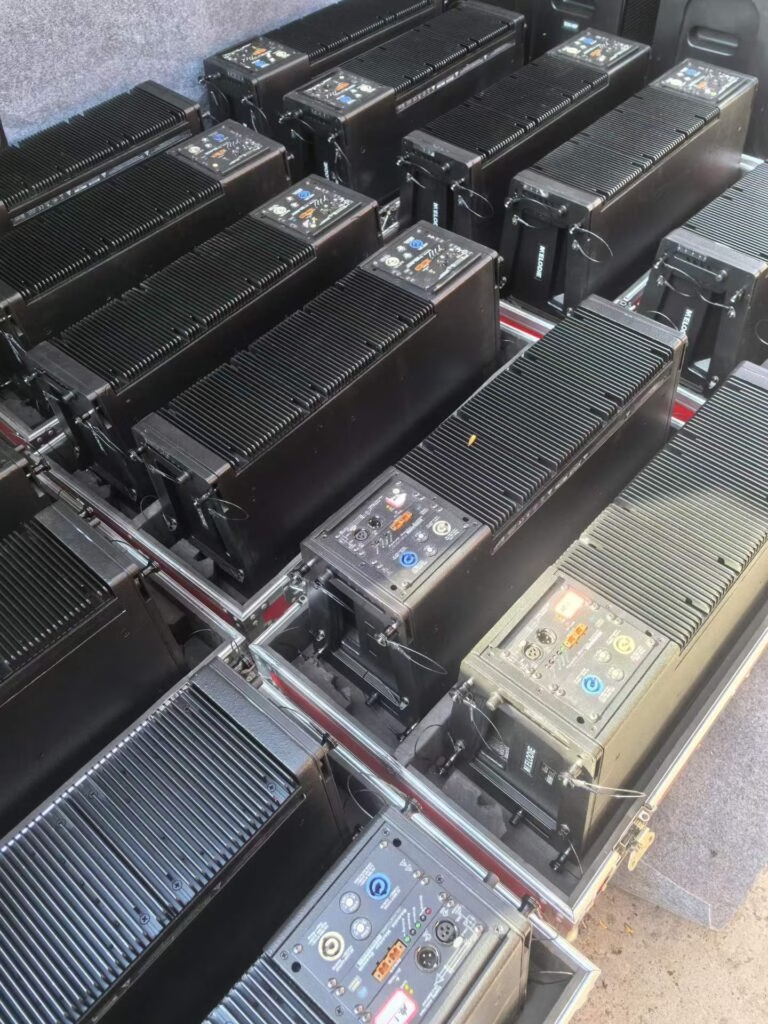
Power specs matter most on self-powered gear, which is why the rear-panel photo on the K-array KF12 self-powered speaker is the first thing to check. Passive cabinets like most of the used speakers category have no voltage spec at all.
Key Takeaways
- 220-240V/50Hz gear runs directly in the UK, EU, Africa and the Middle East.
- Check the rear label: 100-240V means no converter at all.
- Buy a transformer at 2x the rated draw, never the same figure.
- On motors, Hz matters more than volts, especially on turntables.