What are the real drawbacks?
Three, and they are not small. First, the LCD is small and dims; a replacement is getting harder to source. Second, networking is limited, so multitrack recording needs a card, and app control is not native. Third, the workflow is 2005-era, meaning plenty of page-flipping compared to a modern touchscreen desk. If your operators expect to mix from an iPad on the balcony, this is the wrong console.
Also check the internal battery. On a 15-20 year old desk, a dead backup battery can wipe your scene memory on power cycle, and it is a soldered job on some revisions.
What should you inspect before paying?
Power it on cold and time the boot. Cycle every motorised fader through a full recall, twice. Sweep all 48 channels with a signal generator. Check phantom power on every preamp, since it is a common failure and cheap to fix but annoying in bulk. Then confirm the installed Mini-YGDAI cards match what you need, an ADAT-only desk is a different purchase to one with analog outs.
Is there a better alternative at the same price?
If you need modern networking, a used small-format digital desk from the 2018-2021 era at the same money is more future-proof but has fewer channels and a menu-driven workflow. If you need 48 channels for USD 1,800, nothing else in that bracket does it with this build quality. The shop is the place to compare landed prices before you commit.
Should you buy one or two?
One, unless you run two rooms or tour. Two desks means two sets of spares and twice the storage. The better use of that money is a spare output card and a tested cable loom. If you do buy two, buy them from the same production run so the firmware and card layout match, mixing revisions will cost you a show one night.
Key Takeaways
- USD 1,500-2,200 is a fair 2026 price with case.
- 48 channels and 23 kg, no new desk at that price comes close.
- Small dim LCD and 2005 workflow are the real drawbacks.
- Check the internal backup battery before buying.
- Not the desk for app-first operators.
Yes, at USD 1,500-2,200 with the flight case. The DM1000 is a 48-channel digital desk that weighs 23 kg, and 20 years after release every live engineer on the planet can operate one. What it does not have is modern networking, an app, or 96 kHz on every card slot. For a 200-400 capacity room it is still a serious tool.
What do you actually get for that money?
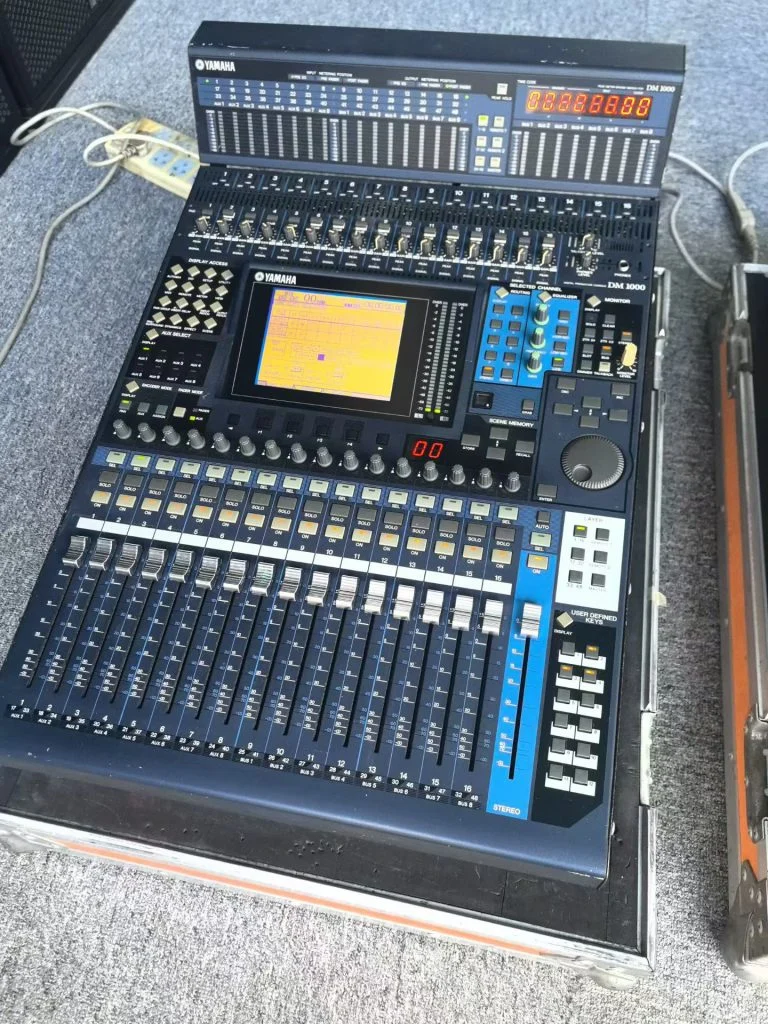
48 input channels, 8 aux sends plus stereo and 8 matrix outputs, 8 omni outs on the base unit, expandable with Mini-YGDAI cards. Motorised faders, internal effects and scene memory. The console reads like a small PM series: everything you need for a four-piece band plus three monitor mixes, and nothing you do not.
A used Yamaha DM1000 digital mixing console in excellent condition with its case is the version to hunt for. Loose units without a case usually have rack rash and a missing output card.
Why do buyers still pick it over a new budget desk?
- Channel count. USD 1,800 of new digital desk buys you 16-24 channels. The DM1000 gives 48.
- Fader feel. Motorised 100 mm faders, not the short travel ones on entry-level desks.
- No learning curve. A freelance engineer arrives and mixes. That matters when you hire per show.
- Repairability. Yamaha service documentation is public. Local techs have seen these desks.
What are the real drawbacks?
Three, and they are not small. First, the LCD is small and dims; a replacement is getting harder to source. Second, networking is limited, so multitrack recording needs a card, and app control is not native. Third, the workflow is 2005-era, meaning plenty of page-flipping compared to a modern touchscreen desk. If your operators expect to mix from an iPad on the balcony, this is the wrong console.
Also check the internal battery. On a 15-20 year old desk, a dead backup battery can wipe your scene memory on power cycle, and it is a soldered job on some revisions.
What should you inspect before paying?
Power it on cold and time the boot. Cycle every motorised fader through a full recall, twice. Sweep all 48 channels with a signal generator. Check phantom power on every preamp, since it is a common failure and cheap to fix but annoying in bulk. Then confirm the installed Mini-YGDAI cards match what you need, an ADAT-only desk is a different purchase to one with analog outs.
Is there a better alternative at the same price?
If you need modern networking, a used small-format digital desk from the 2018-2021 era at the same money is more future-proof but has fewer channels and a menu-driven workflow. If you need 48 channels for USD 1,800, nothing else in that bracket does it with this build quality. The shop is the place to compare landed prices before you commit.
Should you buy one or two?
One, unless you run two rooms or tour. Two desks means two sets of spares and twice the storage. The better use of that money is a spare output card and a tested cable loom. If you do buy two, buy them from the same production run so the firmware and card layout match, mixing revisions will cost you a show one night.
Key Takeaways
- USD 1,500-2,200 is a fair 2026 price with case.
- 48 channels and 23 kg, no new desk at that price comes close.
- Small dim LCD and 2005 workflow are the real drawbacks.
- Check the internal backup battery before buying.
- Not the desk for app-first operators.