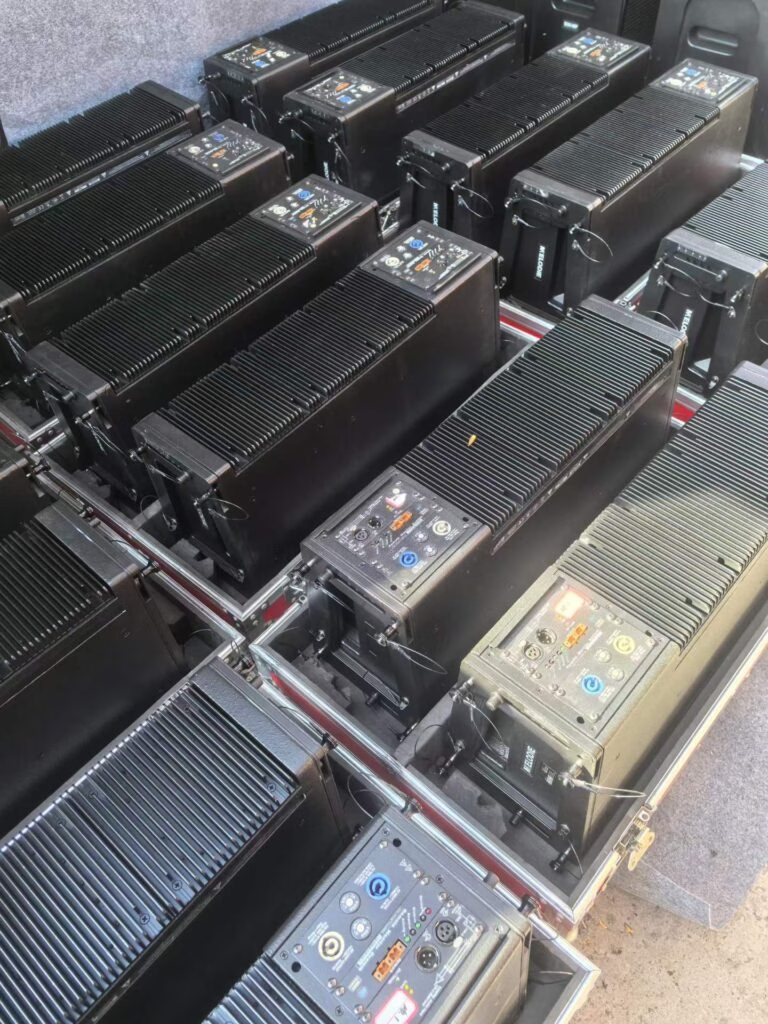
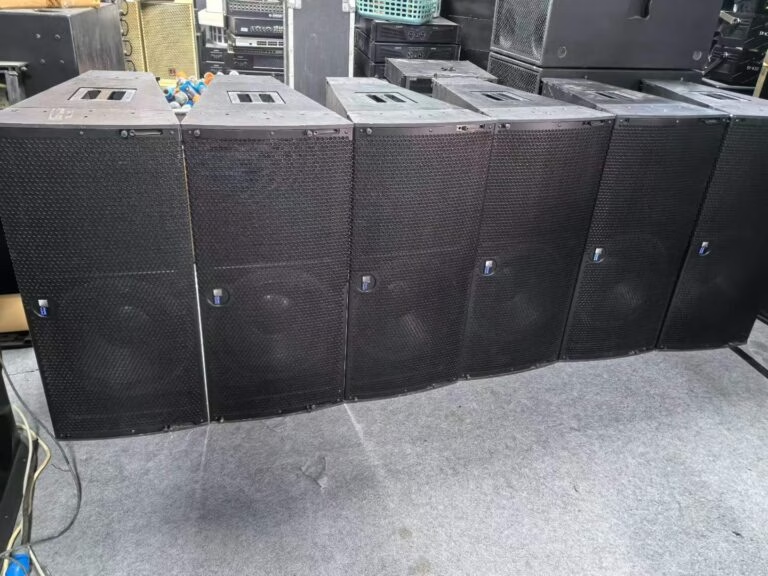
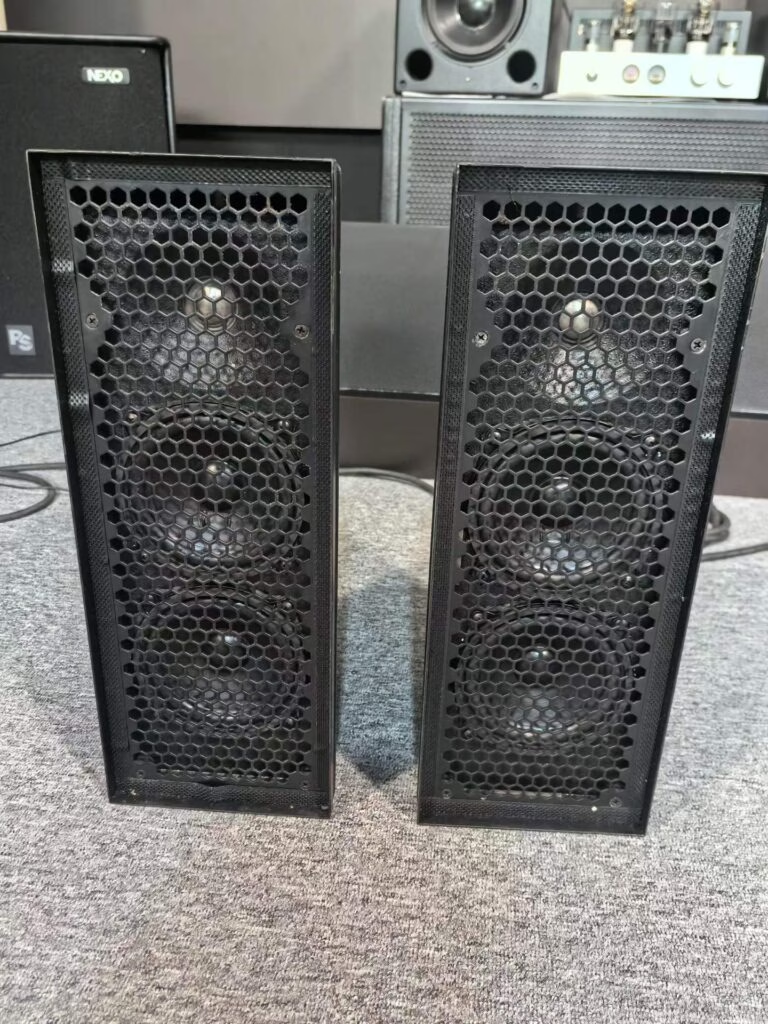
Short answer: in 2026 a used K-array KF12 self-powered box lands around $650-900 landed, a used Yamaha DM1000 console around $900-1,300 with the flight case, and a used Shure SM58 stays at $55-75 no matter what the listing says. Anyone quoting $200 for a working 12-inch powered top is either selling a clone or measuring the price before freight.
I sell used Chinese-market pro audio out of Guangdong and I see buyer expectations miss by 30-50% almost every week. The gap is rarely negotiated down. It shows up as silence after the quote, then a buyer who buys a $240 speaker off a marketplace and emails me three months later asking why the amp module died.
What does the used DJ equipment for sale cheap tier really get you?
The $150-350 band is real, but it is a different class of gear. At that level you are looking at unbranded or house-brand powered boxes, 10-12 inch, usually 100-250W RMS, no DSP presets, and cabinets made from 12-15mm particle board. They work for a bar that needs background music Tuesday to Thursday.
What you do not get: serviceable amp modules, spare parts, or a serial number the manufacturer still recognises. When one dies, it dies. For a wedding DJ running 40 events a year that is a terrible bet. For a café owner who needs four speakers and can afford to replace one, it is fine.
| Buyer | Budget band | What actually works | Where it breaks |
|---|---|---|---|
| Wedding / mobile DJ | $600-1,000 per top | Branded 12-inch powered, 500W+ class D | Cheap amp modules run hot at 8-hour events |
| Bar / restaurant | $150-350 per box | House-brand 10-inch, 100-250W | No spare parts after 2 years |
| Church, 200-400 seats | $400-700 per box | Used Yamaha / JBL / K-array 12-inch | Wrong coverage angle, not build quality |
| Small club / venue | $900-1,400 per top | K-array KF12 class, 12 units available now | Freight cost surprises, not gear cost |
Why does the same model cost 2x more in one country?
Freight and duty, mostly. A pair of 12-inch powered tops weighs around 45-55kg packed and eats roughly 0.35-0.45 cubic metres. Sea freight from Shenzhen to a European port was running $85-160 per cubic metre in late 2026, plus $150-350 in fixed charges (documents, port handling, delivery to door). That is $60-120 of pure logistics on a $400 speaker.
Then duty lands on top. The EU charges 2-4.7% on most loudspeakers, the UK similar, and several African markets add 20-35% import duty plus VAT. A $350 speaker in Guangzhou becomes $520 on a shelf in Nairobi before the reseller adds margin. That is not a rip-off, it is arithmetic.
How much should you pay for a used Yamaha DM1000 in 2026?
A working DM1000 with the original flight case sits at $900-1,300. The console launched in 2001 as a 48-channel 96kHz desk and still moves because church and small-venue engineers know the layout. Ours are listed with the case because a DM1000 without one has usually been rack-mounted and dusty for a decade.
Above $1,400 you are paying for someone’s nostalgia. Below $700 with no case and no test video, assume at least two fader banks need replacing, and budget $120-200 for the parts.
Why do bargain listings vanish when you ask for details?
Because the price was never real. The $180 12-inch powered top on a marketplace is usually one of three things: a 6-year-old box with a dead amp module, a genuine unit photographed once and sold to five buyers, or a shill listing that funnels you into a WhatsApp chat with no return policy.
A seller with real stock answers three questions without hesitation: what is the serial number, how many units, and can you send a video of this exact one playing. In ten years of buying in Guangzhou I have never had a legitimate exporter refuse all three. I have had plenty of brokers go quiet after the first one.
Our own listings are boring on purpose. Twelve K-array KF12 boxes, one serial list, one test video per unit. Boring is the most reliable signal in this market.
What is the cheapest way to buy without getting burned?
- Ask for a serial number and a photo of the rear panel. Refurb sellers glue new labels on. Serial numbers are harder to fake.
- Get a 90-second video of the unit playing at volume, not a photo of it on a pallet.
- Pay a deposit, inspect, then pay the balance. Any exporter who refuses staged payment is telling you something.
- Compare landed cost, not unit price. A $200 cheaper speaker with $180 extra freight is not cheaper.
If you are pricing a DJ rig specifically, the used DJ gear category shows what is actually in stock with photos and serial numbers. For venue installs, the K-array KF12 self-powered 2-way speaker is the closer comparison at $650-900 a box.
Key Takeaways
- Landed price beats list price: freight and duty add $60-200 per box on Asian exports.
- A used K-array KF12 at $650-900 and a used Yamaha DM1000 at $900-1,300 are the 2026 reference points.
- Below $350 you are buying disposable gear, not serviceable gear.
- Always ask for a serial number and a playing video before paying a deposit.