Four checks, four minutes: tap the body and listen for rattle, sweep 50 Hz to 16 kHz to find response holes, shout into it at close distance to expose diaphragm damage, then wiggle the connector while listening. Cosmetics come last, because a scratched mic body tells you nothing about the capsule.
Why is the tap test first?
Because it catches the most expensive failure in one second. Hold the mic at the grille and tap the body with two fingers. You should hear a dull thud. A metallic ring or a rattle means the capsule mount is loose or a screw is bouncing inside. On a condenser, a loose capsule is a USD 150-400 repair on a USD 200 mic, so it is a write-off.
What does a frequency sweep reveal?
Holes in the response. Play a sweep or use a phone tone generator and listen for a drop or a buzz at a specific band. A dip around 8-12 kHz on a dynamic mic usually means a dented diaphragm or dust on the magnet gap. Full-range sweeps also expose intermittent cables, which show up as crackle when the sweep hits a certain pitch, and that is often just the XLR, not the capsule.
How do you spot a fake or a swapped capsule?
- Serial numbers. Real SM58 and Beta series mics have the serial stamped, not printed on a sticker.
- Weight. Counterfeits are light. Compare against the spec sheet to the gram.
- Grille mesh. Fakes use coarser mesh that dents easily and scatters HF.
- XLR pins. Genuine mics have pins that grip firmly at first insertion.
The weight check alone catches most counterfeit SM58s, which run 30-50 g light against the real 298 g.
Does the mic matter as much as the room?
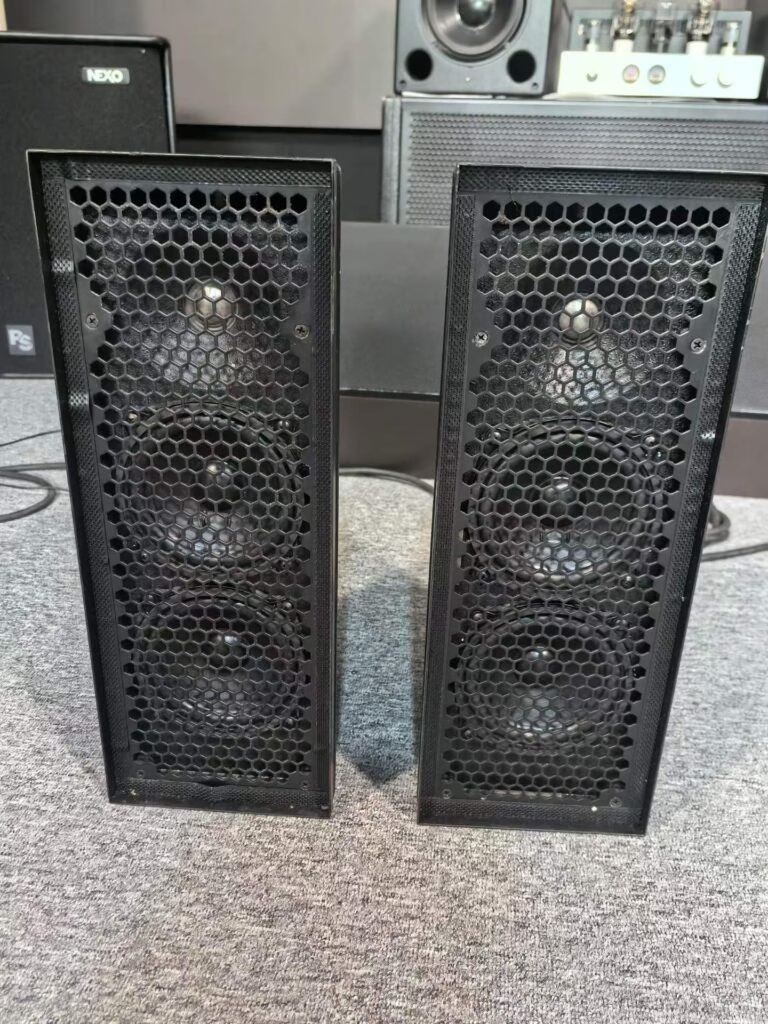
For handheld vocals, less than you would think. Once you are past a decent dynamic capsule, the stage, the monitors and the singer’s technique decide the result. A USD 400 used mic in a bad room sounds worse than a USD 150 one in a treated space. Spend the savings on a decent pair of speakers before upgrading capsules. Our K-array KF12 self-powered speaker is a fair reference point for what clean, low-distortion monitoring sounds like.
What about wireless systems?
Different rules. Ask the frequency band first, because a system in 470-608 MHz may be illegal or unusable in your country depending on local rules, and re-tuning is not always possible. Then check the transmitter battery door, the antenna threads (they strip), and whether the receiver’s display has dead segments. Walk-test the range with the bodypack, do not trust a bench test at two metres.
How much should a used mic cost?
| Mic type | New (USD) | Used fair (USD) |
|---|---|---|
| Dynamic handheld, brand | 180-400 | 70-150 |
| Condenser, large diaphragm | 350-900 | 150-380 |
| Wireless handheld system | 500-1,400 | 200-550 |
Above 50% of new price on a used dynamic mic makes no sense, since a new capsule is the whole risk. Browse microphones for current stock and grades.
How should a used mic be packed for shipping?
In a hard case, in its own foam cutout, inside a carton with 5 cm of padding on all sides. Capsules are fragile in a specific way: they hate a single sharp shock, not vibration. A mic loose in a padded bag will arrive with a shifted capsule mount. Insist on a case, and photograph the packing stage if the order is above a few hundred dollars.
Key Takeaways
- Tap test first. Loose capsules are not worth repairing.
- A sweep finds response holes and cable faults in under a minute.
- Weigh the mic, fakes run 30-50 g light.
- For wireless, check the band is legal in your country before anything else.
- Pay under 50% of new for a used dynamic mic.