For most working rigs, no. A digital console covers the job and an analog desk in the same rack is dead weight. It earns its place in three situations only: as a redundant front end when the digital desk’s failure would cancel the show, as a dedicated drum sub-mixer that feeds the digital desk, and as the board that volunteers can actually operate.
What does redundancy actually buy?
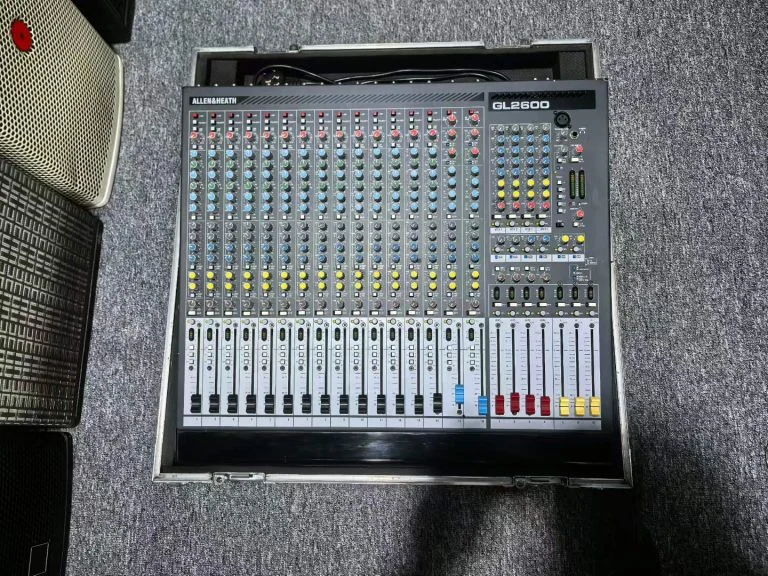
It buys time. A digital desk that dies mid-show means no show, and no show means refunds. An analog 16-channel desk patched alongside, with the four vocal mics and the playback split into it, means you can switch in 30 seconds and finish the night acoustically. That is worth $400-900 if you run ticketed events.
If you run weddings and parties for hire, the logic is stronger than it looks. One cancelled event costs more than the spare desk.
Is a drum sub-mixer still relevant?
Yes, in small rooms. Summing 8 drum channels into two returns frees 6 channels on the main desk and lets a drummer adjust their own balance. A used 8-channel analog mixer costs $100-250 and does this better than any digital sub-mixer at the price, because it is instantaneous and has real knobs.
The trade-off is a second gain structure to learn and one more thing in the cable path. If your drummer is not technical, this idea backfires.
Which used analog desks are worth keeping?
| Use case | What to look for | Budget |
|---|---|---|
| Show backup | 16 channels, working mutes, clean master section | $400-900 |
| Drum sub-mix | 8 channels, 4 mic pres, simple EQ | $100-250 |
| Volunteer front end | Locking channel strips, labelled, no menus | $300-600 |
| Studio sidecar | Good pres, direct outs | $500-1,200 |
What are the real downsides?
- Rack space and weight, often 15-25kg for a 24-channel frame.
- Every fader pot is another failure point you have to maintain.
- No scene recall, so switching back takes minutes, not seconds.
- Cable count roughly doubles when both are live.
- Staff who never learned it will avoid it.
The honest verdict: an analog backup is insurance, and insurance you never drill is worthless. Run the switchover once a year or the desk is just ballast.
What if you already run digital and like it?
Then spend the analog money on a second digital desk of the same model. Two identical desks mean one set of spares, one firmware to learn, and a scene file you can load. That is better redundancy than mixing architectures. A used Yamaha DM1000 as a backup to another DM1000 is a stronger plan than a DM1000 plus an old analog frame.
If your primary desk is modern and app-controlled, though, a cheap analog frame is the only backup that works without touching your app or your network.
What about the input list problem?
A digital desk with 32 inputs spoils you. When a band arrives with 40 sources, the analog backup cannot help, and its 16 channels become a monitor world instead of the main mix. If your backup is genuinely small, plan its role now: vocals, playback and two DI lines. Deciding this during a failure is how shows get cancelled.
Write the role on gaffer tape on the desk itself. Volunteers and freelancers will not read your run sheet, but they will read the board.
See the current range of used mixing console listings for real prices and stated condition before you commit.
Key Takeaways
- An analog console earns its rack space as insurance, drum sub-mixer, or volunteer front end — not as a main desk.
- Two identical digital desks beat one digital plus one analog for redundancy.
- A cheap 8-channel analog mixer still handles drum sub-mixing better than most digital alternatives.
- Rehearse the switchover once a year or the backup is decorative.