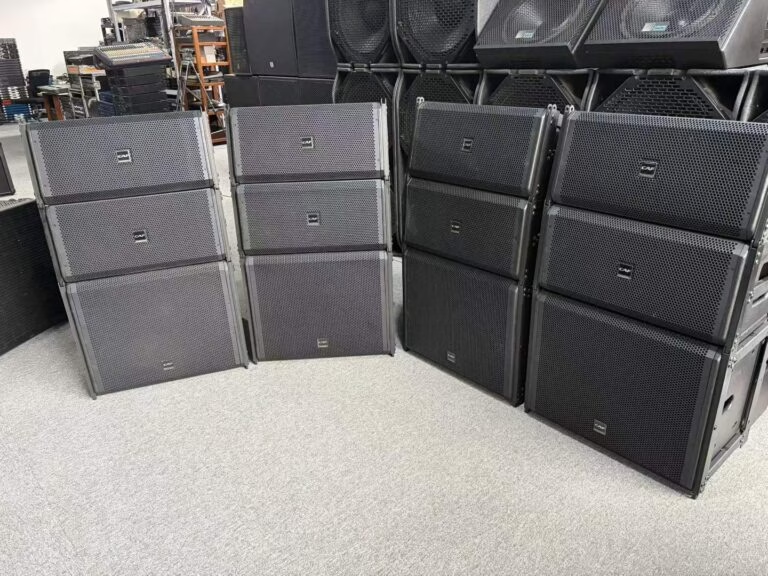
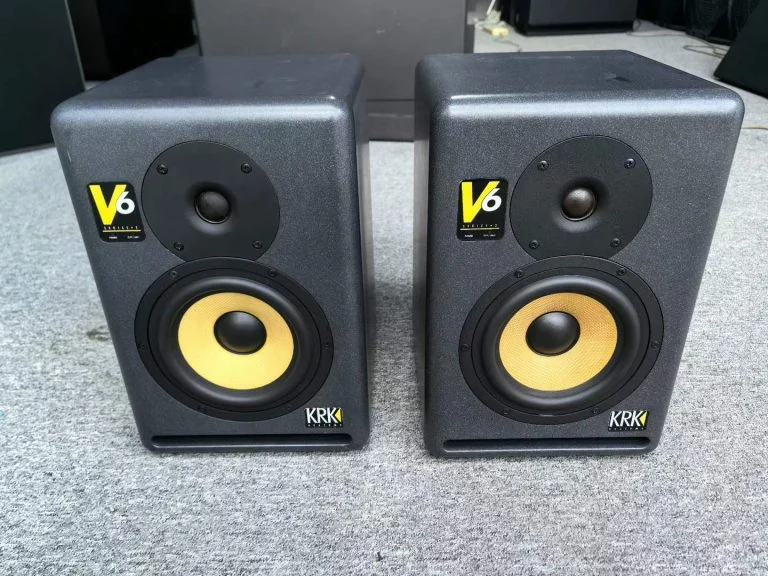
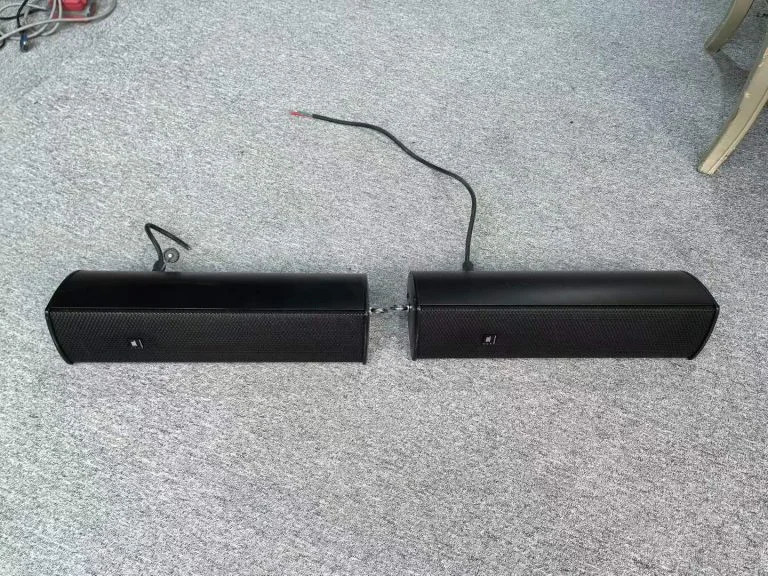
Pack used speakers for sea freight in double-wall 5-ply cartons with 50 mm foam corner blocks on all eight corners, one box per carton, or four boxes per pallet strapped and stretch-wrapped. Sea transit lasts 25–40 days, so humidity and vibration damage more speakers than drops do.
I have loaded a little over 200 pallets of used audio gear out of Shenzhen and Ningbo. The damage pattern from ocean freight is almost always the same, and it is avoidable with about $6 of extra packing per box.
What actually damages speakers in transit?
Vibration, then humidity, then handling. In that order.
Containers oscillate at 1–15 Hz on a ship’s hull. A speaker cone is a rigid piston on a flexible spider, so 30 days of low-frequency vibration fatigues the surround. Boxes that arrive with slightly loose cones were not dropped; they were rattled.
Humidity is the underrated one. A container on a North Sea or Indian Ocean route swings between 40 °C and 5 °C daily. Moisture condenses on steel and penetrates cardboard. Ferrite magnet baskets rust, and the rust finds its way into the voice coil gap.
- Vibration: fatigues surrounds and loosens cabinet screws.
- Humidity: rusts baskets, mildews grille cloth and tolex.
- Handling: chips corners, bends grilles, cracks plastic horns.
What packing materials do you need?
| Item | Spec | Cost per box |
|---|---|---|
| Carton | 5-ply double wall, 10 mm margin around box | $2.50–$4 |
| Corner foam | 50 mm EPE, 8 pieces | $1.80–$3 |
| Baffle foam | 25 mm PE, cut to cone diameter | $0.60 |
| Desiccant | 2 × 100 g silica packs | $0.40 |
| Stretch wrap | 23 µm, per pallet | $3 |
Total for a 12-inch box: about $6–$9. Per pallet of four: $35–$45 including strapping. That is nothing against a $400 speaker.
How should a single speaker be packed?
- Photograph everything before you pack. Damage claims need before pictures.
- Cover the grille with a cloth, then tape the cone area with a 25 mm foam disc so the cone cannot move.
- Put two 100 g silica packs inside the carton, not touching the driver.
- Fit corner foam so there is no gap. Shake the carton — nothing should shift.
- Double-tape all seams with 48 mm packing tape. Single taping fails at 60% humidity.
- Label “THIS SIDE UP” and include the gross weight; carriers in China often ignore both, but customs paperwork needs it.
The baffle foam disc is the step most people skip. Twenty-five millimetres of PE foam pressed against the cone stops the vibration fatigue described above. On a 15-inch cone this costs sixty cents.
How do you build a pallet?
Four 12-inch boxes per standard 1200 × 1000 mm pallet, in a 2 × 2 layout. Put the heaviest at the bottom. Stack with corners aligned; offset stacking crushes cartons.
Wrap the stack with stretch film top to bottom, at least six revolutions, then two vertical straps over the top and two horizontal. Use plastic corner protectors under the straps or the straps cut into the cartons.
Pallet weight: four 12-inch active boxes run 80–110 kg gross. This sits comfortably under the 1,000 kg per-pallet limit for LCL sea freight and keeps handling to a single lift.
What does sea freight cost?
LCL from Shenzhen to Rotterdam runs roughly $95–$160 per cubic metre in 2026, plus a $60–$90 destination handling fee per shipment. A pallet of four 12-inch boxes occupies 1.3–1.6 m³.
Per speaker, that works out to $35–$65 to Europe, and $45–$80 to West Africa or South America. Air freight is 4–6× that, only worth it for consoles and microphones where the value-to-weight ratio is better.
One warning: freight forwarders quote per cubic metre but bill the higher of volume or weight at 1 m³ = 1,000 kg. Speakers are light, so volume wins and you pay for air. Pack tight.
Key Takeaways
- Use 5-ply double-wall cartons with 50 mm corner foam, 8 corners.
- Add a 25 mm foam baffle disc to stop cone vibration fatigue.
- Two 100 g silica packs per box fight 30 days of container humidity.
- Four 12-inch boxes per pallet, heaviest at the bottom, two vertical straps.
- LCL sea freight lands around $35–$65 per speaker to Europe.
We pack and crate every unit ourselves, including the K-array KF12, and the speaker category shows what is boxed and ready.