Is the DM1000 still a good buy in 2026?
**Yes, if you pay 1,200-1,800 USD for a tested unit with its flight case.** The Yamaha DM1000 launched in 2003 with 48 channels, 96 kHz capability and a layout engineers still know. Two decades on it is not competitive on features, but it is competitive on reliability and price.
What it is not: a 2026 console. No Dante card by default, no tablet control worth using, and the screen backlight is a finite resource.
What was the DM1000 designed for?
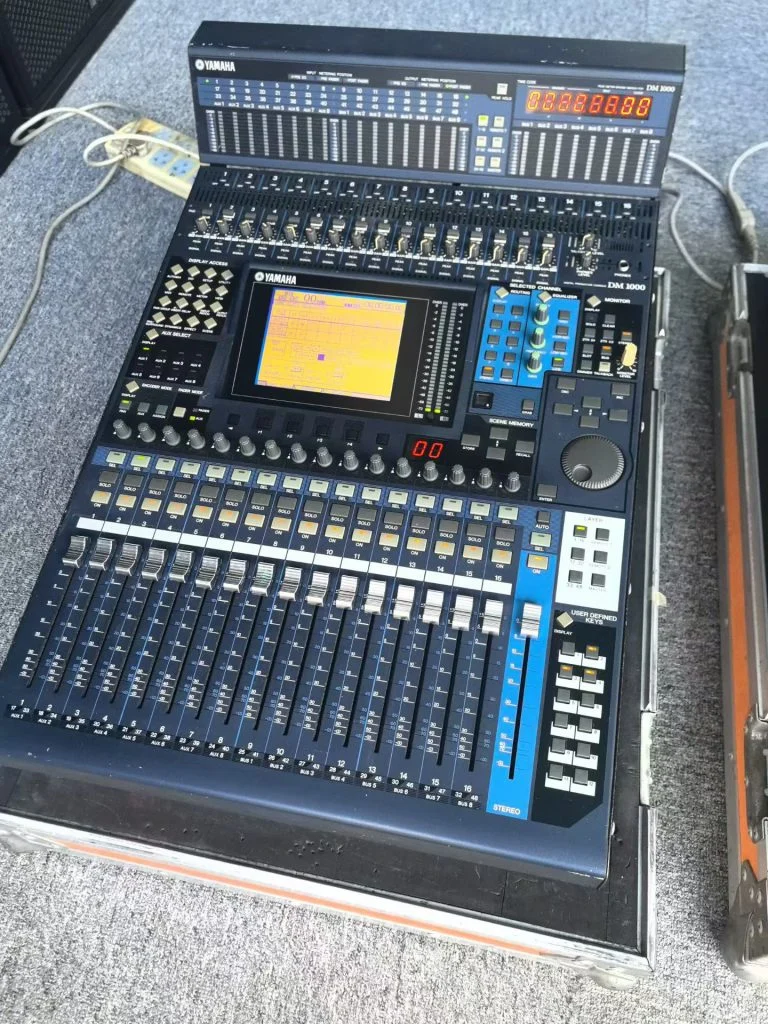
Buying a used Yamaha DM1000 in 2026 means buying a 2003 design, and that is the whole point. Yamaha built it as a compact digital desk for installs and small tours. 48 mono channels, 8 mix buses, 8 matrix outputs, 4-band EQ on every channel, and internal effects that were genuinely useful in 2003 and still are. It shipped with ADAT and TDIF options, which dates it and also explains why units with cards sell for 300 USD more.
The reason engineers remember it fondly is the surface: 16 faders at a time, a clear section per function, no touchscreen dependence. You can drive a whole show from the buttons after an hour with the manual.
What breaks, and what does repair cost?
Three failures show up again and again on units from this era:
- The LCD backlight dims or dies. Replacement panels run 80-200 USD and are the most common fix.
- Fader motors get noisy or stop holding position. Individual fader replacement is a 40-90 USD part.
- The internal PSU ages. Recap work is 120-250 USD at a competent shop.
None of these are deal-breakers, and all of them are visible in a 30-minute test. What kills a DM1000 is water damage or a lightning strike on the input board, which is why you ask for photos of the rear panel before you commit.
How does it compare with newer used desks?
The comparison that matters is not feature lists. It is price against remaining life:
| DM1000 (2003) | Mid-2010s digital desk | New entry digital | |
|---|---|---|---|
| Price used | 1,200-1,800 USD | 2,500-4,000 USD | 3,500-6,000 USD |
| Channels | 48 | 32-64 | 16-32 |
| Screen risk | Backlight, known fix | Touchscreen, costly | Warranty |
| Spares | Cheap and findable | Model dependent | N/A |
The mid-2010s desk sounds better and has recall by tablet. The DM1000 costs half as much and can be fixed with parts you can still buy. If your show is 24 channels of a band and a few vocal mics, that trade is easy.
Who should skip it?
Anyone mixing a festival with visiting engineers who expect current tools. Anyone who needs Dante as a first-class citizen rather than an add-in card. And anyone running a venue where the desk never moves and a 300 USD monthly payment on a modern console is easier to justify than a repair budget.
For everyone else — churches, small clubs, rehearsal rooms, touring bands with their own engineer — the math still works. A tested Yamaha DM1000 digital mixing console with flight case at 1,200-1,800 USD is roughly a third of what comparable channel counts cost new. Compare the rest of the used mixing consoles, and if you want the condition report for a specific serial number, contact us and ask for it before you pay.
Key Takeaways
- Used DM1000 sells for 1,200-1,800 USD tested, more with ADAT or TDIF cards fitted.
- 48 channels, 8 buses, 8 matrices, and a surface engineers can learn in an hour.
- Backlight, fader motors and PSU are the three known fixes, all under 250 USD each.
- Skip it if your operators expect Dante natively or modern touchscreen recall.