No converter for Europe, Africa, Asia or Australia: Chinese gear is built for 220-240V and those grids are 230V. You need one for the US, Canada and Japan, where outlets are 100-120V, and a transformer of the right size is not cheap.
What voltage is Chinese pro audio gear built for?
Most of it is 220-240V at 50 Hz, because that is what the domestic grid supplies. A Chinese amplifier or console will have a plate on the back reading 220V-240V AC 50/60Hz, and that detail matters more than the model number.
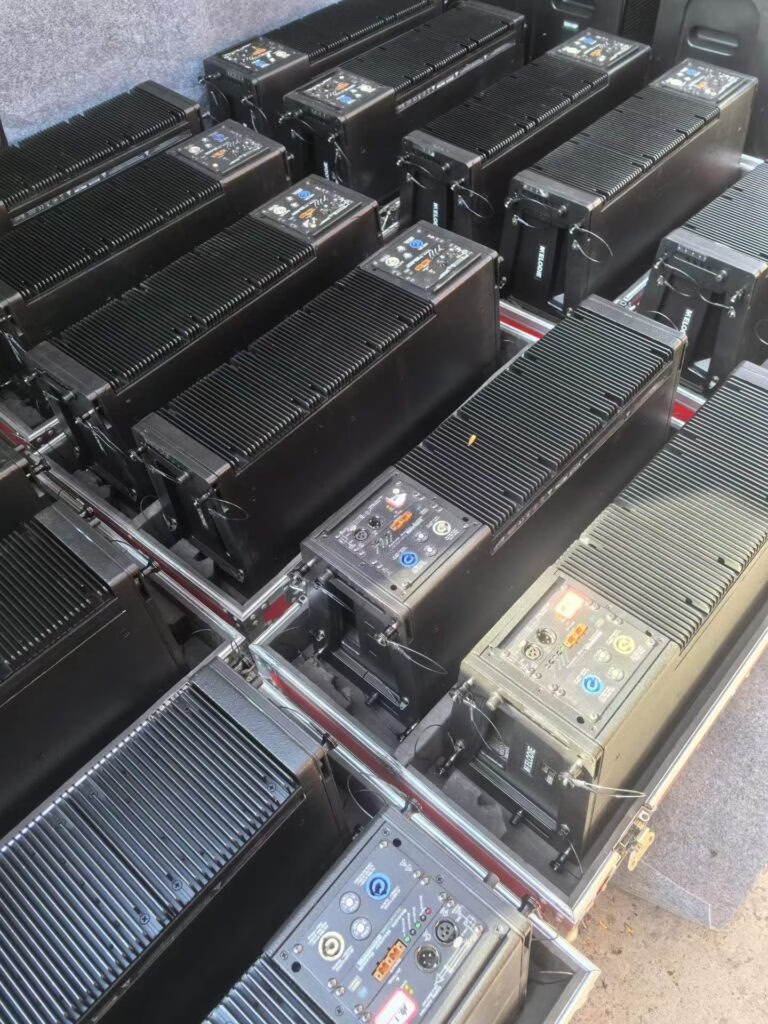
Check the plate rather than the listing. Sellers copy the manufacturer spec into descriptions, and manufacturers changed voltage ranges between production runs. The plate on the actual unit is the only reliable source, and a seller who will not photograph it is a seller to skip.
That means it drops straight into a UK, German, French, Spanish, Italian, UAE, Nigerian, South African or Australian venue with nothing in between. Those grids run 230V nominal, within the tolerance the gear was designed for.
It does not drop into the United States, Canada, Japan, Taiwan or most of Latin America, where outlets are 100-127V. There the question stops being about a plug adapter and becomes about a transformer.
When is a plug adapter enough and when is it not?
A plug adapter only changes the shape of the pin. It does nothing to the voltage. Fitting a UK plug to a 120V circuit gives you a device that half works, browns out under load, and eventually dies.
A voltage converter changes 110V to 230V and needs to be sized for the load. A 20 kg touring amplifier like an MC2 Audio T45 draws around 2 kW at full output. A 2 kW transformer is 250-450 USD, weighs 15-20 kg, hums, and gets hot.
Size the transformer generously. A device rated 500W continuous can pull 1,200W on the first second of a bass drop, and a transformer that trips on inrush is a transformer you will end up bypassing. Buy 2.5x the continuous rating and never 1:1.
For small items – a DI box, a passive splitter, an effects unit at 30W – a 300W step-up transformer for 60-90 USD is fine. For amplifiers, it is a bad idea and I would not do it.
What about 50 Hz versus 60 Hz?
This is the part people miss. Voltage is easy to convert. Frequency is not, unless you buy a motor-generator, which costs more than the equipment.
A power amplifier with a switch-mode supply does not care about 50 or 60 Hz. A transformer-based amplifier runs hotter on 50 Hz because the core saturates slightly earlier, and its capacitors see more ripple current. It works, and it shortens life.
Turntables, fans and any motor are the real problem. A 60 Hz motor on a 50 Hz supply runs 17% slow. A turntable that plays a semitone flat is a turntable you cannot use for DJ work, and there is no cheap fix.
How do you check before you buy?
Photograph the voltage plate. It is on the back panel of every device that matters, and sellers usually have it in one of their photos or can send it in a minute.
Look for a switch or a range. Anything marked 100-240V or with a 115/230V selector is universal and safe anywhere. Anything marked 230V only is not.
Check the plug type too. Chinese plugs are often I-type (two flat pins and a ground) or a bare cable end. You will be re-terminating, so budget 10-20 USD for a proper plug and a few minutes with a screwdriver.
Ask for the power consumption figure in watts, not amps, because amps on a 220V plate translated to 120V starts arguments. If a seller quotes 8A, that is 1,760W at 220V and 960W at 120V, so the same device needs a 10A circuit either way.
And check the fuse. A device fused for 240V needs roughly double the current rating on a 120V supply, and a 5A fuse on a 2 kW amplifier will nuisance-trip in a hot rack.
Is it worth buying 220V gear for a 110V country at all?
Usually no, unless you have a fixed install with one dedicated transformer and an electrician who will wire it properly.
For portable work, the transformer turns a 15 kg amplifier into a 35 kg problem, and it introduces a hum loop that no amount of cable dressing will fix. Buy the local voltage version or buy something else.
Safety matters here too. A step-up transformer with a floating output can leave a chassis at 115V relative to ground, and that is a shock waiting in a dark room. Only use a transformer that bonds neutral to ground and only with a licensed electrician signing it off.
There is one exception. High-end touring amplifiers in 220-240V are much cheaper and more available from China than their 110V equivalents, because most of the world runs 230V. If you are building a fixed rack in a US venue with a dedicated 240V circuit, importing 220V gear makes real sense and saves 30-40%.
For everyone else: check the plate first, then decide. That single photo settles ninety percent of these cases.
Key Takeaways
- Chinese pro audio gear is almost always 220-240V, which suits Europe, Africa, Asia and Australia with no converter.
- A plug adapter changes the pin, not the voltage; a converter is a different device and needs sizing for the load.
- A 2 kW step-up transformer costs 250-450 USD and weighs 15-20 kg, so converting amplifiers is rarely sensible.
- 50 Hz motors run 17% slow on 60 Hz and vice versa; that cannot be fixed cheaply on turntables.