Usually not. Almost all professional audio gear made after 2005 carries a 100-240V 50/60Hz universal supply, so a $5 plug adapter is all you need. A converter is only necessary when the rear label shows a single fixed voltage such as 120V or 100V. Read that label before you buy anything else.
This question comes up constantly from buyers in Europe, Africa and Latin America who assume Chinese export stock is 220V only. China runs 220V, yes, but the gear itself is almost always universal because manufacturers ship the same power supply worldwide.
How do you read the voltage label?
Look for a text block near the mains inlet. Three patterns cover almost everything. “100-240V~ 50/60Hz” means universal, no converter. “220-240V~” means it works in Europe, Africa and most of Asia but not North America. “120V~ 60Hz” means US-market gear that needs a step-up transformer in a 230V country.
If the label is missing or unreadable, ask for the model number and check the manual. A seller who cannot supply a photo of the rear panel is a seller you should not be wiring money to anyway.
When is a transformer genuinely required?
- US-market amplifiers. Many 1990s and 2000s power amps were built in fixed 120V versions for the US market.
- Japanese-market gear. 100V, not 120V, and it needs a proper 100V transformer, not a travel converter.
- Vintage consoles. Pre-1990 desks usually have fixed transformers inside.
- Some subwoofers. Big amp modules still ship region-specific in a few product lines.
What size transformer do you need?
Take the device’s rated wattage from the rear label, multiply by 1.5, and buy for that. Audio gear draws peak current on transients; a 500W amplifier can pull 700-800W on a bass hit even if it idles at 150W. Undersizing causes voltage sag, which sounds like a compressor you did not add and eventually kills the transformer.
| Device rated | Transformer rating | Typical cost |
|---|---|---|
| 300 W | 500 VA | $60-110 |
| 800 W | 1,500 VA | $150-260 |
| 1,500 W | 2,500 VA | $280-450 |
What about a K-array KF12 self-powered speaker specifically?
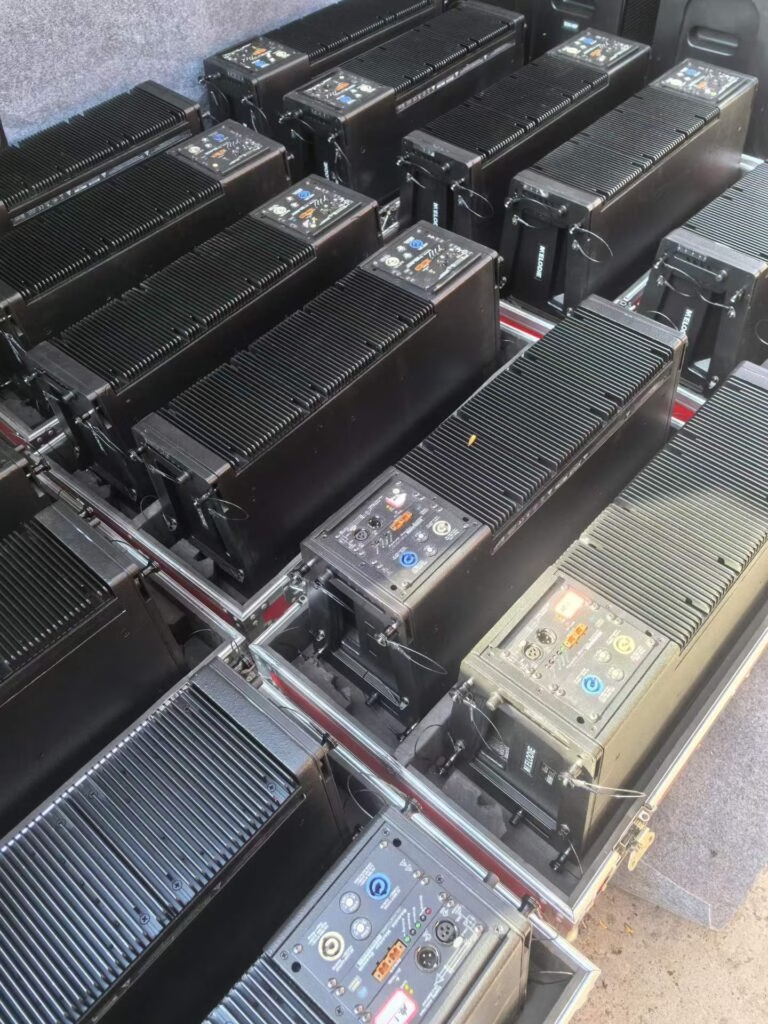
Powered speakers are the category where this question bites hardest, because the amplifier is inside and you cannot swap it. On the KF12 the rear panel shows the accepted input range; units built for export are typically universal. Confirm with a photo of the exact unit’s plate, not the model brochure, because manufacturers sometimes build region-specific batches for large orders.
If it does turn out to be fixed-voltage, one transformer per speaker is the practical answer. Sharing a single big transformer across several powered boxes creates inrush problems: three amplifier modules powering on together can trip the transformer’s breaker even when the steady load is well within rating.
Does frequency matter, 50 or 60 Hz?
For audio gear, rarely. Universal supplies rectify AC to DC, so 50 Hz versus 60 Hz makes no difference. The exception is gear with an AC motor or a mains-referenced timing circuit: some turntables and a few tape machines run at the wrong speed on the wrong frequency. Transformers do not change frequency, so if you have a 60 Hz turntable in a 50 Hz country you need a frequency converter, which costs $200-500.
What else should you check before plugging in?
- Plug type. China uses type I; Europe type C/F; UK type G; US type A/B. Adapters cost $3-8.
- Earthing. Never use a two-pin adapter that defeats the earth on a metal-chassis amplifier.
- Breaker load. A 2,500 VA transformer on a 10 A circuit is fine; two of them on a shared ring is not.
- Ventilation. Transformers get hot. Leave 20 cm of clear space and never box them in a rack with the amps.
Should you buy an export version instead?
If you have a choice, yes. Ask the seller whether the stock includes a 220-240V model, which most Chinese warehouses do because the domestic market runs 220V. That saves $150-450 on transformers and removes a failure point from your rack.
The one case where buying the US version makes sense is when you are in a 110V country. Then a 120V unit is exactly right and needs nothing. Check the destination before you check the discount; the right voltage is worth more than 10% off.
Key Takeaways
- Read the rear label: 100-240V means a plug adapter is enough.
- Only fixed 120V or 100V gear needs a step-up transformer.
- Size the transformer at 1.5x the device’s rated wattage.
- Transformers do not change frequency; turntables may need a frequency converter.
- Never use an adapter that disconnects the earth pin on a metal chassis.