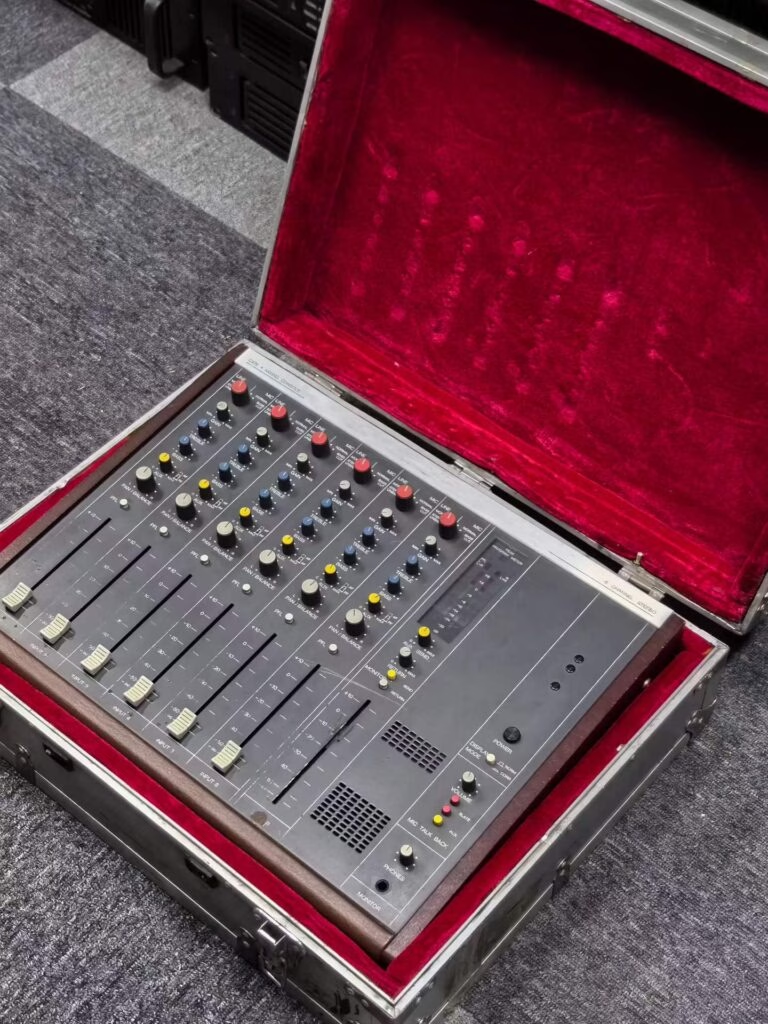
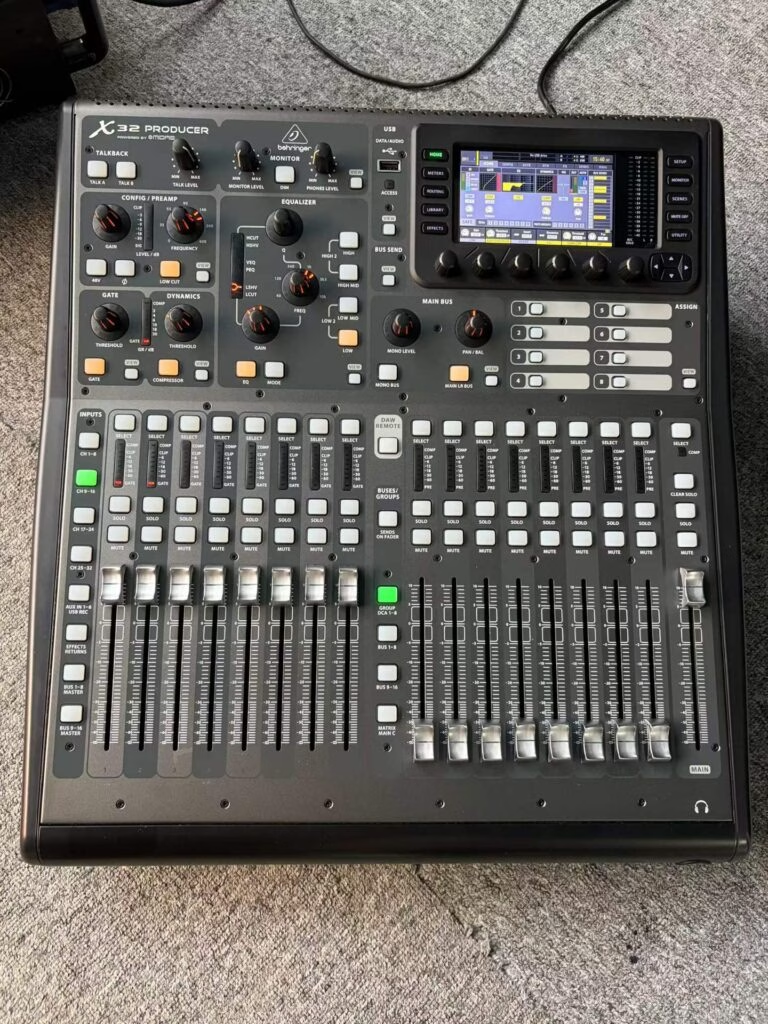
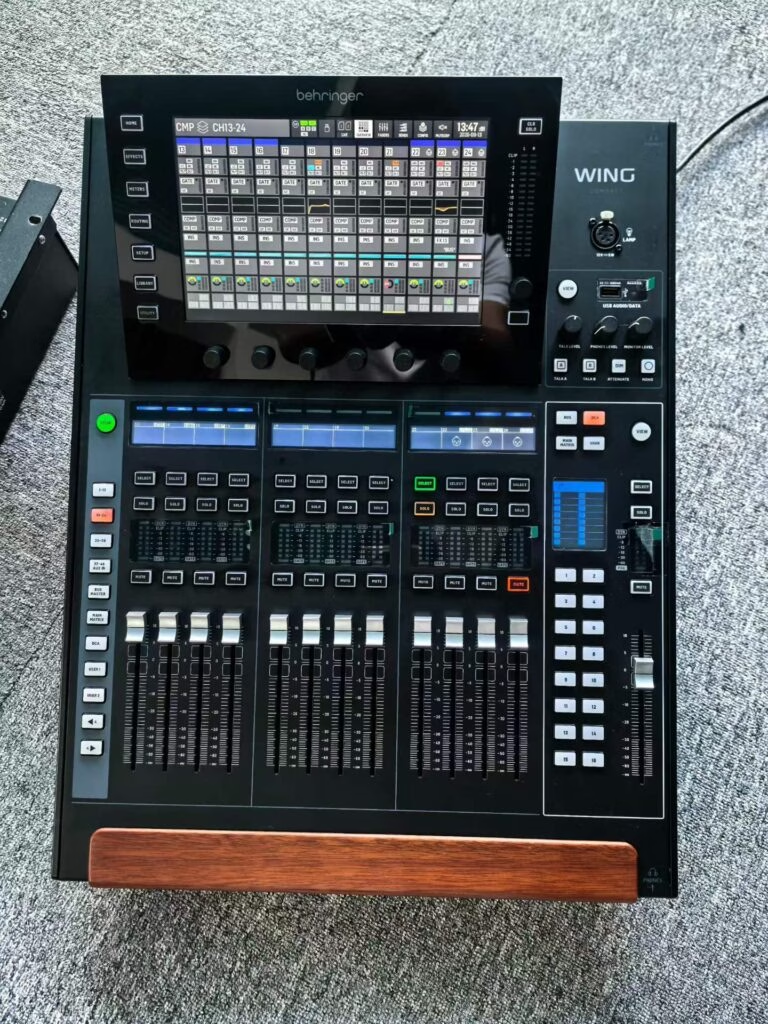
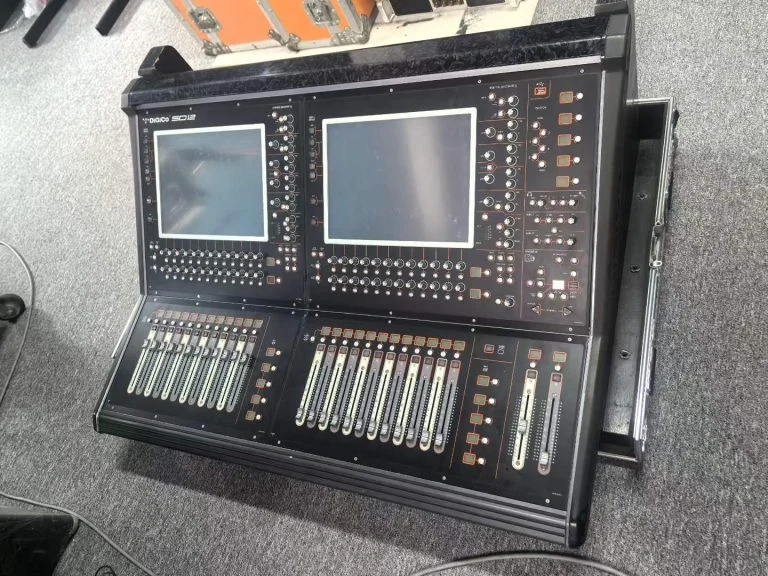
Used digital if you need channel count, scene recall, or multitrack over USB. Used analog if repair access matters more than features and you already own outboard. Price gap in 2026 is smaller than people expect: $900-1,600 for a 24-32 channel digital desk versus $700-1,200 for a comparable analog one — before you add $600-1,500 of compressors and effects.
What do you actually gain with digital?
Fourteen channels of compression, gates and EQ per channel are included. Recall on every show. A single Cat5e snake instead of 32 XLR runs and 40 kilos of copper.
A used Yamaha DM1000 digital mixing console weighs 24 kg and gives 48 input channels, 16 busses and 8 onboard effects processors. Replacing that with an analog equivalent costs more in rack gear than in console.
What do you lose?
Repairability. A dead encoder on a digital desk means a service centre, a firmware that may no longer be downloadable, and a part number that might be discontinued. An analog console has one bad pot and a $3 part.
Also: motorised fader replacement. Those run $40-120 each, and a 24-fader desk with six dead ones is $480 in parts alone.
Which holds value better?
Analog does, oddly. Digital desks depreciate like laptops because a 2006 mixer with a 200 MHz processor reads as ancient. Big analog desks that engineers love keep trading in a narrow band because the supply is fixed and the sound is the sound.
Three-year resale as a rough rule: analog console loses 15-25%, digital loses 30-45%.
Decision table
| You are… | Buy | Why |
|---|---|---|
| A touring band with 20 inputs | Digital, 32 ch | Recall, recording, one snake |
| A club with a fixed desk | Either — install room matters | Digital for EQ lock-out, analog for easy repair |
| A studio tracking live | Analog + interface | Resale, tone, local tech |
| A church or school | Digital with presets | Volunteers cannot wreck a scene |
| Anywhere with no service centre | Analog | Fixable anywhere |
What about hybrid?
Common and underrated. Analog front end into an interface into a laptop, mixing in the box. You get analog preamps, digital recall, and no dependence on a console screen that might die. Cost: a 16-channel analog desk at $400-700 plus an interface at $300-600.
Key Takeaways
- Digital: channel count, recall, recording, one cable run.
- Analog: repairs, resale, tone, no firmware dependency.
- 24-32ch digital used: $900-1,600. Analog equivalent: $700-1,200 plus outboard.
- Motorised faders cost $40-120 each to replace.
- No local service centre? Buy analog.
Compare unit specs directly on the used mixing console category.