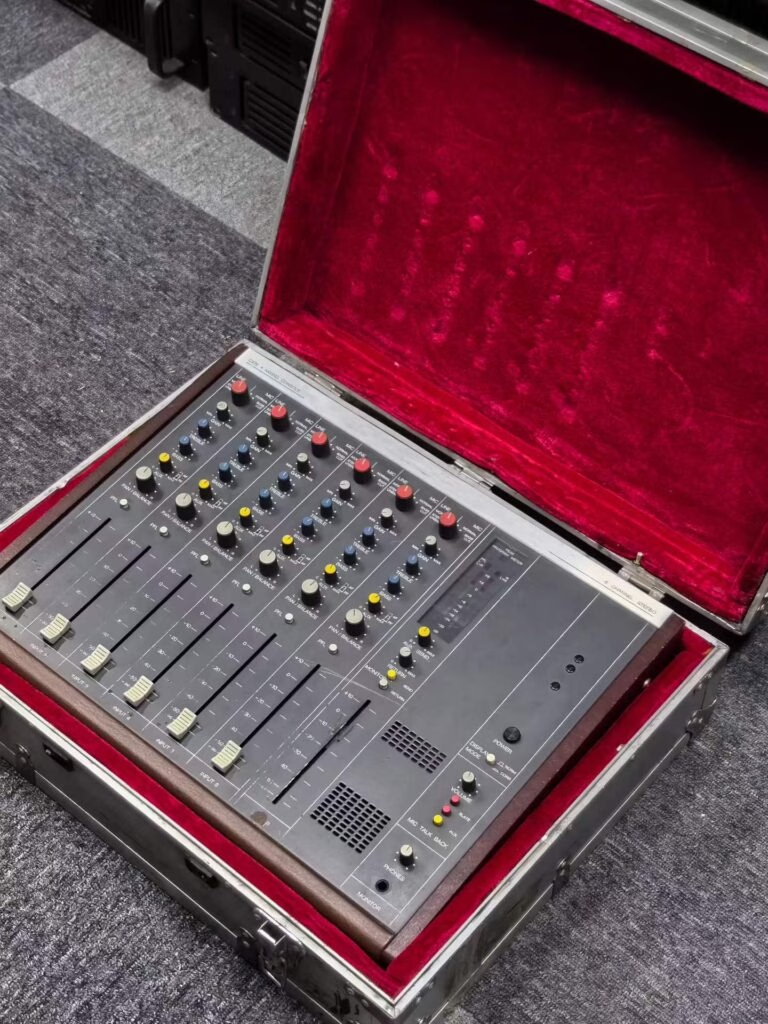
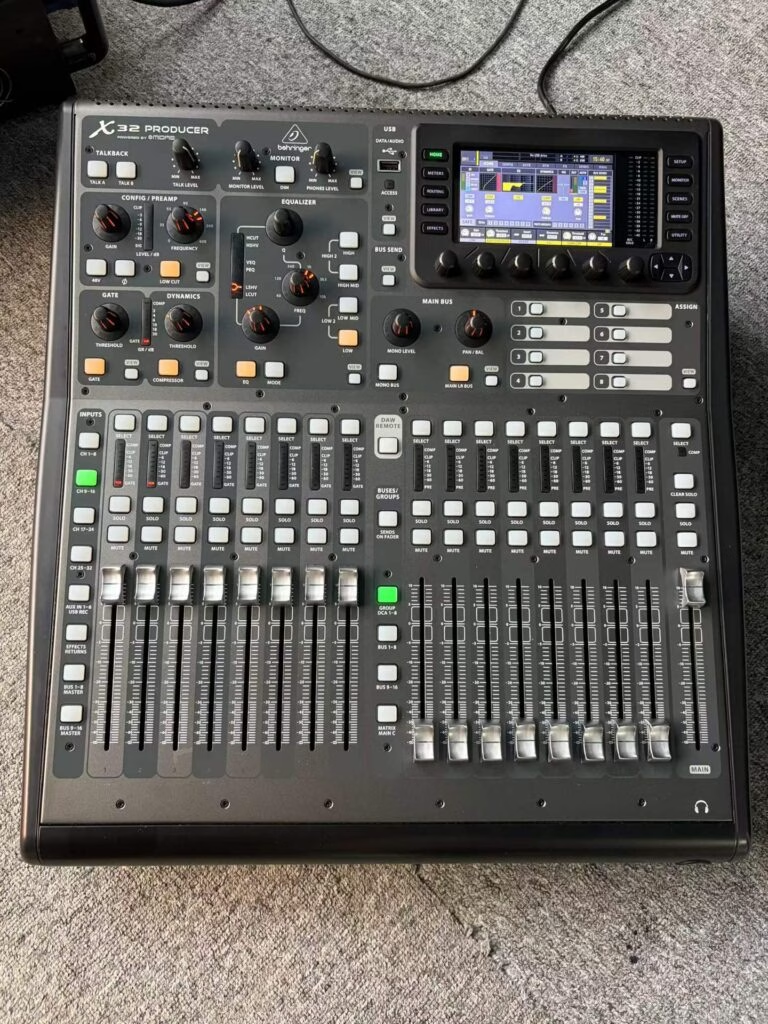
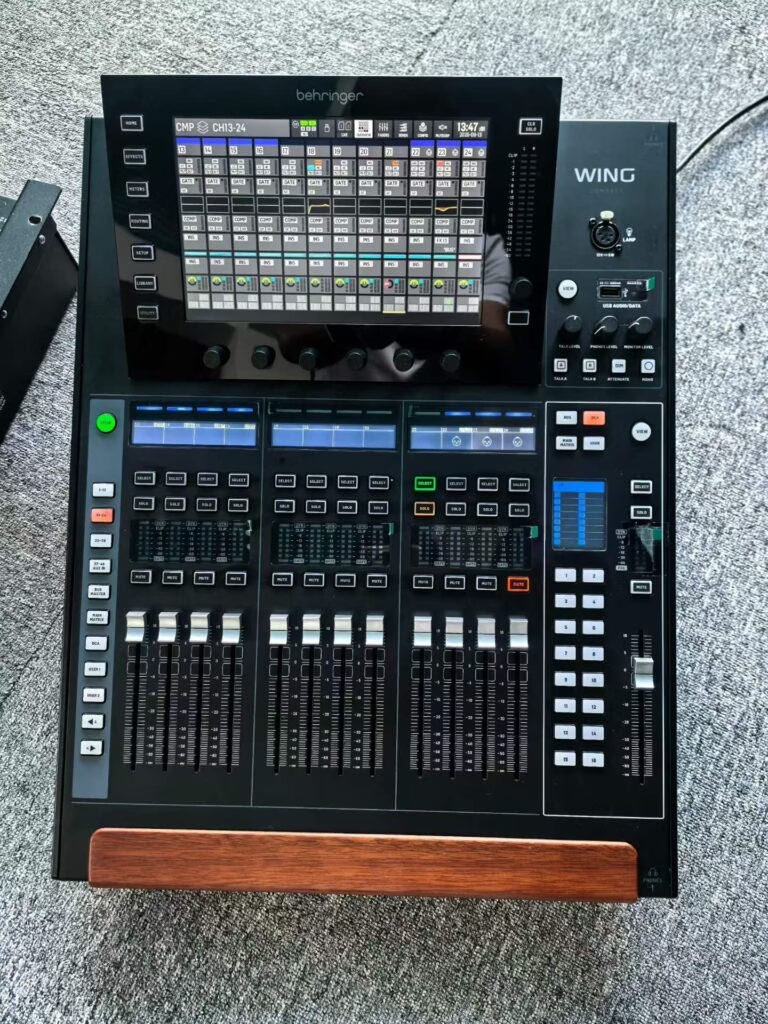
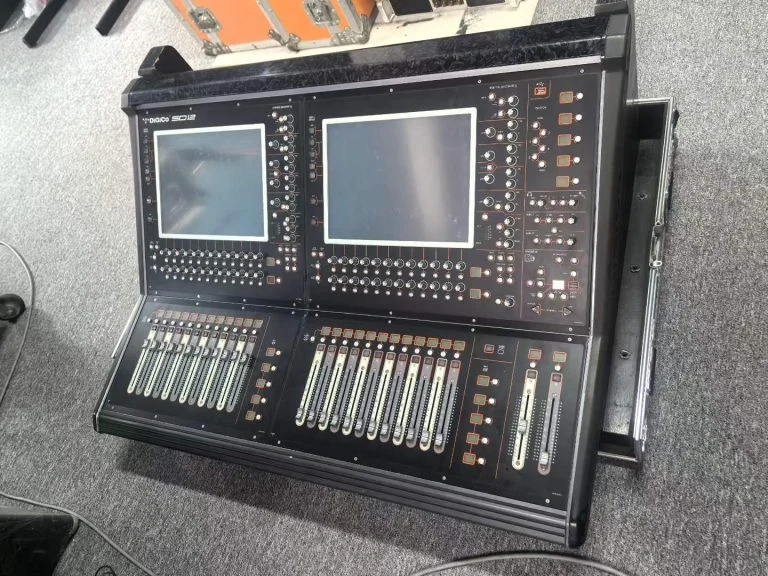
Buy used analog if you mix the same kind of show every week and want something a local tech can repair with a soldering iron. Buy used digital if you need 32 channels, stored scenes and multitrack recording in a single road case. The price lines cross near $1,200 in 2026: below that, analog wins on reliability per dollar; above it, digital does more per kilogram.
What does a used console cost in 2026?
| Type | Example class | Used price | Channels |
|---|---|---|---|
| Analog, 16 ch | compact 4-bus | $250-700 | 16 mono |
| Analog, 32 ch | 8-bus live desk | $900-2,400 | 32 mono |
| Digital, 16-24 ch | Yamaha DM1000 class | $900-1,600 | 48 input |
| Digital, 32-48 ch | mid-tier live digital | $2,000-6,500 | 48+ input |
Note the input count. A digital desk with 48 inputs at $1,200 is cheaper per input than a 32-channel analog at $1,400 — but it has fewer faders, more menus, and a screen that can die.
What fails first on each type?
- Analog: scratchy pots and faders, dead channels from dirty inserts, cracked solder joints on the master section. All repairable, mostly cheap.
- Digital: motorised faders, backlight and LCD failures, flash memory wear, discontinued firmware. Screen and fader repairs run $80-260 each.
That asymmetry decides the argument. A 2004 analog desk with two dead channels still does 30 channels of work. A digital desk with a dead screen does nothing at all until the part arrives, and on a 2005 model the part may not exist.
Why do people still buy a 20-year-old Yamaha DM1000?
Because it does 48 inputs, 8 auxes and full scene recall in 12 kg, and because thousands were made — spares and service knowledge are everywhere. A used DM1000 with a flight case sells for $900-1,600. Compare that with $4,000+ for a modern 48-input digital desk.
The catch: it is a 2004-era design. No Dante, limited USB, small screen, and Yamaha stopped adding features long ago. If you need networked audio or remote control apps, look elsewhere. If you need reliable 48-channel mixing for a fixed venue, the Yamaha DM1000 remains one of the best value desks on the used market.
Which one suits a rental company vs a fixed venue?
Rental companies should lean digital. Scenes mean a different engineer can recall last month’s show in 20 seconds, and that is billable. Fixed venues with one house engineer should lean analog: fewer failure points, no firmware, no learning curve for a substitute operator at 6pm on a Friday.
Mobile DJs are a separate case. Neither desk makes sense — a 4-channel DJ mixer and a controller covers 90% of gigs, and a 16-channel analog desk is dead weight in a car boot. See the DJ gear category before you buy a console you will never use.
What should you check at the inspection?
For analog: every channel through a known-good mic, every aux send, every insert, and the phantom power on at least two channels. For digital: every fader moved through its full travel, a scene save and recall, and the firmware version photographed. Then check the PSU — on both types, a failed power supply is the most expensive single fault, $150-400.
One more thing for digital: ask whether the desk was ever used in a fixed install with the screen on 12 hours a day. Backlight hours are the real odometer, and nobody lists them.
Key Takeaways
- Under $1,200, buy analog for reliability per dollar; above it, digital does more per kilo.
- Analog faults are cheap and local; digital faults are expensive and sometimes unfixable.
- A used Yamaha DM1000 runs $900-1,600 with 48 inputs — strong value if you do not need Dante.
- Rental houses should buy digital for scene recall; fixed venues should buy analog.
- Photograph the firmware version and test every fader through full travel.