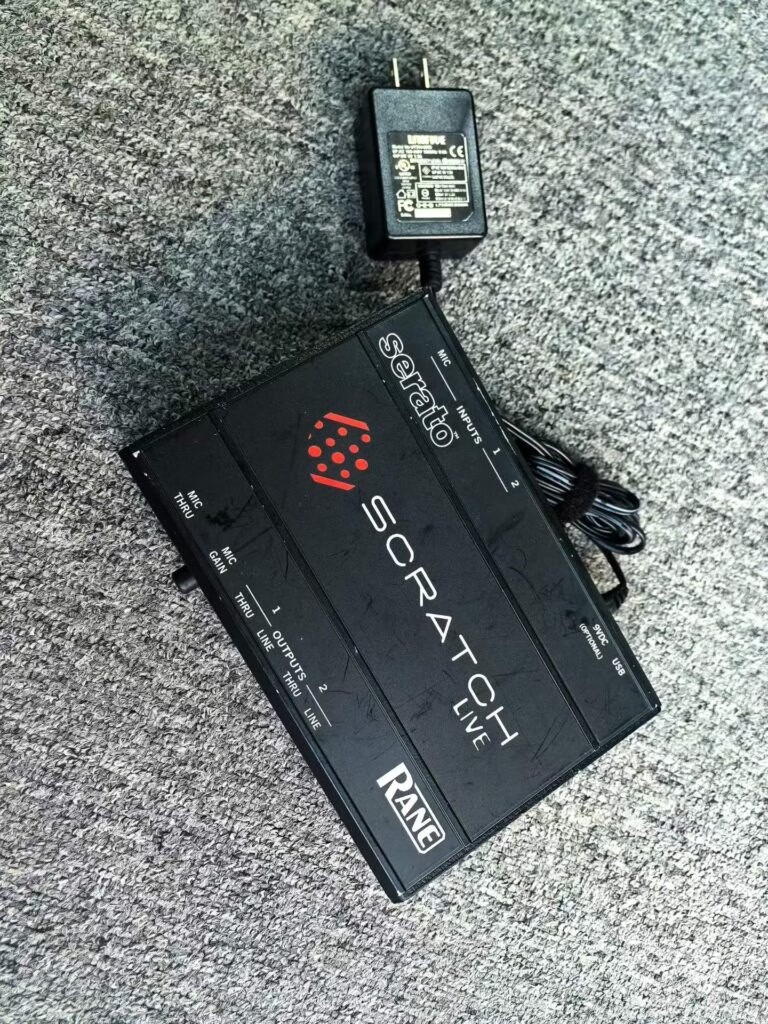
Check the crossfader first, then the jog wheels, then the USB port. A used DJ controller with a worn crossfader is $40–$90 in parts and an hour of fitting; a controller with a dead USB port is usually unrepairable at reasonable cost. Order matters because the crossfader is the most likely fault and the cheapest to fix.
I have moved about 150 used DJ controllers through resale in three years, mostly Pioneer DDJ and Numark units coming off club duty in Asia. The failures are predictable enough to list.
Why is the crossfader the first check?
Because it is a mechanical contact wearing against a carbon track, and club use puts 200–400 movements on it per night. A crossfader in daily club use starts scratching within 12–18 months.
Test it by loading a track in two decks and slowly sliding the crossfader from end to end while both are playing. Listen for crackle, sudden level jumps or dropouts in the middle of the travel. Any crackle that does not clean up after twenty rapid full sweeps is wear, not dust.
Replacement cost: a Pioneer DDJ crossfader module is $40–$90 depending on model, plus 30–60 minutes of fitting. On some budget controllers the crossfader is soldered to the mainboard and the part is not sold separately — that is a walk-away.
How do you check the jog wheels?
Spin each wheel by hand. It should rotate freely with a light, even resistance and stop without wobble. Then test the touch-sensitive top: with a track playing and the deck in vinyl mode, touching the platter should stop playback.
- Grinding or clicking: bearing wear, $25–$60 part.
- Loose side-to-side play: worn spindle, usually not worth fixing.
- Touch sensor dead: a $15 ribbon cable or a failed sensor board.
- Uneven resistance between wheels: one bearing is dryer than the other, clean and regrease.
The touch sensor test catches controllers that look fine but cannot scratch. It takes ten seconds per deck.
What about the USB and audio output?
This is the fault that ends a controller’s life. Plug a USB stick directly into the controller and play a track. Then plug into a laptop and confirm the controller is recognised. Then test the master RCA and headphone jack separately.
A dead USB port on a controller is usually a broken solder joint on the mainboard, sometimes a failed USB controller chip. Repair runs $80–$180 if the board can be accessed, and many are now on a single integrated board. On a $300 used controller, that is the whole value.
Also listen to the master output at low level with no track playing. Hiss or hum means a failing audio codec or a grounded shield. Both are bad signs.
Which controls wear out next?
| Control | Fail rate | Replacement cost |
|---|---|---|
| Crossfader | High | $40–$90 |
| Channel faders | Medium | $15–$35 each |
| Filter and FX knobs | Medium | $5–$15 each |
| Performance pads | Low–medium | $20–$50 (pad board) |
| Play/cue buttons | Low | $5–$12 |
| Jog touch sensor | Low | $15–$40 |
Knobs are cheap but numerous. A controller with four dead knobs is $60 in parts and an afternoon of soldering. Price that in.
How do you check firmware and software?
Ask the seller to update the firmware in front of you, or to show the firmware version on screen. A controller stuck on old firmware may not work with current rekordbox or Serato versions.
Also confirm it is not locked to someone’s account. Some controllers tie to a specific software licence. If the seller cannot demonstrate the controller working with the current software, treat it as unverified.
One more practical point: check that the power supply is original. Many controllers use a 5 V or 9 V DC brick, and a wrong-voltage supply damages the board. A missing original PSU is $15–$30 to replace if you find the right connector.
What is a fair price for a used controller?
Roughly 45–55% of new price for a two-year-old unit in good condition, 30–40% for anything with visible wear. A controller that needs a crossfader drops another $80.
Budget controllers under $300 new are rarely worth buying used at all — the savings are $100 and the risk is a $150 repair. Spend the same money on a used mid-range unit from three years ago instead.
Do not buy a controller with a cracked chassis, no matter how cheap. The chassis holds the jog wheel bearings, and a cracked case translates into permanent wobble.
Key Takeaways
- Crossfader first: wear is common and the fix is $40–$90.
- Test the jog wheel touch sensor — a controller that cannot scratch is scrap.
- A dead USB port usually means an unrepairable mainboard fault.
- Price with firmware and PSU in mind; old firmware breaks software compatibility.
- Skip budget controllers; the savings do not cover the risk.
If you run DJ work alongside live sound, our Yamaha DM1000 digital console mixes both from one surface, and the DJ gear category lists what is available now.