Budget $120 to $450 for a typical active PA speaker repair in 2026. A single amp module swap sits near $180–$260 parts-only, a woofer recone is $90–$150, and a dead DSP board is the killer: $300+ and often unavailable. Above roughly 45% of the box’s used value, walk away.
That is the short answer. The longer one depends on which of four parts failed, and on whether the model still gets parts. I have bought roughly 60 used active boxes over the past three years, mostly for church and small-club installs, and the repair maths has never once been about the driver.
What actually breaks on an active PA speaker?
In my experience with used inventory, failures line up like this:
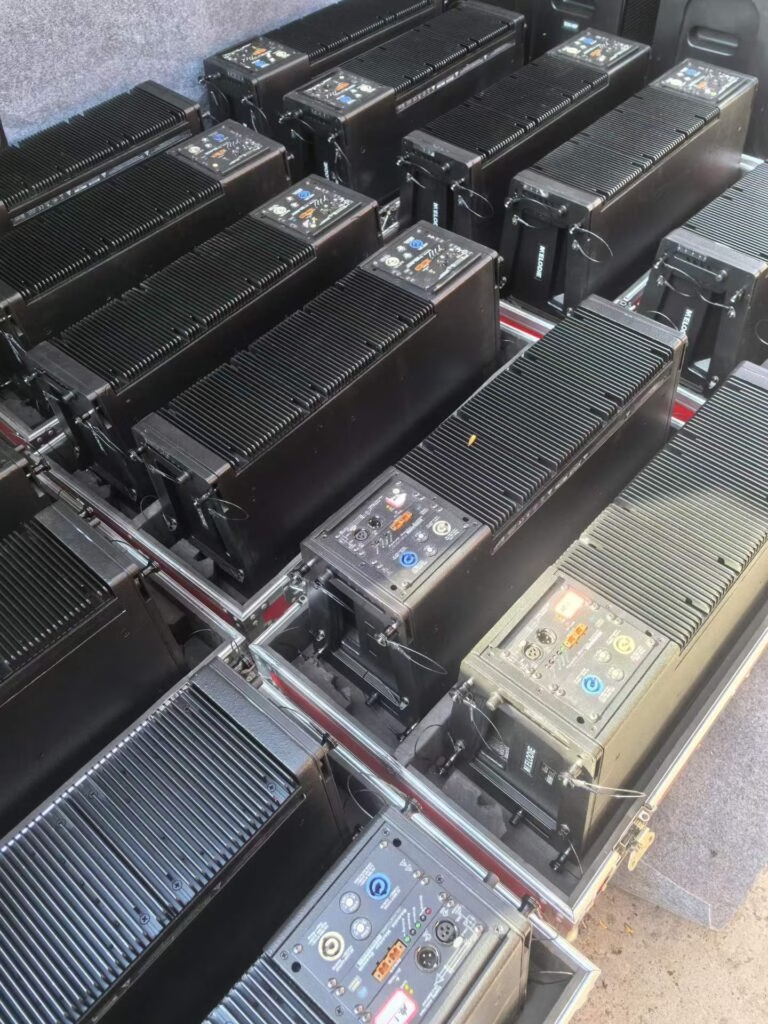
- Amp module / power supply — about 45% of failures. Capacitors dry out, output transistors go short after a hot summer in a van.
- Woofer — 25%. Foam surrounds rot, voice coils rub after a DJ pushes a 12-inch box at 105 dB for six hours.
- Horn driver / diaphragm — 20%. Cheapest fix. A replacement diaphragm for a 1.4-inch compression driver is $35–$70.
- DSP / control board — 10% but the worst. Firmware-bricked boards and dead encoder boards are rarely stocked.
How much does each repair type cost?
| Fault | Parts (USD) | Labour (USD) | Total |
|---|---|---|---|
| Diaphragm / horn | 35–70 | 30–60 | 65–130 |
| Woofer recone | 90–150 | 50–90 | 140–240 |
| Amp module | 180–260 | 60–90 | 240–350 |
| DSP board | 220–380 | 70–110 | 290–490 |
Numbers come from three repair shops I use in Guangdong and one in Rotterdam. European shops add 40–80% on labour. A bench fee of $35–$60 is standard and is charged whether or not you approve the work.
Is it cheaper to repair or replace a used active box?
Look at the used resale value first, then take the 45% rule. A K-array KF12 that changes hands around $700–$900 used can absorb a $350 amp module and still make sense. A generic 12-inch active box worth $180 used cannot absorb a $300 DSP board — you throw it away.
One exception: matched pairs. If you own six identical boxes and one dies, a $400 repair is cheaper than breaking the set. Losing one box from a six-pack forces you to buy two or run odd cabinets on a truss. That constraint has saved my clients more money than any price negotiation.
If the box is passive and the fault is only the driver, repair almost always wins. Passive boxes have no electronics to fail, so a $120 recone on a cabinet you paid $250 for is fine. Compare that to active gear, where the same cabinet carries a module that can total the whole thing.
What should you check before paying for a repair?
- Ask the shop to test the amp module on a bench, not in the cabinet. Half of “dead speaker” diagnoses are a blown fuse or a bad Speakon connector.
- Get the module part number and search availability before authorising. Obsolete class-D modules from 2012–2015 models are the usual dead end.
- Confirm the diaphragm is OEM or a known aftermarket match. A $20 eBay diaphragm on a $2,000 box sounds wrong at 3 kHz and you will hear it in every vocal.
- Ask for the old parts back. A shop that refuses is not being careful.
One more thing I tell every buyer: if the seller already knows the module is gone and prices the box at 40% of market, do the maths before you get attached. A dead module plus shipping usually lands at the same total as buying a working unit locally — unless the model is one you specifically want, like a K-array KF12 or a Yamaha DM1000 feeding your system.
When is repair the wrong call?
Three signals to stop. The board is discontinued and no donor units exist. A previous repair used the wrong module and the housing is drilled out. Or the box has already had two module replacements in four years — that pattern usually means the mains supply in the venue is dirty, and a third module will fail too.
In that last case, spending on a voltage check and a proper surge protector saves more than any repair. Cheap active boxes tolerate 240 V plus a 6% surge badly; that is 254 V into a supply designed around 230 V, and output capacitors rated 250 V do not enjoy it.
Key Takeaways
- Typical active PA repair: $120–$450, with amp modules at $180–$260 in parts.
- DSP board failure is the real risk — $300+ and often unavailable for pre-2016 models.
- Use the 45% rule: repair only if cost stays under 45% of used value.
- Matched sets get a higher tolerance because breaking a pair costs more than the repair.
- Always bench-test the module and get the old parts back.
Buying gear that still has a parts path matters more than a $50 discount. Have a look at the K-array KF12 self-powered speaker we stock with 12 units available, or browse the used speaker category.