Short answer: usually not. Almost every professional audio product sold today has either a 100-240 V switching supply or a rear selector switch for 115 V / 230 V. Converters matter for fixed-voltage gear, for Japanese 100 V stock, and for high-current amps where a cheap converter will sag.
How do you check what a unit actually needs?
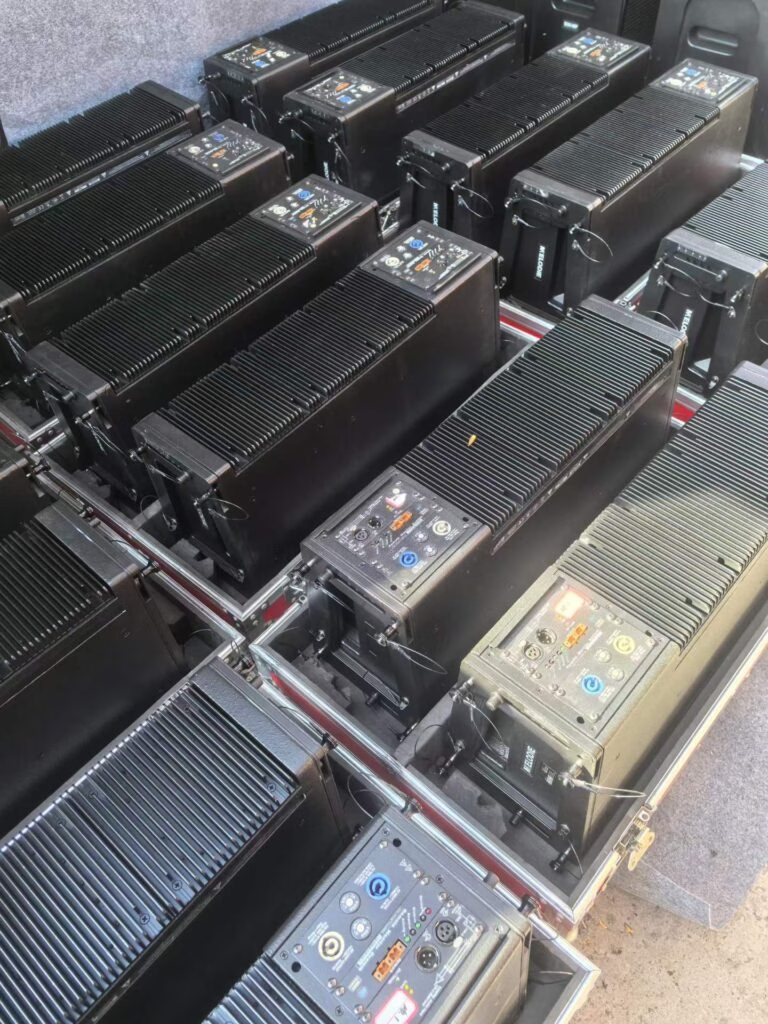
Read the label on the back panel, not the listing. It should say one of three things: “100-240 V ~ 50/60 Hz” (universal, nothing needed), “115 V / 230 V” with a small slide switch (set it and you are done), or a single fixed voltage like “230 V ~” with no switch.
The third case is the one that needs care. A fixed 230 V amp in a 120 V country will not power up properly, and a fixed 120 V amp in a 230 V country will blow its fuse or worse before you finish plugging it in.
What are the real-world voltage standards?
| Country/region | Voltage | Plug | Converter needed | China |
|---|---|---|---|---|
| 220 V | Type I/A | No, when exporting | USA / Canada | 120 V |
| Type B/A | Only for fixed 230 V units | UK / Ireland | 230 V | Type G |
| Only for fixed 120 V units | EU | 230 V | Type C/F | Only for fixed 120 V units |
| Japan | 100 V | Type A | Yes, for most 120-230 V gear | Australia |
| 230 V | Type I | Only for fixed 120 V units |
Japan is the awkward one. Its 100 V supply sits 10-20 V below what most gear expects, and a 120 V amp run at 100 V will still work, only with less headroom and more heat. A 1 kVA step-up transformer for Japan costs $90-$180 and is worth it for anything expensive.
Europe has its own trap, less obvious: older clubs wired at 220 V nominal rather than 230 V. An amp marked 230 V will run happily at 220 V, but if the supply sags to 205 V under load in a busy venue, digital gear can brown out and reset. A $60 line monitor plugged into the same circuit tells you whether that is your problem before you blame the console.
When is a converter genuinely required?
- Fixed 230 V gear going to a 120 V market (US, Canada, parts of Latin America).
- Japanese 100 V gear going to a 230 V market.
- Vintage amps without a selector switch.
- Gear from a 127 V market like Brazil going to a 230 V country.
For those cases, size the converter at 1.5-2x the amp’s rated input power. A 2×800 W amp draws about 2,000 VA at full output, so a 3 kVA step-down is the right size. Under-sizing is the classic mistake: a 1 kVA converter on a 2 kVA load will hum, sag and eventually fail.
Why is a cheap converter a bad idea?
Because cheap step-downs use a transformer with poor regulation and no thermal protection. On a power amp with a heavy transient draw, the output sags, the amp clips early, and the converter runs hot enough to smell. On a console, a sagging supply can cause digital glitches that look like a dead DSP board.
A decent 3 kVA isolation type runs $180-$350. That is cheap against a $2,000 console, and it is the difference between a rig that survives a festival and one that fails at soundcheck.
One more cost nobody budgets for: the converter itself weighs 15-25 kg. If you are shipping gear to a venue, that weight goes in the container too, and it is dead weight you cannot sell. Factor it in when you compare a fixed 230 V unit at $500 against a 115 V-selectable unit at $620. The selector version is often cheaper once the converter and its freight are counted.
What about the little plug adapters?
They only change the pin shape. They do not change voltage. A Type A to Type G adapter does nothing for a 120 V unit plugged into 230 V. Every year someone plugs a US amp into a UK socket with a $3 adapter and turns the power supply into a firework.
Also check current rating. A cheap adapter rated at 6 A will get hot on a 2 kW amp. Buy adapters rated for at least 13 A and check the fuse.
How does this affect buying used stock from China?
Chinese domestic stock is almost always 220 V, which suits Europe, Africa, the Middle East, Australia and most of Asia without a converter. For US and Canadian buyers, most export stock can be set to 115 V via the selector, or comes with a universal supply. Ask for a photo of the back-panel label before you pay — it takes the seller 30 seconds and it removes the whole question.
Current stock is listed on our used sound equipment shop page with the input voltage noted per unit. If you need 115 V stock, say so when you enquire and we will confirm from the label.
Key Takeaways
- Most modern pro audio gear is 100-240 V and needs no converter at all.
- Read the back-panel label; a selector switch is not the same as fixed voltage.
- Size a converter at 1.5-2x the amp’s input power — a 3 kVA unit for a 2 kW amp.
- Japan’s 100 V supply is the most common reason a converter is actually required.
- Plug adapters change pins, not voltage, and a 6 A adapter will overheat.