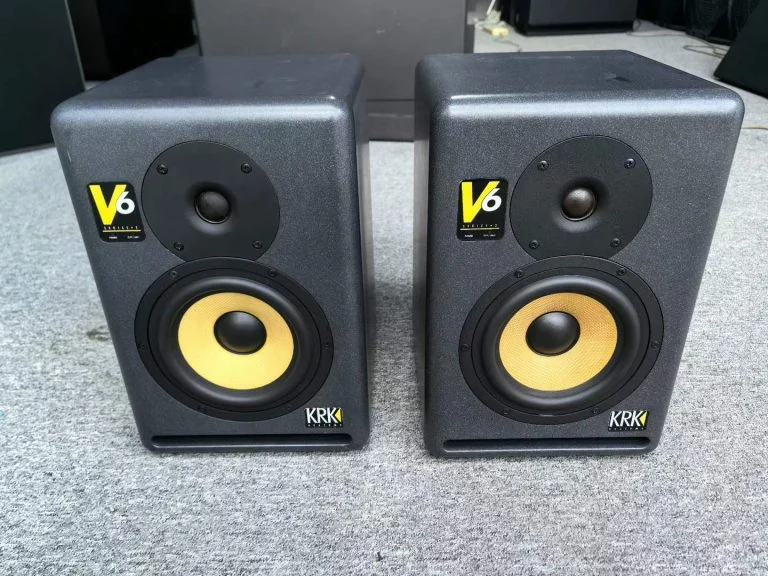
Spend the money on a matched pair, not on a newer model. Used studio monitors sell at 40-55% of new, and the parts that define the sound, drivers and cabinets, age slowly. A used KRK V6 Series 3 pair runs USD 320-450 against USD 799 new. The risk is entirely in the electronics you cannot see.
Active monitors hide an amplifier and a DSP board behind the woofer magnet. When that board dies, the monitor stops being a monitor.
What separates a good used pair from a bad one?
- Same production run, same serial prefix on both units.
- Under 10 years old, so surrounds are still supple.
- Amp plates warm but not hot after 30 minutes at moderate level.
- No hiss at unity gain with nothing playing.
- Original power supply, not a generic replacement brick.
How do you test them?
Feed the same mono signal to each monitor separately at the same level. Sweep 40 Hz to 16 kHz. A buzz around 200-400 Hz means cabinet resonance. A rasp above 10 kHz means a tired tweeter. Neither is fixable cheaply on a sealed active cabinet.
Then kill the signal and listen at unity gain. Audible hiss will ruin quiet passages, and no amount of acoustic treatment hides it.
When is new the better call?
| Situation | Buy used? | Why |
|---|---|---|
| Matched pair, under 10 years | Yes | 45% saving, low risk |
| Adding one unit to an existing pair | Risky | Run-to-run variation is audible |
| DSP-corrected model from before 2015 | No | Board failure is terminal |
| Pairs under USD 300 new | No | USD 100 saving is not worth it |
Should you treat the room first?
Yes. A USD 450 used pair in a treated room beats a USD 1,500 new pair against a bare wall with a 120 Hz null. Bass traps and a thick rug change the frequency response more than any model upgrade under USD 2,000.
Nearfield monitors are for close listening, not for playback in a room. If you need volume and throw, a powered PA box makes more sense than a bigger monitor. Our KRK V6 Series 3 pair covers the mixing side, and the K-array KF12 covers playback.
Key Takeaways
- Used monitors save 40-55% and their drivers usually last a decade.
- Test each unit separately and listen for buzz at 200-400 Hz.
- Mismatched tweeters make every mix decision slightly wrong.
- Below USD 300 new, used savings do not justify the risk.
- Treat the room before you upgrade the monitors.