Direct answer: on used audio gear, “Excellent” and “Like New” are seller words, not standards. In practice “Like New” means unboxed and used under 20 hours with no marks, about 60-75% of new price; “Excellent” means fully working with light scuffs, about 50-65% of new price. Neither word tells you the age of the capacitors or the wear on the faders.
That is the bit buyers miss. Two speakers graded Excellent can be two years apart in real condition and five years apart in capacitor age. One will outlive the other by a decade, and the grade looks identical on both listings.
Is there one grading scale everyone uses?
No. Reverb runs its own Mint to Poor ladder, eBay sellers invent words, and Chinese exporters take the domestic 骨蔽 scale (99成新, 95成新, 9成新) and map it loosely onto English. “9成新” becomes “90% new”, which sounds precise and means nothing measurable.
Treat the grade as a filter to shortlist, then verify with specifics. The question that matters is not how many stars, it is what has been replaced, what is worn, and whether it still measures in spec.
What should each grade realistically allow?
| Grade | Cosmetics | Function | Typical discount |
|---|---|---|---|
| Like New | No visible marks, original box | Under 20 hours of use | 60-75% of new price |
| Excellent | Light scuffs, faded badges | All original drivers, full output | 50-65% of new price |
| Good | Scratches, dented corners | Works, 1-2 replaced parts | 35-50% of new price |
| Fair / Parts | Cracks, missing grilles | Intermittent or dead channel | 15-30% of new price |
Why do the words fail on speakers but work on mixers?
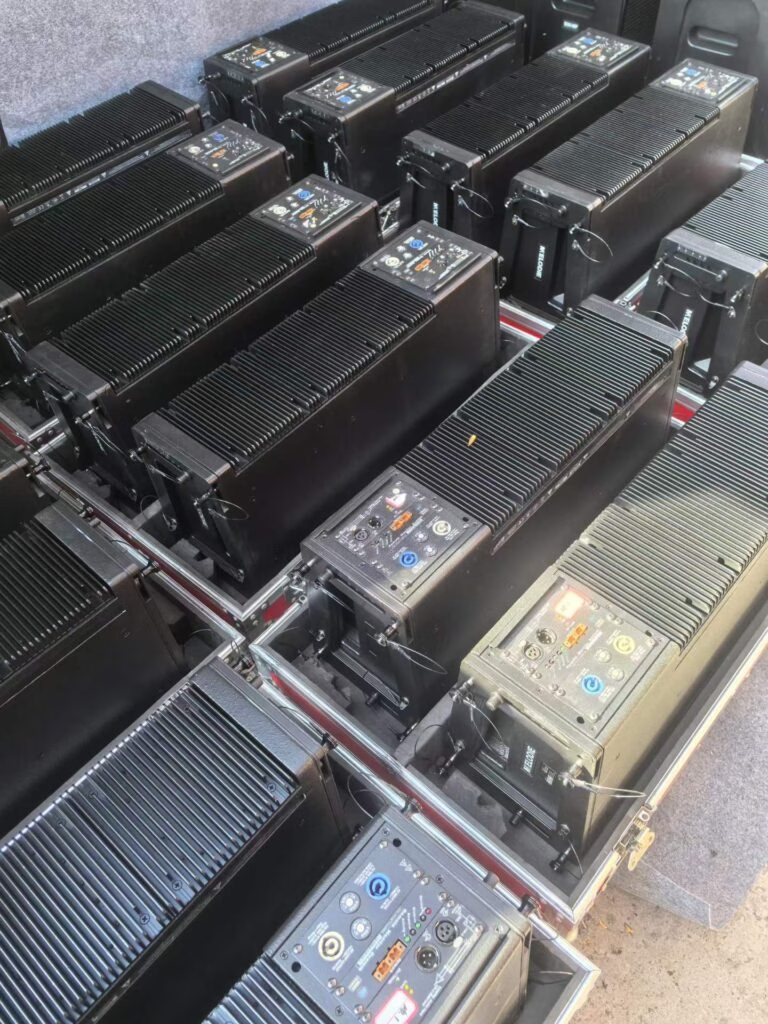
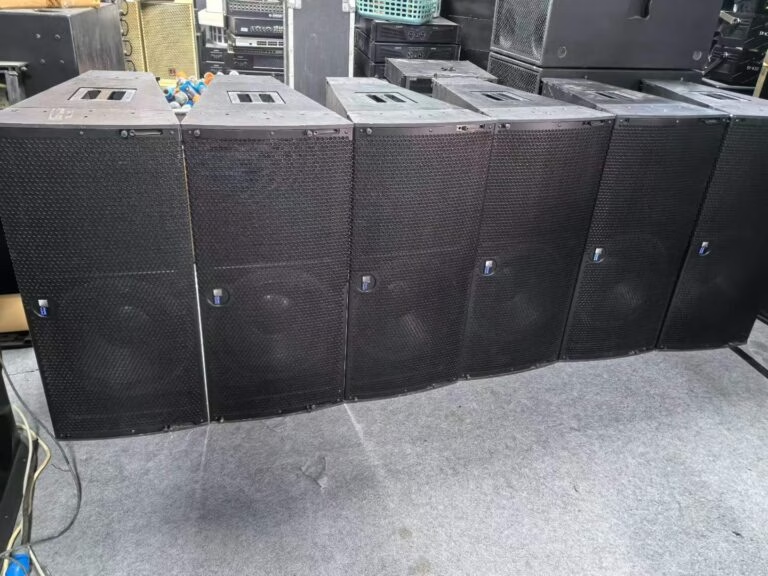
A powered speaker is a wooden box with a driver, an amp module and a DSP board. The box grade tells you about the wood. It says nothing about the module. A 2013 K-array KF12 that has done 400 events can look Excellent and still have capacitors at end of life, which shows up as hum at idle or a dropout on the first hot night.
The K-array KF12 self-powered 2-way speaker is a fair reference here: graded Excellent with all 12 original drivers, and that claim is worth something because the amp modules were bench-tested at 1kHz for 30 minutes each, not just switched on.
Consoles are easier. A DM1000 graded Excellent means every fader moves freely, the LCD is readable at normal angle, and all 16 mic inputs pass signal. Those three checks cover 90% of real failures on that desk, which is why console grades travel better than speaker grades.
What does a paid inspection actually look like?
If the seller is 8,000km away, the inspection is a checklist you send them. Give the exact tests: switch on with no input for 3 minutes and record the noise floor, run pink noise at 90dB for 5 minutes, sweep the master fader and listen for crackle, and photograph the inside of the amp module if it is accessible. Requests that specific get honest answers, because faking them takes real effort.
Expect a small charge, $20-40, for the seller’s time. It is the cheapest insurance in this purchase. Two of the last ten used speaker batches I handled had a dead channel that a five-minute test caught before the container loaded.
Keep the recording. If the unit arrives humming at 100Hz and the video was clean, you have proof and a claim on the deposit. Without the video you have a phone call and goodwill, which are worth about $0.
What should you actually ask before trusting a grade?
- Serial number and a photo of the rear label. Refurbishers relabel; genuine serials are harder to fake.
- Hours of use, if the unit logs them. Digital consoles and DSP amps often do.
- Which parts were replaced, and with what. “New amp module” without a brand is a red flag.
- A video at full volume for at least 60 seconds, showing the meters.
Two more things worth checking: the K-array KF12 listing, where every listing has a rear-panel photo, and the condition notes on the used speakers category page. Neither replaces your own serial-number check.
Key Takeaways
- Grades are seller vocabulary, not a technical standard.
- Like New = under 20 hours, 60-75% of new. Excellent = working, light scuffs, 50-65%.
- On powered speakers, the cabinet grade says nothing about amp module life.
- Ask for serial number, replaced parts list and a 60-second playing video.