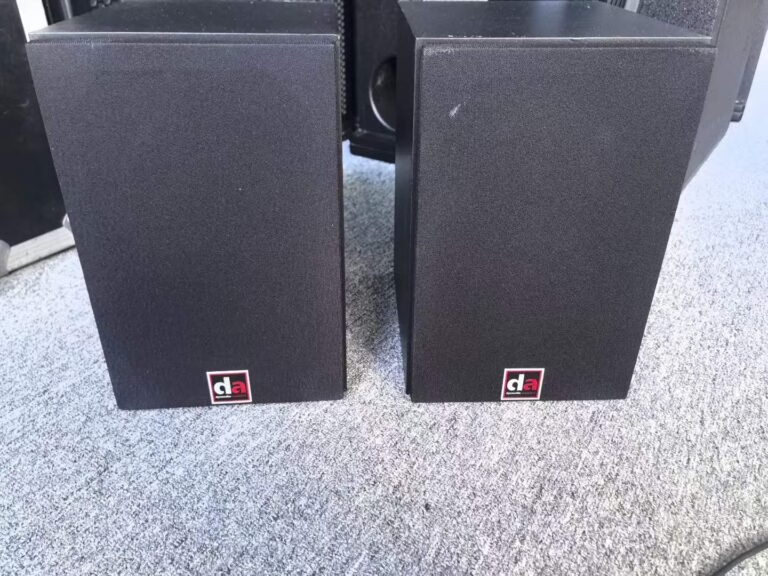
Yes for mixing, no for mastering. The KRK V6 Series 3 rolls off around 45 Hz, so you will make bass decisions with incomplete information, and that is the same problem it had when new. What you get at half price is a midrange you can trust and a cabinet that survives 10 years on a shelf.
What does a used V6 pair cost in 2026?
| Item | Price |
|---|---|
| New V6 Series 4 pair | $900-1,000 |
| Used V6 Series 3 pair | $380-550 |
| Replacement tweeter | $65-110 |
| Amp module repair | $90-160 |
Note the repair line. A used pair at $420 plus a $160 amp repair equals close to new-adjacent money. Budget for one repair across the pair and you are still ahead, but only if you buy at $450 or lower.
How does the V6 compare with modern budget monitors?
The V6 beats most $400 new pairs on cabinet resonance and cabinet volume. It loses on DSP. Modern budget monitors often ship with built-in room correction and a proper crossover at 2.2 kHz, while the V6 uses a simpler analog crossover and rear-panel boundary EQ only.
If you mix in an untreated room, a modern cheap monitor with DSP correction may beat a used V6. If you have some treatment already, the V6 wins.
What fails on a V6 and how do you spot it?
- Tweeter dome pushed in by an enthusiastic guest: look for a dented dome, it changes HF response
- Amp hiss at idle: put your ear 20 cm away, should be inaudible with no input
- Power switch crackle, a $12 part but an annoying job
- Rubber surround cracking on units stored in dry, hot rooms
Is it worth it over buying new?
At $400 or below, yes. Above $500, buy new with a warranty. The V6 earns its keep on midrange accuracy and on the fact that a decade-old pair still holds value if you resell in two years.
See the current listing for the KRK V6 Series 3 active studio monitor pair.
What is the biggest limitation?
Low end. A 6.5 inch woofer in a small sealed-adjacent box does not tell you what is happening at 40 Hz, and most electronic music lives there. Keep a pair of headphones you trust as a cross-check, and accept that this monitor is a midrange tool.
Key Takeaways
- A used V6 Series 3 pair runs $380 to $550 against $900 to $1,000 new.
- Buy at $450 or below; above $500, new with warranty wins.
- Roll-off near 45 Hz makes bass decisions unreliable.
- Budget $65 to $160 for one tweeter or amp repair across the pair.
- Dented tweeter domes are the most common used-market defect.
How do you place a V6 in a small untreated room?
Close to the front wall, 30 to 60 cm, and away from corners. The V6 has rear-panel boundary EQ, so use it: if the desk sits within 40 cm of a wall, cut the low shelf by 2 to 3 dB. Tweeters at ear height, forming an equilateral triangle with your head. That is free and it beats most room correction software.
A 3.5 m by 4 m bedroom studio will have a strong mode around 43 Hz and another near 86 Hz. Neither is fixable with EQ on a monitor that rolls off at 45 Hz.
How do you verify a used pair actually matches?
Play a mono pink noise file and stand between the speakers. A matched pair images dead centre. A mismatched pair, even one with a replaced tweeter from a different batch, pulls the image to one side. Do this test before paying; it takes 60 seconds and catches more problems than any spec check.
What is the honest verdict after 10 years?
- Good midrange, trustworthy for vocal and guitar mixing
- Weak below 50 Hz, so always cross-check bass on headphones
- Rear-panel controls are coarse: three-position switches, not fine EQ
- At $400 or less, it is still the sensible buy for a treated small room