Buy used if the pair is matched and the surrounds are intact. Everything else is noise. A used pair of 6-inch active studio monitors runs $180-450 against $350-800 new, and the driver technology has barely moved in ten years. What has moved is capacitor age.
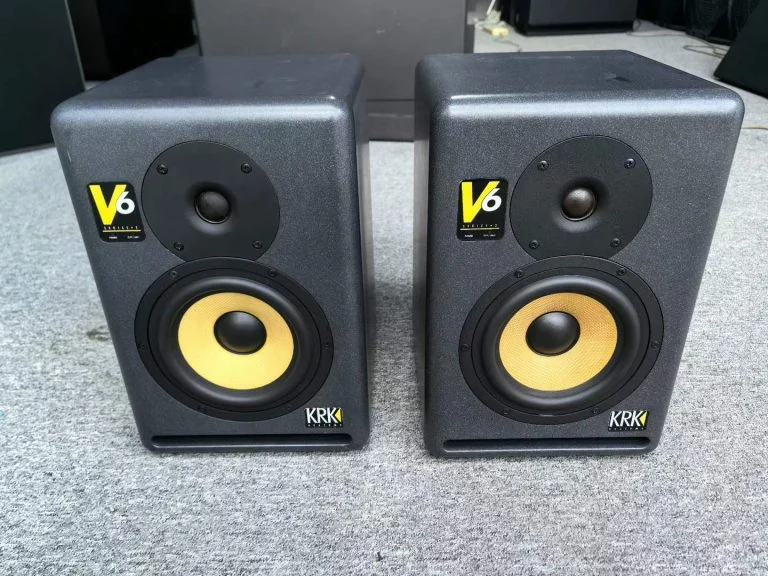
Studio monitors are one of the few audio categories where used makes almost no functional compromise. A 2014 pair of KRK V6s and a 2024 pair do the same job. The differences that matter are physical: foam, capacitance and whether the two boxes were ever really a pair.
What actually matters more on used studio monitors — drivers or amps?
The amps, and specifically the capacitors. An active monitor has a power amp per driver and a crossover built from electrolytics. After 12-15 years those caps drift, and the drift is not identical between two cabinets that have run at different temperatures. The result: your stereo image tilts, and you mix 1-2 dB bright on one side without knowing it.
You can measure it. Play a mono pink-noise track, sit at the listening position, and switch between L and R. The two should sound near-identical. If one is duller or louder by more than 1 dB, the caps or a driver have drifted.
How do you check foam and surrounds on used studio monitors?
Look at the woofer surround with a torch at an angle. Cracks, a chalky texture, or foam that crumbles when touched means it is done. Foam surrounds have a real lifespan of 12-15 years regardless of use, so an unused pair stored in a dry room can be worse than a working pair.
Refoam kits are $25-45 per driver and a competent shop charges $60-90 to fit them. That is a reasonable repair on a $400 speaker and a poor one on a $120 speaker — which is why cheap used monitors at 15 years old are usually a false economy.
Is a used pair always a matched pair?
No. This is the most common problem with used studio monitors and the hardest to spot. Buyers upgrade one cabinet after a failure, then sell the pair. Serial numbers one apart are ideal. Serial numbers from different production runs mean different tweeter revisions and a slightly different crossover.
Our KRK V6 Series 3 active studio monitor pair is listed with both serial numbers precisely because that is the thing buyers keep asking about. A matched pair from one run is worth 15-20% more than a mismatched one, and it is worth paying.
How much should used studio monitors cost?
| Size / class | Used pair | New pair | Worth it? |
|---|---|---|---|
| 5-inch entry active | $120-280 | $250-450 | Only if under 6 years old |
| 6-7 inch mid active | $180-450 | $350-800 | Yes, if matched |
| 8-inch active | $350-800 | $700-1,500 | Yes |
| Passive + amp | $200-600 | $500-1,200 | Yes, easier to repair |
Passive monitors with an outboard amp deserve more attention than they get. They are harder to place and you need a decent amp, but when something fails you replace one box instead of hunting a discontinued amp module.
Do you need a subwoofer with used studio monitors?
Probably not, and adding one badly is worse than not adding one. A 6-inch monitor rolls off around 45-55 Hz. A sub crossed at 80 Hz fills the bottom octave, but in an untreated room under 25 square metres it usually excites a room mode instead. If you do add one, put it 30-40 cm off the floor and cross it no higher than 85 Hz. If you cannot localise it by ear, it is set up right.
What if your room is the real limitation?
Then used is clearly right. Below 20 square metres, room modes around 80-150 Hz dominate whatever you spent on monitors. Put the money into bass traps and a used pair of 6-inch monitors instead of a new pair of 8-inch ones. A $300 used pair in a treated small room out-resolves a $900 new pair against a bare wall every time.
If you also run live sound from the same room, a used digital desk is a cheap way to add monitoring control — the Yamaha DM1000 gives 48 channels and 16 auxes for under $1,500 used, which is less than most 8-channel interfaces.
Key Takeaways
- Matched serial numbers matter more than age.
- Foam surrounds last 12-15 years whether used or not.
- Pink noise L/R test exposes cap drift in 60 seconds.
- Under 20 m², spend on treatment before bigger drivers.