
Description
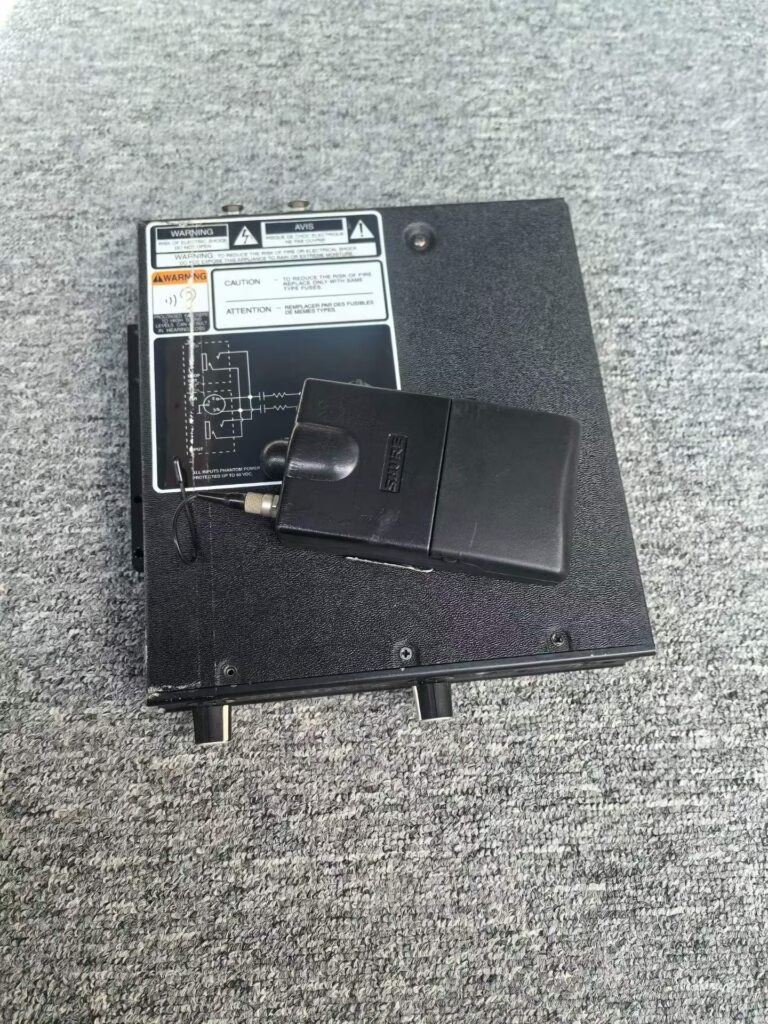
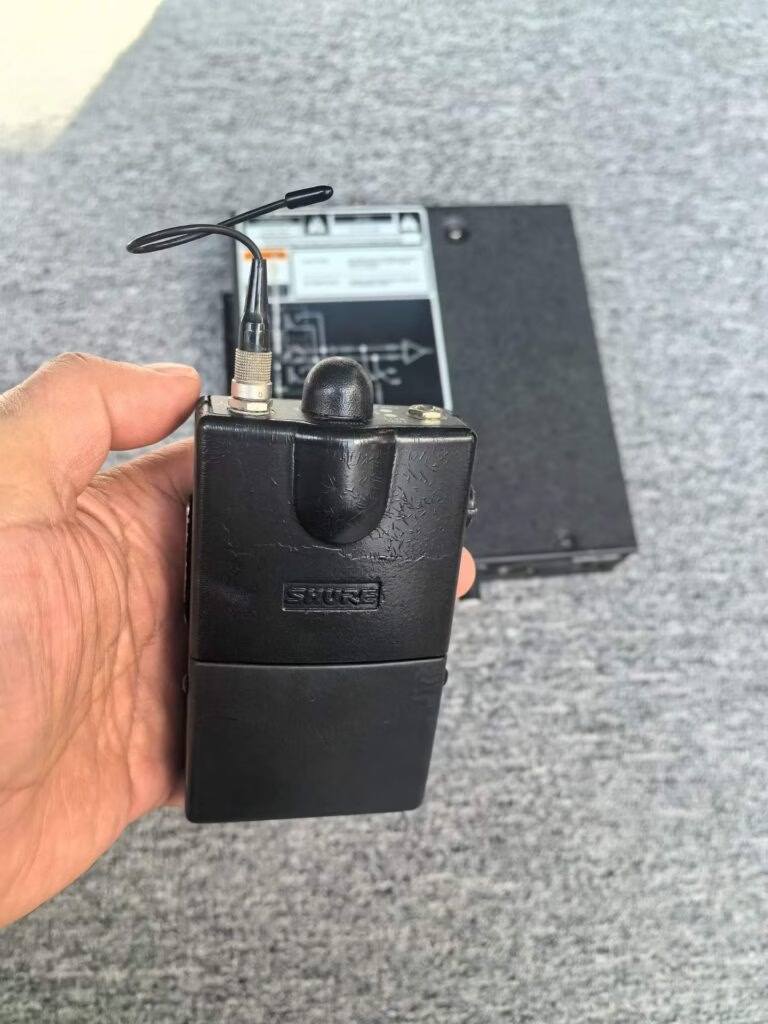
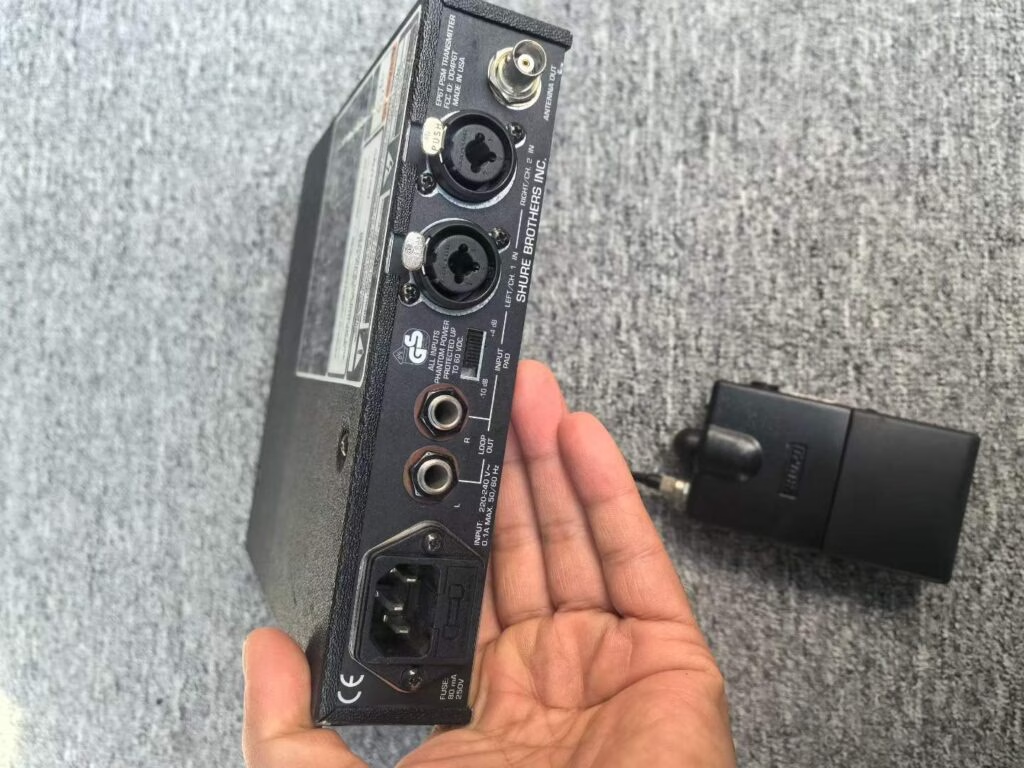
What this is: a Shure PSM 600 personal monitor system — one EP6T half-rack stereo transmitter and one P6R belt-pack receiver. The PSM 600 was Shure’s entry into serious in-ear monitoring, and the EP6T on the back panel is the export version: the 220–240 V mains model with the CE mark, which is what most of the world outside North America actually needs.
If you have been priced out of PSM 900 or PSM 1000 gear, this is the honest alternative. It is analogue UHF, it is stereo, and it has the one feature that most cheap IEM systems still lack: proper MixMode, so a performer can blend their own voice against the band from two separate feeds without asking the monitor engineer for anything.
Why the PSM 600 still earns its rack space
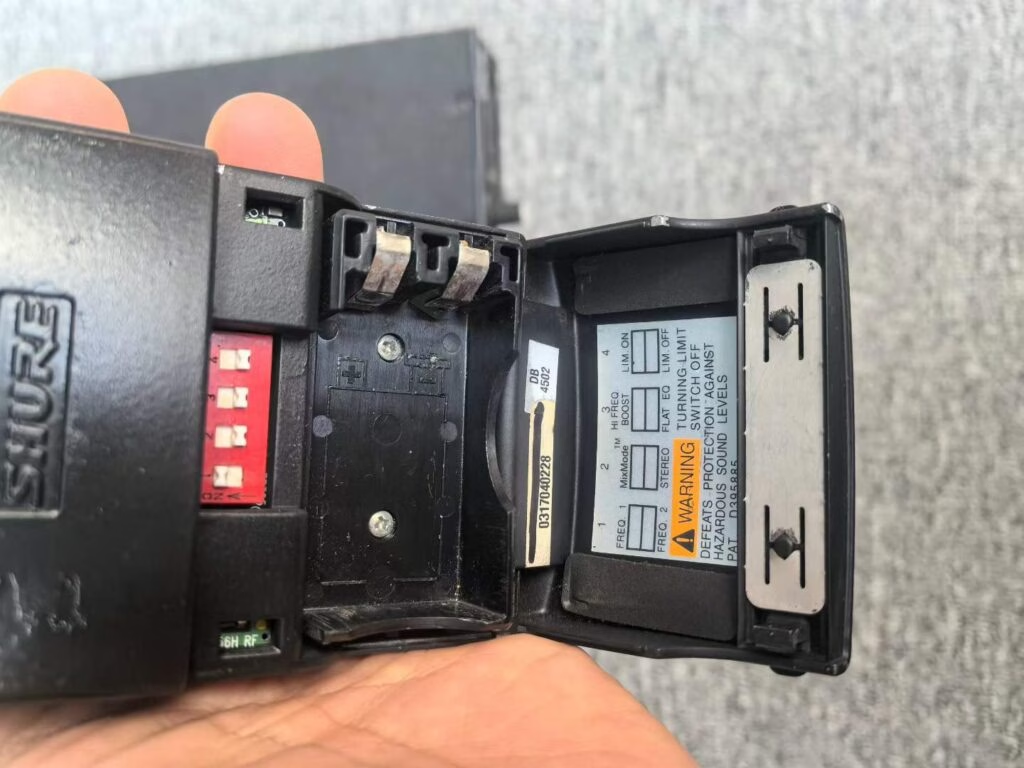
Modern digital IEM systems do more — networking, encryption, per-pack limiting, phone apps. They also cost five figures per system and they can fail in ways that require a laptop to diagnose. The PSM 600 does one job: it takes two line-level inputs, transmits them in stereo (or as two independent mono mixes), and a belt pack plays them back into a pair of earphones. There is no menu, no network, no firmware. The P6R is configured with four recessed DIP switches, and the settings are printed on the inside of the battery door so you cannot lose them.
For a working bar band, a church, a small theatre or a rehearsal room, that is usually all anyone actually needs.
What is in this listing
- Shure EP6T stereo transmitter — half-rack, 1U chassis, internal linear power supply, 220–240 V AC 50/60 Hz input
- Two combined XLR / 1/4-inch TRS inputs (LEFT/CH. 1 and RIGHT/CH. 2), electronically balanced
- L/R LOOP OUT jacks for daisy-chaining the same mix to a second transmitter or a recording device
- INPUT PAD switch, +4 dBu / −10 dBV, with phantom-power protection on every input up to 50 V DC
- BNC ANTENNA OUT with the whip antenna fitted
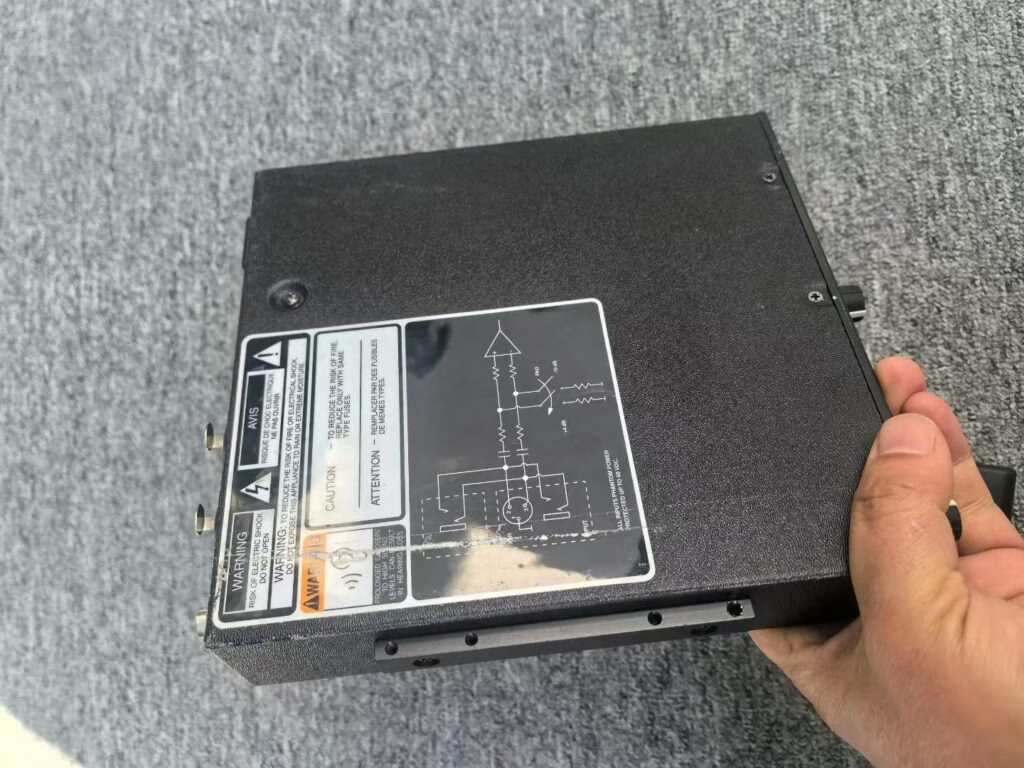
- Rear safety and fuse labelling intact; internal fuse is the 230 V 80 mA / 250 V time-delay type
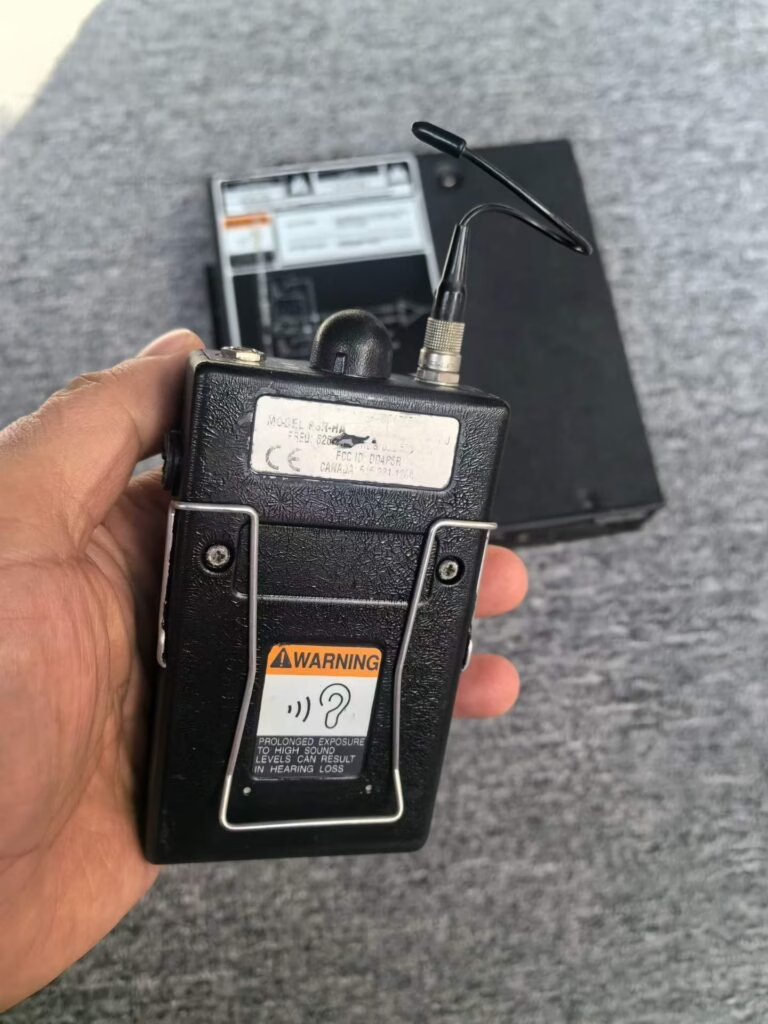
- Shure P6R body-pack receiver — metal body, belt clip, whip antenna, 9 V battery, 3.5 mm stereo earphone jack
- One 9 V battery is included with the pack as photographed
What you will need to add
No earphones are included. The P6R drives any 3.5 mm stereo earphone with an impedance of 16 Ω or more — which covers everything from a pair of cheap earbuds to moulded custom IEMs. If you are buying this for a vocalist, budget for proper moulds; the difference between generic buds and moulds matters far more than the difference between this system and a newer one.
You will also want a rack shelf or the original PA745 rack-mount kit if you are putting the EP6T in a case. As photographed the transmitter is a bare unit, not in a rack.
The honest part: bands and licensing
This is the bit that decides whether the system is useful to you, so read it before you order. The EP6T covers the 626–862 MHz UHF range, and which slice of that range your unit actually transmits on depends on the country code it was built for. Shure shipped the PSM 600 in a long list of country versions — HA and HB on 626.475/632.550 and 629.975/634.775 MHz, HC through HE up around 642–656 MHz, the MF/MG/MH/MJ/MK codes in the 801–828 MHz region for most of continental Europe, KB/KC/KD around 855–861 MHz for the UK and Ireland.
We have not been able to read the frequency table on this specific unit, so we are not going to pretend to know which one it is. What we will do is photograph the rear frequency label and the model sticker for you before you pay. Ask, and you get the photos.
That matters because 626–698 MHz is not usable in the United States. The FCC sold that spectrum to mobile operators; 600 MHz wireless operation is prohibited there, and any transmitter that lands in that range is a paperweight in the US. This EP6T is the 230 V export version, which is consistent with it being a European or Asian market unit — but confirm the band with us rather than assuming.
In most of Europe, an in-ear monitor system needs an operator licence or must sit inside a licence-exempt channel, and the rules changed again in 2024. Check your national regulator before you power it up on stage.
Condition, honestly stated
Used, working, and cosmetically honest. The transmitter chassis has scuffs on the edges from rack life and the rear panel labels are intact but not mint. The P6R body pack shows the usual polishing on the belt clip and around the battery door, and one small dymo-style asset label is on the case. The battery door is present and closes properly, and the DIP switch legend inside it is fully legible, which is more than you can say for most units that have been on the road since the nineties.
We have powered the transmitter and confirmed it runs, and the receiver’s battery contacts are clean. We have not done an RF walk test or measured deviation — if you need that, tell us and we will do it and send the numbers rather than a promise.
Specifications (Shure PSM 600, from the manual)
Transmitter — EP6T
- RF output power: 100 mW (+20 dBm) typical, conducted (country dependent)
- Modulation: FM ±35 kHz deviation nominal, MPX stereo
- Audio response: 50 Hz – 15 kHz (+0, −3 dB re 1 kHz)
- Inputs: XLR female and 1/4-inch TRS combined, electronically balanced, 20 kΩ
- Nominal input level: +4 dBu or −10 dBV (switchable pad)
- Maximum input level: +25 dBu (+4 setting) / +13 dBu (−10 setting)
- Phantom power protection: up to 60 V DC
- Power: EP6T 220–240 V AC, 50/60 Hz; 55 mA max at 230 V; fuse 80 mA / 250 V time delay
- Dimensions: 44.5 × 197.4 × 238.1 mm (1¾ × 7¾ × 9⅜ in), half-rack
- Weight: 1.62 kg (3 lb 9 oz)
Receiver — P6R
- RF sensitivity: 1.2 µV typical; image rejection 70 dB; spurious rejection 60 dB
- Squelch threshold: 4 µV typical
- Audio output: 3.5 mm stereo jack, left = tip, right = ring, ground = sleeve; minimum load 16 Ω
- Battery: 9 V, 4–6 hours depending on volume
- Dimensions: 27.2 × 64.5 × 85.1 mm; weight 0.52 lb
- User settings via 4-position DIP switch: Freq 1/2, Stereo or MixMode, Hi-Freq Boost or Flat EQ, Limiter on/off
- Price: on request
Who it suits
- Bands moving to in-ears for the first time — cheap entry, real Shure RF, and MixMode without extra hardware.
- Houses of worship — the transmitter lives in a rack, the pack goes to whoever is singing that week.
- Theatre and corporate AV — two mono mixes from one transmitter is genuinely useful for a presenter plus a musical cue feed.
- Anyone outside North America — the 230 V EP6T is the version you need, and the CE marking is real, not a sticker.
Shipping and questions
Both units ship together, packed properly. Tell us your country and we will confirm the band before dispatch, because shipping an IEM system to the wrong regulatory region helps nobody. Ask for the rear-label photos if you want to check the frequency yourself.
More options in used in-ear monitors, our Shure UR2 handheld transmitters if you need the mic side of a wireless rig, or the full used inventory for consoles, amps and PA. Shipping outside the region is covered on our export page.