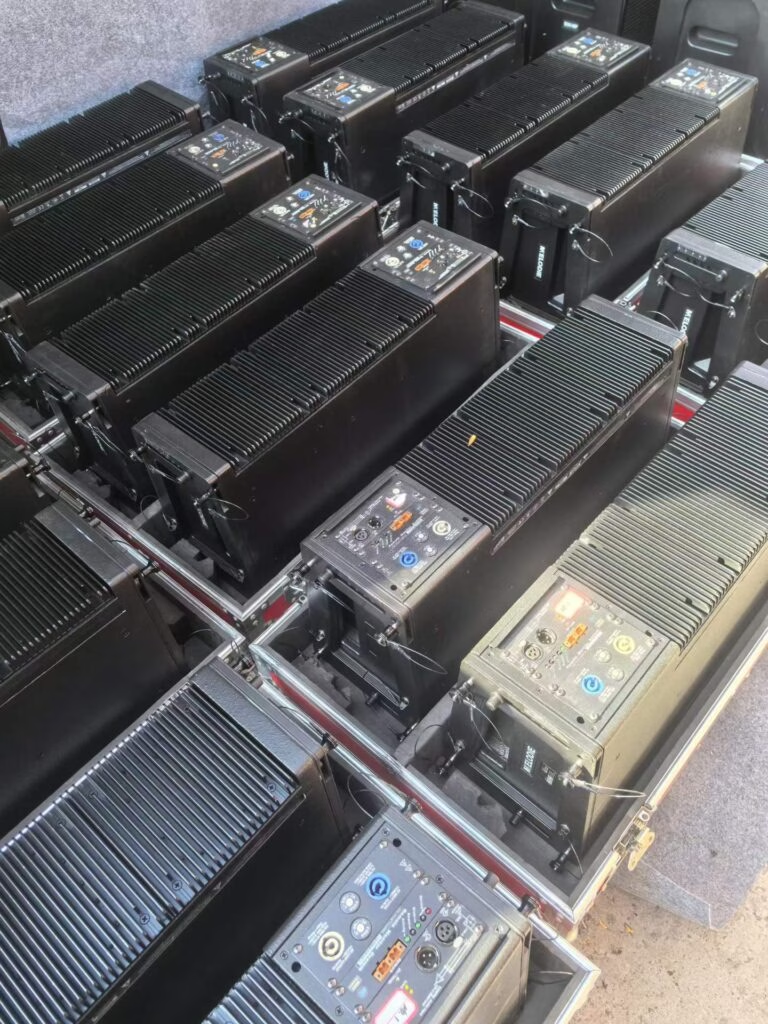
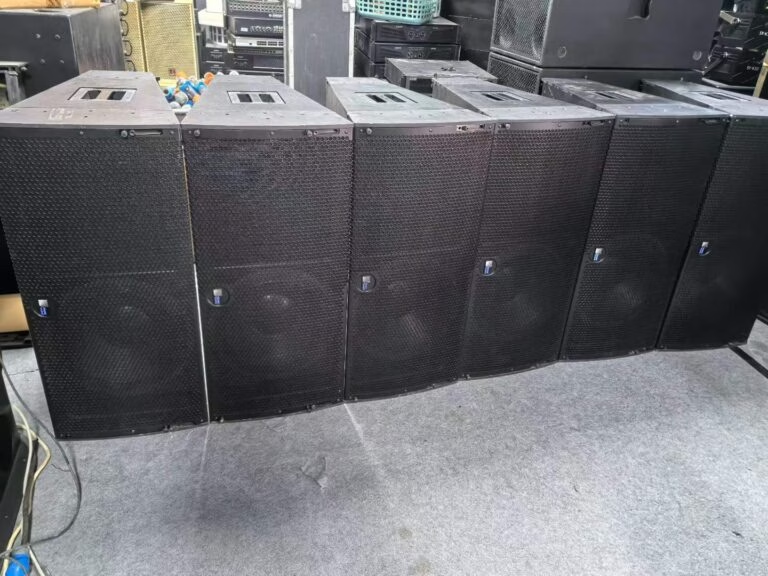
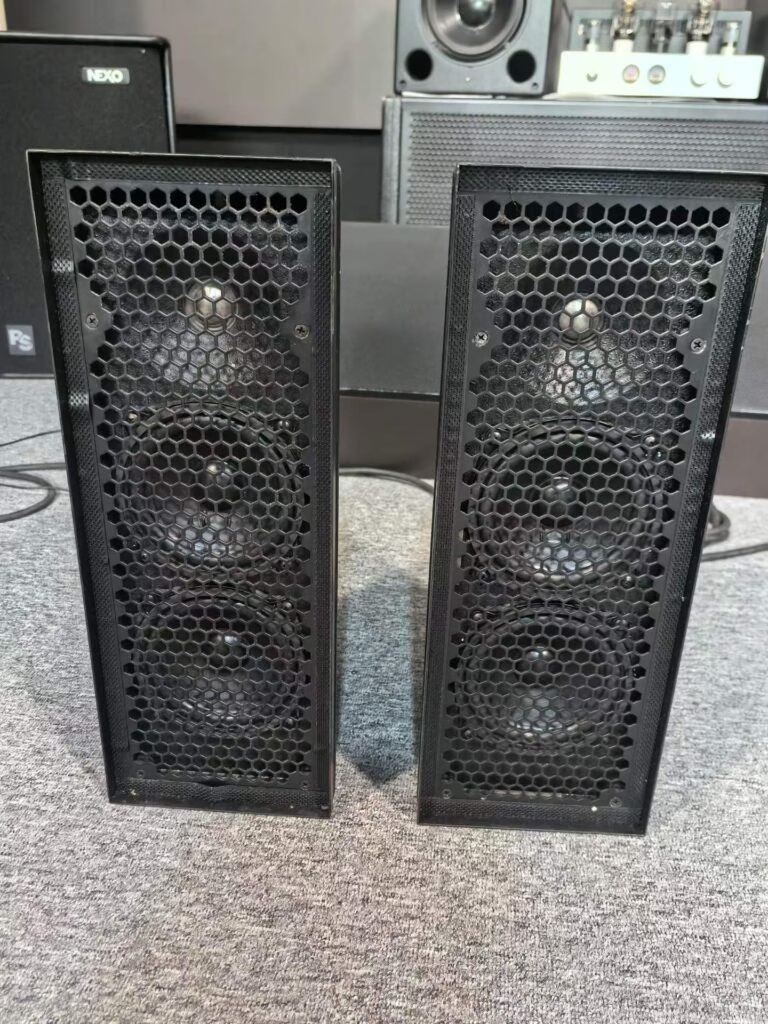
Expect to pay 30-55% of the new price for used professional audio gear. A powered 12-inch speaker that cost $1,000 new sells for $300-500. A 16-channel analog console from 2015 is worth around $250-600 depending on condition. Pay more than 60% of retail and you are paying new-money for old hardware.
These numbers are for working gear with a known history, not for eBay mystery boxes. Chinese export lots are a different market entirely, and that market is where most of the bargains sit right now.
What are the real ranges in 2026?
Prices below come from export listings and European and African dealer stock observed over the past year. Shipping is not included; a 40HQ container of speakers from Shenzhen to Durban adds roughly $2,800-4,500 in ocean freight.
| Category | New price band | Used fair price | Notes |
|---|---|---|---|
| Powered 12″ speaker (pair) | $1,400-2,200 | $450-800 | Check amp module date |
| Passive 15″ full-range (pair) | $700-1,200 | $180-350 | Cheapest value in the market |
| 16-32ch analog console | $1,200-3,000 | $250-700 | Faders are the cost driver |
| Digital console 32-48ch | $4,000-12,000 | $1,200-3,500 | Firmware and touchscreen matter |
| DJ controller (2ch) | $700-1,100 | $250-420 | Jog wheels wear fast |
| Tour amp, 4x1000W+ | $3,000-8,000 | $700-2,000 | Capacitor age is the gamble |
Compare those figures with a JBL KP4010 pair we list at a fraction of the new street price, and it becomes obvious why export buyers stop shopping locally. The bulk lot version is priced per box, which is how rental companies actually buy.
A pair of JBL KP4010 passive 10-inch speakers is a typical entry point for a small club or a mobile DJ who needs volume without a speaker-management system.
Why is used dj equipment for sale cheap in some markets?
Three things drive price down, and only one of them is good news.
- Stock rotation. Rental houses in Shenzhen and Guangzhou retire gear on a fixed 3-5 year cycle whether it is broken or not. That is the good discount.
- Missing accessories. No flight case, no power cable, no rack ears. Easy to fix for $60-150, but sellers price it as damaged.
- Grey imports. Units brought in without a paper trail. Cheap until a firmware lock or a dead amp module arrives and nobody stocks the part.
How much should condition knock off the price?
Physical scratches are cosmetic and worth a 5-10% discount at most. Grille dents cost more than people think because a rattle shows up at high SPL. A re-coned driver means the price should drop 25% or you walk.
What actually matters is whether the gear was in a rack or thrown in a van. Rack-mounted gear with intact paint on the front panel almost always outlasts nicer-looking gear that travelled loose. Ask for a photo of the back panel, not the front. Back panels tell the truth: worn speakON sockets, mismatched screws, a replaced IEC inlet.
What hidden costs should you add to the budget?
Add 15-20% on top of the purchase price for a first-year service. Amplifier capacitors on 10-year-old tour amps are the usual surprise: a full recap on a 4-channel touring amp runs $250-450 in parts and labour. If you are importing, add customs duty (typically 5-20% by country and HS code), port handling of $150-400 per container, and inland trucking.
Budget the shipping as a fixed block rather than per unit. It changes the maths completely: on a $4,000 order, freight and duty can be 40% of the landed cost. On a $20,000 order the same container adds 12%. This is the single strongest argument for buying in quantity rather than one piece at a time.
Where should you not try to save money?
- Microphones. A used condenser with a dirty capsule cannot be fixed cheaply. Buy new unless you can test it in person.
- Anything with a lithium battery. DJ gear and wireless receivers with sealed cells are a shipping headache and replacements are often discontinued.
- One-off digital consoles. If the manufacturer stopped firmware support before 2020, a dead touchscreen turns the console into a doorstop.
The reverse is also true. Passive speakers, analog power amps, mic stands, cable, and flight cases are the safest used buys in the entire category. Very little to break, and what breaks is repairable by any decent tech.
How do you negotiate a used audio equipment price without being annoying?
Ask one question and then wait: “What is the lowest price for the full lot?” Sellers who move volume answer with a number. Sellers who don’t, quote the list price again. Then offer 85% of whatever they said, in writing, with a 48-hour validity. That structure works because it gives them a decision with a deadline instead of a debate.
Photo evidence of a known fault is your best lever. A dented grille, a scratch on a mixer’s LCD or a missing knob is worth 10-15% off, and most sellers would rather take it than relist.
Key Takeaways
- Used pro audio trades at 30-55% of new price; above 60% only for near-new gear with documentation.
- Passive speakers and analog amps are the safest used purchases; condenser mics and battery-powered gear are the riskiest.
- Budget 15-20% extra for a first-year service, especially on amplifier capacitors.
- Freight plus duty runs 12-40% of landed cost depending on order size, so buy in volume.
- Negotiate with a written offer at 85% and a 48-hour deadline.
Want a landed-cost quote on a specific lot? Send the model list and destination port through our contact page and you will get a number, not a brochure.