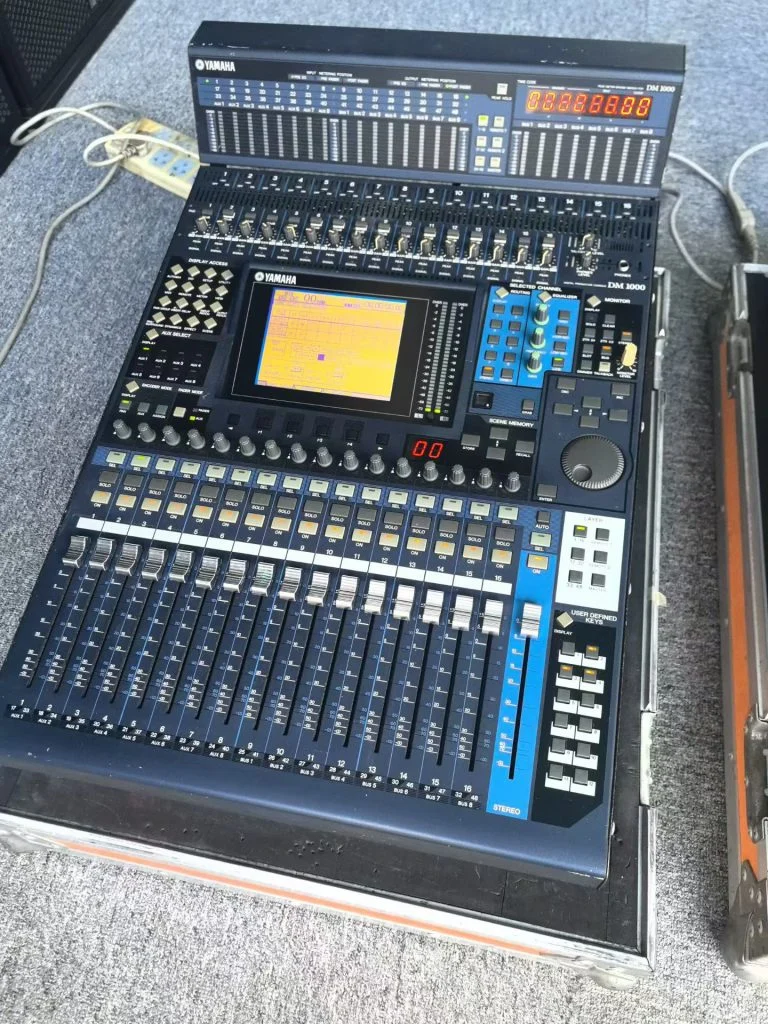
Where it still earns its keep: corporate AV, churches, theatre playback and any job where you mix from a fixed position and need matrix outputs. A tested used DM1000 sells for USD 1,400-2,500 and delivers 48 input channels, 16 mix buses and 8 matrix outs. Where it loses: anything that needs a tablet walkaround or a networked stage box.
The DM1000 shipped in the early 2000s alongside the larger DM2000. It was the compact workhorse of that generation. Two decades on, the reason it survives is simple: the firmware is stable and the preamps are quiet. Few digital desks that old still power on reliably. This one mostly does.
What are the real specs?
| Parameter | Yamaha DM1000 |
|---|---|
| Input channels | 48 |
| Mix buses | 16 |
| Matrix outputs | 8 |
| Faders | 17 motorised (100 mm) |
| Sample rates | 44.1 / 48 / 88.2 / 96 kHz |
| Expansion | 2 x mini-YGDAI slots |
| Weight | approx. 24 kg |
| Rack width | 19-inch |
The two YGDAI slots are the part that matters in 2026. With an ADAT or MADI card you can pull in a modern stage box and stay on the DM1000 as the control surface. Without a card, you are limited to the onboard 16 analog inputs plus ADAT on some options.
Which jobs suit it best?
- Corporate AV – you need matrices for lobby feeds, recording and overflow rooms. This is where the DM1000 outshines cheap modern desks.
- Church installs – fixed position, volunteers, scene recall for service patterns. Pair it with a locked cabinet and it runs for years.
- Theatre playback – cue-driven operation with a stable OS and predictable latency at 48 kHz.
- Broadcast voice – quiet preamps, usable channel EQ, no fan noise complaints at 2 m.
It is a poor fit for touring bands mixing from an iPad at the back of the room. There is no built-in Wi-Fi control, and the remote software expects a PC. If your workflow depends on a tablet, buy something newer.
What fails on a 20-year-old DM1000?
Three things, in order of frequency. The internal battery dies and the desk forgets its clock and some scene data; it costs pennies but needs a soldering iron. The fader belts stiffen and a fader starts to drag. And the backlight panel behind the small LCD dims to unreadable.
Ask any seller for a photo of the LCD under power and a video of every fader moving through its travel. Those two checks filter out most bad units before you pay for freight.
How much should you pay, and what does it cost landed?
Tested units with a flight case run USD 1,400-2,500 from China. Sea freight on a 24 kg cased desk is around USD 220-380 to a European port, and air is USD 600-900 if you need it in a week. A DM1000 in Excellent condition with its flight case is a common request for us from African and Middle Eastern buyers rebuilding church systems.
Compare that with a new 32-channel digital desk at USD 3,000-5,000 with fewer matrix outs. The DM1000 wins on routing per dollar and loses on portability and support.
How does it pair with the rest of a rig?
Four of our K-array KF12 speakers plus a DM1000 is a complete corporate package: 48 inputs covers two lectern mics, eight lavaliers, playback and a video feed. That bundle moves often. Total used cost sits near USD 5,000-7,000, which is a fraction of new.
Key Takeaways
- The Yamaha DM1000 offers 48 inputs, 16 mixes and 8 matrices in a 19-inch frame.
- Tested used units run USD 1,400-2,500; sea freight adds USD 220-380.
- Best jobs: corporate AV, church installs, theatre playback. Worst job: tablet-based walkaround mixing.
- Check the internal battery, fader belts and LCD backlight before you buy.