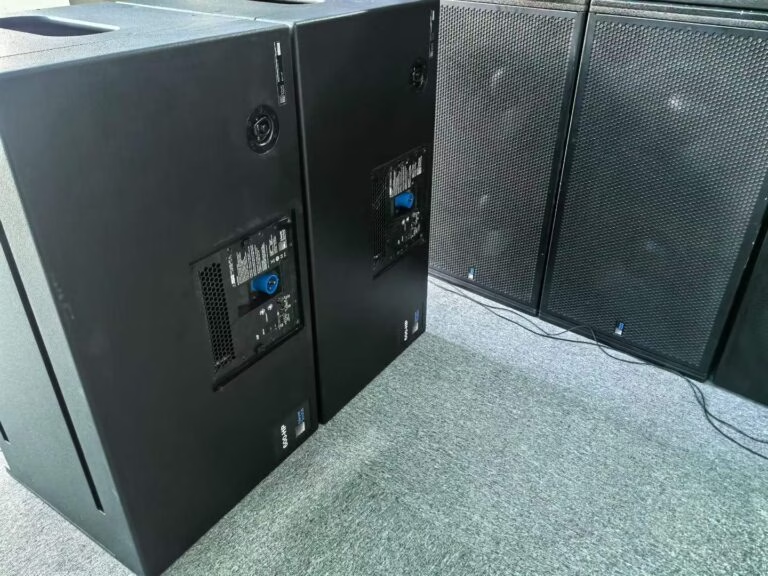
Test both cabinets, not one. A used speaker pair is one product, and half of the pairs sold online turn out to have a swapped driver, a different impedance load, or one cabinet that has been re-coned. Fifteen minutes with a tone generator and a multimeter catches nearly all of it.
The failure I see most is not blown drivers. It is a pair that was never a pair — two cabinets bought at different times, with different driver generations, sold as a set. They will play, and one will always be louder.
What should you check on used speakers for sale?
- Cone and surround. Run a fingertip around the surround. Cracks or a sticky feel mean foam rot, and foam surrounds fail at roughly 12-15 years.
- Coil rub. Push the cone gently inward, dead straight. Any scrape is a warped voice coil.
- DC resistance. A multimeter across the terminals should read about 6-7 ohms on an 8 ohm driver, 3-4 ohms on a 4 ohm one. Open circuit or 0.5 ohms means a dead or shorted coil.
- Driver part numbers. Both cabinets must match. This is the check people skip and it is the one that matters.
- Grille and handles. A bent handle is cosmetic. A bent baffle is not.
How do you listen-test a used speaker at moderate level?
Play a 40 Hz sine sweep and a 1 kHz tone at roughly conversation volume. Not loud. Loud hides rattle. You want a buzz that appears at one specific frequency — that is a loose screw, a split cone, or a cabinet joint that has opened.
Then play a familiar vocal track and walk from one side of the room to the other. If the image shifts oddly, one cabinet’s tweeter is weaker. In a passive pair, swapped horn polarity will also kill your centre image and you cannot hear it on a single cabinet test.
Are used powered speakers a different risk?
Yes, and a bigger one. A passive speaker fails visibly. A powered speaker has an amplifier board and a switch-mode supply inside, and those age. Listen for hiss at zero input — audible hiss that grows over 30 seconds usually means supply caps on the way out.
The K-array KF12 self-powered 2-way speaker is a useful reference point: 12-inch woofer, 1-inch compression driver, onboard DSP and Class-D amplification. On a used unit like that, confirm the DSP boots to its preset menu and that both the XLR and the power inlet lock firmly. A loose IEC inlet on a powered cabinet is an intermittent power fault waiting to happen.
What is a fair price for a used passive speaker pair?
For 10-inch passive two-way cabinets in good shape, $120-350 a pair is normal. Twelve-inch goes $180-500. Add 60-100% for powered versions of the same box, mostly for the amp module. JBL and Peavey hold up better than no-name boxes because recone kits and driver parts are still listed.
If a pair is priced under $100 and described as “works great”, budget for at least one re-cone at $40-90 per driver. Our Peavey NC-110 passive 10-inch pair listing shows the level of detail you should expect from a serious seller: driver part numbers, cabinet condition, and what was tested.
Does cabinet material affect what a used speaker is worth?
It affects it more than sellers admit. Plywood cabinets survive trucking; MDF and particle board swell once water gets in, and a swollen cabinet will not sit flat. Knock on the side panel. A dull, dead thud is fine. A hollow rattle means the internal bracing has come loose, which is a $60-120 glue-and-clamp job if you can get the back panel off, and impossible on sealed cabinets.
Weight is a rough proxy. A 10-inch passive cabinet under 9 kg is probably thin MDF. The same box in 15 mm plywood runs 12-14 kg and will still be square after ten years of load-ins.
What should make you walk away?
Three things. Mismatched driver part numbers sold as a pair. Freshly painted cabinets that hide repaired corners. And any seller who will not let you run a sweep. Paint over a failed joint is cheap to do and expensive to discover at load-in.
Key Takeaways
- Match driver part numbers on both cabinets — this is the top check.
- Multimeter: 6-7 ohms for an 8 ohm driver, 3-4 for a 4 ohm.
- Listening at low volume reveals rattles that loud playback hides.
- Passive pairs: $120-350 (10-inch), $180-500 (12-inch). Powered costs 60-100% more.