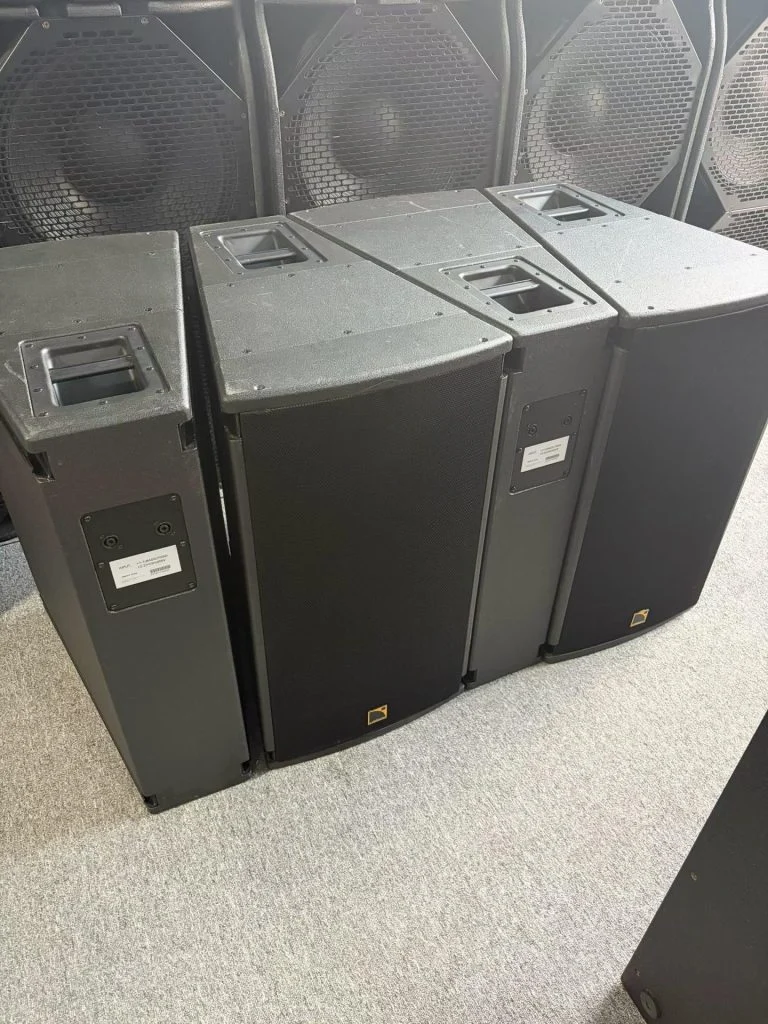
A used L-Acoustics ARCS single 15-inch speaker sells for $1,400 to $2,200 in 2026. It is a point-source cabinet designed to cover a room from one position, not a line array element. For rooms up to about 800 seats, a pair of ARCS hangs can replace a small array and save you a lot of rigging.
L-Acoustics builds near Paris and the ARCS name has run through several generations since the 1990s. The single 15-inch version uses a coaxial-style layout with a rotatable horn, so one cabinet covers about 60 by 40 degrees. It is a heavy box at roughly 45 kg.
What do used ARCS cabinets cost?
- Single cabinet, working: $1,400 – $1,800
- Matched pair with fly bars: $3,000 – $3,800
- Four-piece hang with bumpers: $5,800 – $7,500
- Cabinet needing driver work: $700 – $1,000
Why buy ARCS instead of a small line array?
Rigging time. Two ARCS cabinets on a single fly bar go up in 20 minutes. A four-box line array needs a bumper, a chain hoist and two people who know the angles. For a venue that hosts 200 events a year with a small crew, the time saved is real money.
The limitation: a point-source hang drops off faster with distance than an array. In a deep room — more than 30 metres front to back — the back rows lose clarity and you will need delays. If the room is wide and shallow, ARCS is the better shape.
What should I check before buying used ARCS?
First, the horn rotation. These cabinets get configured for landscape or portrait use, and a cabinet sold with the horn in the wrong orientation is common. Rotating it correctly takes 15 minutes and a screwdriver, so it is a minor issue, but check that the horn is not cracked.
Second, the driver. ARCS cabinets are usually driven by an external amplifier with L-Acoustics presets, so the cabinet itself is passive. Push the cone gently and listen for scraping. Third, the rigging points — a dropped cabinet bends the fly bar, and a bent bar will not lock into a bumper.
Does it need a specific amplifier?
Yes, ideally. L-Acoustics publishes presets for its own amplified controllers. Running ARCS on a generic amp works but you lose the factory limiting and EQ curves, which is half the value of the box. Budget for an L-Acoustics compatible amp or an LA4 style controller in the total.
The L-Acoustics ARCS single 15-inch full-range speaker listing shows condition and rigging hardware. If you would rather have a self-powered system that needs no controller, the K-array KF12 covers similar rooms with built-in amplification.
How many ARCS cabinets cover a typical room?
Two per side for a room 20 to 25 metres deep. Three per side if the room is wide and the audience wraps around. Each cabinet covers about 60 degrees horizontally, so a four-box hang covers 120 degrees of seating with minimal overlap.
That is the whole appeal: fewer boxes, less rigging, predictable coverage. The trade-off is that a point source cannot be shaded the way an array can, so the front rows get louder than the back. Skilled riggers tilt the hang to compensate.
What is the resale risk on old ARCS?
It is a professional product with a narrow buyer pool, so resale takes time. A pair priced fairly will sell in a few weeks to a rental house or a venue; one priced optimistically sits for months. Buy at 40 to 50 percent of new and you can exit at the same level.
The driver and horn parts are still supported by L-Acoustics, which is the main reason these cabinets stay liquid. A discontinued competitor model at the same age is worth a third as much.
Key Takeaways
- Used ARCS single 15″: $1,400–$2,200 in 2026.
- A point-source cabinet, not an array element.
- Best in wide, shallow rooms up to roughly 800 seats.
- Check horn orientation, cone condition and fly bars.
- Factory presets need a compatible amplified controller.